Desserts · Part 2 of 3: Instructions
Cookies and Cream Cheesecake with Dark Chocolate Ganache Step-by-step instructions
- Prep
- Cook
- Total
- Serves
- 12
Before you start
Before starting, make sure the cream cheese is at room temperature for a smooth, lump-free filling. Prepare the dark Oreo butter crust if not using a store-bought one, and have the springform pan ready. Measure all ingredients accurately, and preheat the oven to 325°F (163°C).
Have a wire rack ready for cooling, and ensure you have enough time to chill the cheesecake overnight, as this is essential for the final texture. Gather all equipment: a large mixing bowl, an electric mixer, a spatula, and a 9-inch springform pan.
Ingredients at a glance (6)
- 300 g dark Oreo butter crust
- 800 g whipped vanilla bean cream cheese
- 180 g icing sugar
- 300 ml double cream
- 200 g hand-crushed Oreo chunks
- 200 g warm 70% dark chocolate ganache
Instructions
Prepare the Crust and Filling
- Prepare the CrustPress the dark Oreo butter crust into the bottom of a 9-inch springform pan, making sure it is even and compact. This crust is made beforehand, so simply press it into the pan and set aside.Look for The crust should be evenly packed and cover the bottom of the pan completely.Tip Use the bottom of a measuring cup to press the crust firmly for an even layer.
- Make the FillingIn a large bowl, beat the whipped vanilla bean cream cheese with the icing sugar until smooth and creamy. Gradually add the double cream and continue beating until the mixture is light and fluffy.Look for The filling should be smooth, glossy, and hold soft peaks when the beaters are lifted.Tip Make sure the cream cheese is at room temperature for a lump-free filling.
- Fold in the Oreo ChunksGently fold the hand-crushed Oreo chunks into the whipped cream cheese mixture using a spatula. Be careful not to overmix, as you want the Oreo pieces to remain distinct throughout the filling.Look for The Oreo chunks should be evenly distributed without being crushed further.Tip Use a folding motion rather than stirring to keep the filling airy.
- Assemble the CheesecakePour the filling over the prepared crust and spread it evenly with a spatula. Tap the pan gently on the counter to release any air bubbles.Look for The top of the filling should be smooth and level.Tip Tap the pan just a few times to avoid cracking the surface.
At the end of this phase, you should have a firm, even crust in the pan and a smooth, fluffy filling with visible Oreo chunks. The filling should hold soft peaks and taste sweet and creamy. The mixture should be well combined but not overmixed. The pan should be filled evenly, and the top should be smooth. This is the foundation of the cheesecake, so take your time to get it right.
Bake and Chill
- Bake the CheesecakePlace the cheesecake in a preheated oven at 325°F (163°C) and bake for 50 minutes. The edges should be set but the center should still have a slight jiggle.Look for The edges will look set and slightly puffed, while the center will be moist and tender.Safe temperature 160°F (71°C) internal temperature (egg dishes)Tip Bake the cheesecake in a water bath to prevent cracking, if desired.
- Cool and ChillRemove the cheesecake from the oven and let it cool completely on a wire rack. Once cooled, cover the pan and refrigerate overnight, or for at least 8 hours, until fully chilled and set.Look for The cheesecake should be completely chilled and firm to the touch.Tip Chilling overnight is essential for the best texture and clean slices.
After baking, the cheesecake should have a lightly browned top and the edges should be set. The center will still be slightly jiggly, which is normal. Once cooled and chilled overnight, the cheesecake should be firm and sliceable. The texture should be creamy and smooth, with no cracks. The cheesecake should release easily from the springform pan, and the crust should hold together.
Finish and Serve
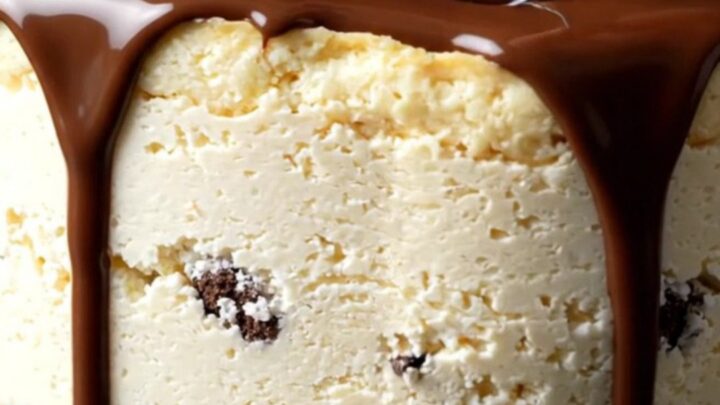
- Add the GanacheAfter the cheesecake has chilled, remove it from the springform pan and place it on a serving plate. Pour the warm 70% dark chocolate ganache over the top, letting it flow down the sides.Look for The ganache should coat the top and drip elegantly down the sides.Tip Warm the ganache slightly if it has thickened, but do not overheat.
- Serve and EnjoySlice the cheesecake with a sharp knife, wiping the blade clean between cuts. Serve chilled and enjoy the rich cookies and cream flavor with the dark chocolate ganache.Look for Each slice should show a clean cross-section with the crust, filling, and ganache.Tip For neat slices, dip the knife in hot water and dry it before cutting.
The ganache should be glossy and coat the top and sides of the cheesecake evenly. When sliced, each piece should show a clean cross-section with the crust, filling, and ganache layers.
The cheesecake should be cold, and the ganache should be set but still slightly soft. The overall appearance should be elegant and inviting, with the dark chocolate contrasting beautifully with the cream-colored filling.
Common mistakes
One common mistake is overmixing the filling, which can incorporate too much air and cause cracks during baking. Mix just until smooth and fluffy. Another pitfall is opening the oven door during baking, which can cause the cheesecake to crack or sink.
Keep the oven closed until the baking time is complete. Also, do not skip the overnight chilling; it is crucial for the texture and flavor development. Finally, be careful when pouring the ganache; if it is too hot, it may melt the cheesecake, so let it cool slightly before using.
How to tell it’s done
The cheesecake is done when the edges are set and slightly puffed, but the center still has a slight jiggle. To check, gently shake the pan; the center should wobble like jelly, not ripple like liquid. The internal temperature should reach 160°F (71°C) to ensure the eggs are fully cooked.
After removing from the oven, the cheesecake will continue to set as it cools and chills. Once thoroughly chilled, it should be firm to the touch and slice cleanly. If the center appears overly wet or the cheesecake cracks, it may have been overbaked, so adjust the baking time next time.
- Egg dishes: 160°F (71°C) in the thickest part
Up next · Part 3 of 3
4 variations · storage & make-ahead · 5 answers · printable card
Tips, FAQ & printable recipe (Part 3)← Back to the ingredients (Part 1)