Desserts · Part 2 of 3: Instructions
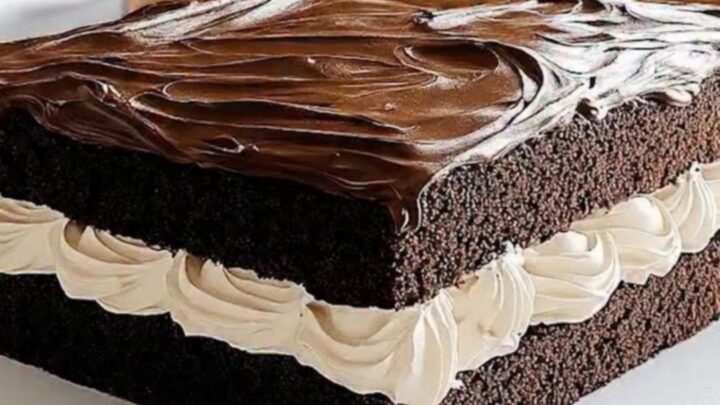
Decadent Chocolate Ding Dong Sheet Cake with Cream Filling Step-by-step instructions
- Prep
- Cook
- Total
- Serves
- 12
Before you start
Before beginning, ensure all ingredients are at the appropriate temperatures; the cake must be fully cooled, while the ganache should be at a pourable but thickened consistency.
Clear enough space in the refrigerator to hold the 9x13 inch pan flat. Prepare the offset spatula, a serrated knife, and a clean workspace to ensure the assembly process is efficient and organized for the best possible results.
Ingredients at a glance (3)
- 1 box store-bought or made ahead chocolate cake mix
- 2 cups whipped cream filling, store-bought or made ahead
- 1 cup chocolate ganache, store-bought or made ahead
Instructions
Cake preparation
- Prepare the cake baseIf using a pre-made cake base, ensure it is completely cooled before proceeding. If baking from a mix, follow the package instructions to bake the cake in a 9x13 inch pan. Once baked, allow the cake to cool entirely on a wire rack to ensure the structural integrity of the layers when slicing and filling.Look for The cake should be completely cool to the touch.Tip Cooling the cake fully is essential to prevent the cream filling from melting upon application.
The cake base must be completely cool to the touch, with no residual heat radiating from the pan. The surface should be flat and level, providing a stable foundation for the filling. If the cake has domed during baking, trim the top evenly with a serrated knife to ensure the layers align perfectly when reassembled.
Layering the cream
- Layer the cream fillingUsing a long serrated knife, carefully slice the cooled cake horizontally into two even layers. Spread the whipped cream filling evenly over the bottom layer of the cake. Place the top layer of the cake back onto the cream filling, pressing down very gently to secure the layers without compressing the fluffy texture of the filling. If preparing a cooked custard-based filling, ensure it reaches 160°F (71°C) to be fully cooked.Look for The cream should be spread in an even, consistent layer.Safe temperature 160°F (71°C) internal temperature (egg dishes)Tip Use an offset spatula to achieve a perfectly smooth and level layer of cream across the surface.
The cream filling should be distributed in an even, smooth layer, extending just to the edges of the bottom sponge. When the top layer is placed, it should sit flush with the bottom, with no gaps or squeezed-out edges. The entire assembly should feel cohesive and stable before moving on to the final topping stage.
Applying the ganache
- Apply ganache and servePour the chocolate ganache over the top of the cake, spreading it toward the edges with an offset spatula. Allow the ganache to set in the refrigerator for at least 30 minutes to firm up. Once set, use a metal spatula to slice the cake into squares and serve immediately on a clean plate.Look for The ganache should appear glossy and firm to the touch.Tip Dip your knife in warm water and wipe it dry between cuts for perfectly clean edges on every slice.
The ganache should be poured in a steady stream and spread gently to cover the entire top surface. Once set, the surface should look smooth, glossy, and firm to the touch, indicating that the fats have properly solidified.
It should be easy to slice through cleanly without the ganache dragging or pulling away from the cake surface.
Common mistakes
A common error is attempting to fill the cake while it is still warm, which inevitably leads to the cream melting and the layers shifting. Another mistake is using a dull knife, which can tear the crumb and ruin the aesthetic of the cross-section.
Avoid skipping the chilling phase, as the cake needs time for the components to bond; rushing the process prevents the clean, sharp edges that define this classic dessert.
How to tell it’s done
The cake is considered done when the ganache has set firmly enough to be sliced without running, typically after 30 minutes of refrigeration.
The layers should be stable, and the cream filling should hold its shape when the slice is lifted with a metal spatula. There is no internal temperature for the cake itself, but the visual cues of a set, glossy topping are the primary indicators of readiness.
- Egg dishes: 160°F (71°C) in the thickest part
Up next · Part 3 of 3
2 variations · storage & make-ahead · 3 answers · printable card
Tips, FAQ & printable recipe (Part 3)← Back to the ingredients (Part 1)