Dinner · Part 2 of 3: Instructions
Crockpot Roasted Red Pepper Goat Cheese Chicken (Dump-and-Go) Step-by-step instructions
- Prep
- Cook
- Total
- Serves
- 4
Before you start
Before anything goes into the slow cooker, drain the jar of roasted red peppers thoroughly and pat them dry; excess jar liquid is the main reason this sauce comes out thin. Smash the four garlic cloves with the flat of a knife so their flavor releases freely. Measure the chicken broth and have the goat cheese log ready to break into chunks. Check that the chicken breasts are roughly the same size and trim any large flaps of fat or thin tail ends so they cook at the same rate.
Ingredients at a glance (8)
- 4 boneless skinless chicken breasts (about 6 oz each)
- 12 oz jar roasted red peppers, drained
- 4 garlic cloves, smashed
- 1/2 cup chicken broth
- 6 oz chevre log (creamy goat cheese)
- 12 oz rigatoni, cooked and kept hot
- Fresh basil leaves, for serving
- 3 tbsp pine nuts, for serving
Instructions
Layer the Crockpot
- Build the sauce baseDrain the jar of roasted red peppers well, then scatter them across the bottom of a 6-quart slow cooker. Add the smashed garlic cloves and pour in the half cup of chicken broth. Break the goat cheese log into chunks and drop them over the peppers so everything melts together as the cooker heats.Look for The peppers sit in a shallow pool of broth with cheese chunks visible on top.Tip Pat the peppers dry with a paper towel after draining; less jar liquid keeps the finished sauce thick and velvety instead of thin.
- Nestle in the chickenLay the four chicken breasts in a single layer over the pepper and cheese base, pressing them down gently so they make contact with the liquid. Do not stir; the cheese and peppers should stay underneath and around the chicken, where they will break down and turn into sauce on their own.Look for Each breast is partially submerged, with peppers peeking around the edges.Tip Keep the breasts in one layer rather than stacking them; even contact with the heat gives evenly cooked, shreddable chicken every time.
At the end of this phase, the slow cooker is loaded and ready to latch. The bottom holds a shallow layer of broth with softened pepper strips and garlic scattered through it, and the goat cheese chunks sit on top where the steam will reach them first. The chicken breasts lie flat in a single layer, partially submerged, with the peppers visible around their edges. Nothing should be stirred; the layering order is what lets the cheese and peppers melt beneath the chicken.
Slow-Cook and Shred
- Slow-cook on lowLatch on the glass lid and set the cooker to LOW for 4 hours. Resist lifting the lid during cooking; every peek releases heat and adds 15 to 20 minutes to the cook time. The chicken will poach gently while the peppers collapse and the goat cheese melts into the cooking liquid below.Look for Steam fogs the lid slightly after the first hour of cooking.Tip Set a timer for 3 hours 45 minutes so the pasta water can come to a boil right as the chicken finishes.
- Check the chickenAfter 4 hours on low, lift the lid away from you so the steam escapes safely. The chicken should look opaque throughout and release clear juices when pressed in its thickest part. If any pink remains near the center, replace the lid and give the breasts another 20 to 30 minutes on low.Look for Breasts look plump, opaque, and start to split slightly at the thick end.Tip Thick breasts vary in size; if yours are uneven, pull the smaller ones first and let the larger ones keep cooking.
- Shred the chickenTransfer each breast to a cutting board and shred it with two forks, pulling against the grain into bite-size strands; it should fall apart with almost no pressure. Return the shredded chicken to the cooker and stir it through the softened peppers and melted cheese. The meat is done when it reaches 165°F (74°C) at its thickest point.Look for The strands hold sauce and no fibrous chunks of breast remain.Safe temperature 165°F (74°C) internal temperature (poultry)Tip Shred while the chicken is hot; warm meat pulls apart in long, silky strands instead of crumbling into dry bits.
After four hours on low, the kitchen smells sweet and savory, like roasted peppers and warm cheese. The chicken should be opaque, plump, and splitting slightly at its thickest point, releasing clear juices when pressed. Verify 165°F (74°C) in the center of the largest breast before shredding.
Once shredded with two forks, the meat pulls into long, moist strands that fold easily into the sauce. The peppers should have lost their shape almost entirely, and the goat cheese should have vanished into a coral-pink sauce with no white streaks. If any pink remains in the chicken, re-lid and cook another 20 to 30 minutes.
Swirl, Toss, and Serve
- Swirl into velvetStir the shredded chicken vigorously with a fork or whisk for a minute, mashing any remaining pepper pieces and cheese against the side of the crock. The sauce should turn coral-pink, glossy, and thick enough to coat the back of a spoon. If it seems tight, loosen it with a splash of the pasta cooking water later.Look for The sauce coats a spoon evenly with no separate pools of cheese or liquid.Tip Switch the cooker to WARM now so the sauce holds at serving temperature while the pasta finishes.
- Cook the rigatoniBring a large pot of salted water to a rolling boil and cook the rigatoni until al dente, following the package timing and checking a minute early. Before draining, scoop out a cup of the starchy pasta water. Drain the pasta well and keep it hot; cold pasta seizes the sauce instead of absorbing it.Look for The rigatoni is tender outside with a faint firm center when bitten.Tip Salt the water generously; the pasta seasonings the whole dish, since the slow-cooker sauce itself carries no added salt.
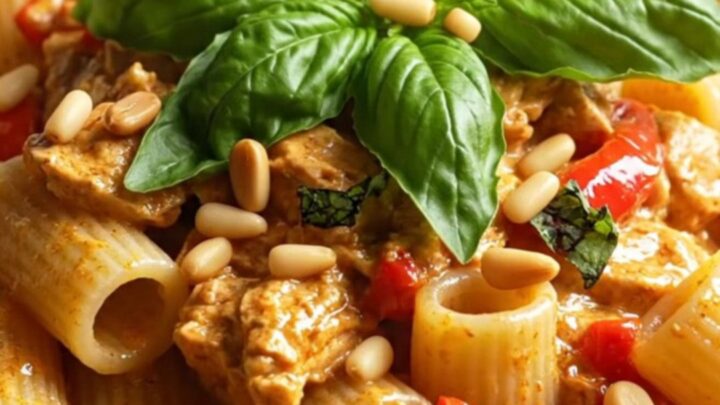
- Toss and serveAdd the hot rigatoni straight into the slow cooker, or pile the pasta into warm bowls and spoon the saucy chicken over it, tossing gently so every tube fills with sauce. Loosen with the reserved pasta water if needed. Scatter fresh basil leaves and pine nuts over each plate and bring it to the table immediately.Look for Each plate glistens with coral sauce, basil bright green, nuts toasted on top.Tip Toast the pine nuts in a dry skillet for two minutes first; it deepens their flavor and keeps them crisp against the creamy sauce.
The sauce is ready when a minute of firm stirring turns it glossy and thick enough to coat the back of a spoon, with no separate pools of cheese, broth, or pepper. The rigatoni should be al dente, drained, and still steaming when it meets the sauce; cold pasta turns the coating chalky.
Each plate should glisten, with sauce filling the tubes and clinging to the shredded chicken. The basil stays bright green and the pine nuts crisp, so add them at the table rather than in the pot. Taste the sauce once through the pasta; the starchy water mellows the tang and rounds out the salt.
Common mistakes
The three most common missteps are all easy to avoid. First, lifting the lid during the four hours: every peek drops the temperature and stretches the cook time, so trust the process and keep the glass closed. Second, under-draining the peppers; jar liquid dilutes the sauce and dulls the sweetness, so drain and pat dry.
Third, shredding cold chicken, which crumbles instead of pulling into long strands; shred while everything is still hot from the cooker. Finally, do not skip reserving pasta water. The sauce thickens as it sits, and a splash of starchy water is what restores the silky, spoon-coating texture right before serving.
How to tell it’s done
The chicken is done when it reads 165°F (74°C) at its thickest point and shreds with almost no resistance from two forks; the strands should be opaque all the way through with clear, not pink, juices. Visually, the breasts look plump and begin to split at the thick end, and the sauce around them has turned uniformly coral with no separate white pool of cheese.
The pasta should be al dente, tender outside with a faint firm center, because it absorbs sauce after tossing. The finished sauce coats a spoon evenly and glosses over the shredded chicken rather than pooling watery at the edges.
- Poultry: 165°F (74°C) in the thickest part
Up next · Part 3 of 3
4 variations · storage & make-ahead · 5 answers · printable card
Tips, FAQ & printable recipe (Part 3)← Back to the ingredients (Part 1)