Dinner · Part 2 of 3: Instructions
Crockpot Cheddar Enchilada Fiesta Chicken Step-by-step instructions
- Prep
- Cook
- Total
- Serves
- 6
Before you start
Before starting, soften the cream cheese at room temperature for about 30 minutes so it blends more easily into the sauce. Drain and rinse the pinto beans to remove excess sodium.
Measure the red enchilada sauce and shred the cheddar cheese. Have a 6-quart slow cooker ready. The only other prep is making or warming the cilantro-lime rice for serving, which can be done while the chicken cooks or just before serving.
Ingredients at a glance (6)
- 3 lb boneless skinless chicken breasts
- 1 1/2 cups red enchilada sauce
- 1 can (15 oz) pinto beans, drained and rinsed
- 8 oz cream cheese, softened and cubed
- 2 cups shredded sharp cheddar cheese
- Cilantro-lime rice, for serving
Instructions
Layer and Cook
- Layer the Raw IngredientsPlace the chicken breasts in the bottom of a 6-quart slow cooker in a single layer. Pour the red enchilada sauce over the chicken, then add the drained pinto beans. Dot the cream cheese cubes over the top, and scatter the shredded cheddar cheese evenly over everything.Look for The chicken is mostly covered by sauce and beans, with cream cheese and cheddar on top.Safe temperature 165°F (74°C) internal temperature (poultry)Tip Use full-fat cream cheese for the smoothest sauce. If using reduced-fat, the sauce may be thinner.
- Cover and Cook on LowCover the slow cooker and cook on low for 4 to 5 hours, or on high for 2 to 3 hours, until the chicken is cooked through and registers 165°F (74°C) in the thickest part. The sauce will look curdled at first; that is normal. Do not stir during cooking.Look for The sauce is bubbly around the edges, and the chicken is opaque and tender.Safe temperature 165°F (74°C) internal temperature (poultry)Tip Resist the urge to lift the lid—every peek adds 15 minutes of cooking time.
After the initial cooking time, the slow cooker smells richly of enchilada sauce and melted cheese. The chicken is opaque and tender, the sauce is bubbly around the edges, and the cream cheese has softened into the liquid.
The cheddar is fully melted, creating a creamy, reddish-orange sauce. Check that the chicken reaches 165°F (74°C) before shredding.
Shred and Combine
- Shred the ChickenTurn off the slow cooker. Using two forks, shred the chicken directly in the pot into large bite-size pieces. Stir the shredded chicken into the sauce, breaking up any large cream cheese chunks. The sauce will become smooth and velvety as you stir.Look for The chicken shreds easily and the sauce turns a uniform crimson color.Safe temperature 165°F (74°C) internal temperature (poultry)Tip For extra-thick sauce, leave the lid off for 10 minutes after shredding.
- Finish Cooking the SauceCover the slow cooker again and cook on low for 15 to 20 minutes, until the sauce is hot and fully combined. The cheese should be completely melted and the sauce thickened slightly. Stir once more before serving.Look for The sauce is glossy and coats the back of a spoon.Safe temperature 165°F (74°C) internal temperature (poultry)Tip If the sauce seems too thin, stir in a tablespoon of shredded cheddar to thicken it.
Once shredded, the chicken is moist and pulls apart easily. The sauce becomes smooth and velvety as the cream cheese and cheddar blend together. The beans are tender and coated in the sauce. The mixture looks like a thick, hearty stew. Taste and adjust seasoning if needed, then let it cook briefly to meld the flavors.
Serve and Enjoy
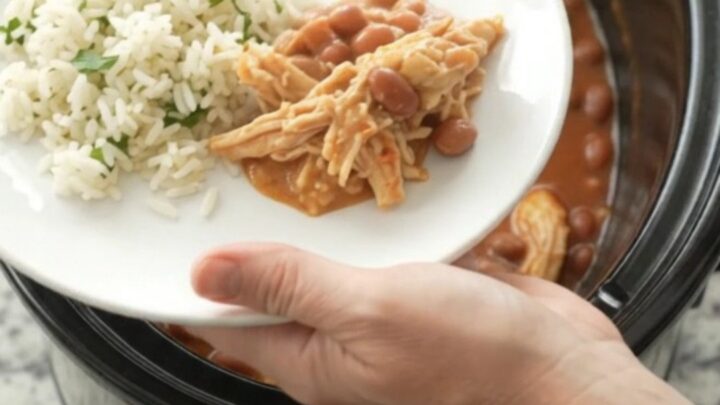
- Serve Over Cilantro-Lime RiceSpoon the fiesta chicken over warm cilantro-lime rice. Use a slotted spoon to portion the chicken and beans, then ladle extra sauce over the top. Serve immediately.Look for Steam rises from the plated dish, and the sauce is thick and creamy.Tip Warm the rice just before serving so the contrast of hot chicken and cool rice is perfect.
The final dish is a vibrant, deep red with creamy streaks of cheese. The chicken is fork-tender, the beans are intact but soft, and the sauce clings to everything. When spooned over rice, it forms a generous, satisfying layer. The aroma is warm and inviting, with a hint of chili and garlic. Serve hot, with extra sauce ladled over the top.
Common mistakes
Do not stir the slow cooker during the first few hours—this can break up the chicken too early and make it dry. Avoid using pre-shredded cheddar, which often contains anti-caking agents that prevent smooth melting.
Do not add extra liquid; the chicken releases juices as it cooks, and the sauce should be thick, not watery. If the sauce curdles, it is usually because the cream cheese was too cold or the heat was too high—stir vigorously to bring it back together.
How to tell it’s done
The chicken is done when it reaches an internal temperature of 165°F (74°C) in the thickest part, and it shreds easily with a fork. The sauce should be thick, glossy, and fully combined, with no visible chunks of cream cheese.
The dish is ready to serve when the sauce is hot and bubbling gently at the edges. If the sauce looks thin, let it sit uncovered for a few minutes to thicken.
- Poultry: 165°F (74°C) in the thickest part
Up next · Part 3 of 3
4 variations · storage & make-ahead · 5 answers · printable card
Tips, FAQ & printable recipe (Part 3)← Back to the ingredients (Part 1)