Appetizers · Part 2 of 3: Instructions
Crispy Za’atar-Crusted Halloumi Fingers with Pomegranate Molasses Step-by-step instructions
- Prep
- Cook
- Total
- Serves
- 4
Before you start
Before you begin, ensure your halloumi is cut into uniform sticks to guarantee even cooking. Prepare three separate shallow bowls for your breading station: one for the flour, one for the whisked egg, and one for the panko, sesame, and za'atar mixture.
Having everything laid out in an assembly line will make the coating process much faster and cleaner. Ensure your serving platter is ready with the labneh spread out, so you can transfer the hot halloumi directly from the plate.
Ingredients at a glance (10)
- 250 g halloumi cheese, sliced into 8 thick sticks
- 50 g all-purpose flour
- 1 egg, whisked
- 80 g panko breadcrumbs
- 2 tbsp toasted white sesame seeds
- 1 tbsp wild za'atar
- 100 ml olive oil
- 1/2 cup garlic labneh for serving
- 2 tbsp pomegranate arils for serving
- 1 tbsp pomegranate molasses for serving
Instructions
Breading the halloumi
- Prepare the halloumi sticksSlice the halloumi cheese block into eight uniform sticks. Place the flour in a shallow bowl, whisk the egg in another, and combine the panko, toasted sesame seeds, and za'atar in a third bowl.Look for Ensure the sticks are uniform in size for even frying.Tip Pat the halloumi dry with paper towels before breading to ensure the coating adheres properly.
- Coat the sticksDredge each halloumi stick in flour, shaking off any excess. Dip into the whisked egg, then press firmly into the za'atar-panko mixture to coat every side thoroughly.Look for The crust should be evenly applied.Tip Press the breading on firmly so it does not fall off during the frying process.
The halloumi sticks should be completely and evenly coated in the za'atar and panko mixture. Check that there are no bare spots on the cheese, as any exposed areas may cause the halloumi to leak during the frying process. The sticks should look uniform and feel firm to the touch, ready for the hot oil bath.
Frying to perfection
- Shallow fry the halloumiHeat the olive oil in a heavy stainless steel pan to 360°F (182°C). Carefully add the halloumi fingers to the hot oil. Fry for sixty seconds per side, turning frequently until the crust is deeply golden and the sesame seeds have popped. To ensure the egg coating is fully cooked, reach an internal temperature of 160°F (71°C).Look for The crust should be golden and crispy.Safe temperature 160°F (71°C) internal temperature (egg dishes)Tip Maintain the oil temperature by not overcrowding the pan.
The halloumi should be sizzling vigorously upon hitting the olive oil. Watch for the crust to turn a deep, rich golden brown. The sesame seeds should be visibly toasted and popping slightly.
The halloumi should retain its shape while the center becomes warm and slightly soft, indicating it is ready to be removed from the pan.
Plating and garnishing
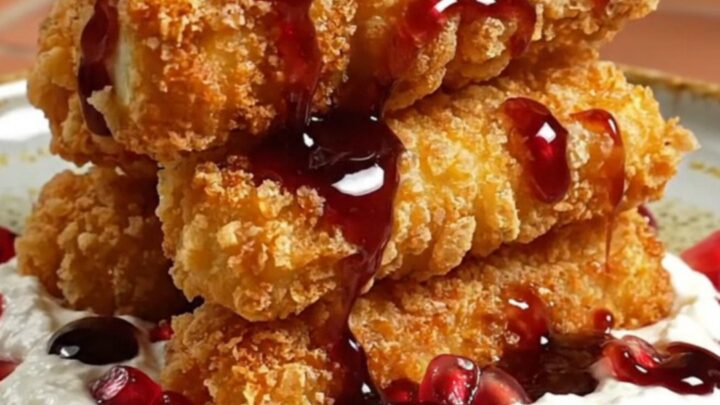
- Plate and garnishSpread a generous layer of garlic labneh on a serving platter. Arrange the hot, crispy halloumi fingers on top. Sprinkle with fresh pomegranate arils and finish with a thick drizzle of pomegranate molasses.Look for The molasses should glaze the sticks beautifully.Tip Serve immediately while the halloumi is warm and the crust is at its crispest.
The halloumi should be arranged elegantly over the cool labneh. The pomegranate arils should be scattered to add a pop of color, and the pomegranate molasses should be drizzled in a deliberate ribbon. Everything should look vibrant, with the hot, crunchy sticks contrasting beautifully against the smooth, cold labneh base.
Common mistakes
A common mistake is overcrowding the pan, which causes the oil temperature to drop rapidly and leads to soggy, oily crusts instead of crispy ones.
Another error is failing to pat the halloumi dry before coating; excess moisture prevents the flour and egg from adhering properly, causing the breading to detach during frying. Finally, ensure the oil is hot enough before adding the cheese; if the oil is too cool, the halloumi will take too long to crisp.
How to tell it’s done
The halloumi is done when the crust is a deep, uniform golden brown and the sesame seeds are fragrant and slightly popped. The cheese inside should feel soft and slightly springy when gently pressed with tongs.
Because the halloumi is only fried for a short time, it will not melt away entirely, maintaining its structure. The egg-based coating must reach 160°F (71°C) to be fully cooked through, although the dish is often served with a softer finish.
- Egg dishes: 160°F (71°C) in the thickest part
Up next · Part 3 of 3
2 variations · storage & make-ahead · 3 answers · printable card
Tips, FAQ & printable recipe (Part 3)← Back to the ingredients (Part 1)