Dinner · Part 2 of 3: Instructions
Crispy Wagyu Potato Korokke in 30 Minutes Step-by-step instructions
- Prep
- Cook
- Total
- Serves
- 4
Before you start
Peel the potatoes and cut them into even 2-inch chunks so they cook at the same rate. Dice the sweet onion finely, about a quarter-inch, so it melts into the mash rather than sitting in large pieces. Set out the butter, white pepper and panko before you start cooking, and spread the panko on a wide plate for coating.
Place a wire rack over a sheet pan near the stove for draining, and pour the frying oil into a deep heavy pot with a thermometer clipped to the side. Have the cabbage shredded and the tonkatsu sauce bottle open on the counter, because once the croquettes come out of the oil, everything moves quickly.
Ingredients at a glance (9)
- 1 lb Russet potatoes, peeled and cut into chunks
- 1 1/2 tbsp unsalted butter
- 1 sweet onion, finely diced
- 5 oz ground wagyu beef
- 1/2 tsp white pepper
- 1 1/2 cups panko breadcrumbs, giant-flake if available
- 4 cups rice bran oil, or another neutral oil, for deep-frying
- Shredded cabbage, for serving
- Tonkatsu sauce, for serving
Instructions
Build the filling
- Steam-dry the potatoesPlace the peeled, chunked potatoes in a large pot of cold salted water, bring to a boil and cook until a knife slides through with no resistance, 15 to 18 minutes. Drain well, return them to the hot dry pot for a minute and mash until completely smooth with no lumps.Look for The mash should look dry and fluffy, not sticky or wet, and hold a peak on the spoon.Tip Steam-drying in the hot pot evaporates surface water so the croquettes hold their shape and crust better.
- Caramelize the onionMelt the butter in a large skillet over medium heat. Add the finely diced sweet onion with a pinch of salt and cook, stirring often, until deep golden and sweetly fragrant, 8 to 10 minutes. Lower the heat if the edges darken too fast.Look for The onion turns amber, glossy and jammy, and the kitchen smells sweet and buttery.Tip Real caramelization takes patience; browning too quickly over high heat turns bitter.
- Brown the wagyuPush the onion to one side, add the ground wagyu beef and cook, breaking it up, until no pink remains, 4 to 5 minutes. Cook it through to 160°F (71°C) measured with an instant-read thermometer, then fold the beef and onion together in the skillet.Look for The beef is deeply browned, crumbly and there is no trace of pink anywhere.Safe temperature 160°F (71°C) internal temperature (ground meat)Tip Wagyu renders rich fat; do not drain it all, as it seasons the filling from within.
- Season and chill the fillingFold the beef-onion mixture into the hot mashed potatoes along with the white pepper. Taste and adjust salt. Spread the filling on a plate or tray and let it cool until firm enough to handle, about 20 minutes, so the ovals hold clean edges.Look for The mixture is thick, moldable and pulls away from the plate in a clean mass.Tip A slightly warm filling shapes more easily than a cold one; do not refrigerate it stiff.
By the end of phase one, the filling should look smooth, pale and studded with amber onion and browned beef. The mash must be fluffy and dry, never sticky, and the mixture should hold a clean peak when spooned. Taste it now: it should be boldly seasoned, since the fried crust dulls salt and pepper slightly. Before moving on, confirm the beef shows no pink anywhere and reached 160°F (71°C), and give the filling its full 20 minutes to firm up on the tray.
Shape and coat
- Shape the ovalsDivide the filling into 8 portions and shape each into a smooth oval about 3 inches long, pressing firmly so no cracks form. Smooth the surface with the back of a spoon; a tight, even oval fries evenly and keeps the panko armor intact.Look for Each oval holds its shape with no cracks or soft, sagging edges.Tip Wet your hands lightly to keep the sticky potato from clinging while shaping.
- Coat in pankoSpread the panko on a wide plate and roll each oval through it, pressing gently so the giant flakes adhere on every side. Coat all eight croquettes before starting to fry, and set them on a tray without touching.Look for Every surface is covered in standing panko flakes with no bare potato showing.Tip Press the flakes on rather than dredging; loose coating falls off in the oil.
Eight tight, even ovals should sit on the tray, each one sealed with no visible cracks, and each completely covered in panko with no bare potato showing through. Press a finger gently into one: the surface should feel firm and the coating should not slide or shed flakes.
If any oval looks lopsided, reshape it now, because an uneven croquette fries unevenly. Only when every croquette is coated and standing apart from its neighbors should the oil go on the heat.
Fry and serve
- Heat the oilPour the rice bran oil into a deep heavy pot to at least 2 inches and clip on a thermometer. Heat over medium until it holds steady at 360°F (182°C). Maintain this temperature throughout; it is the difference between an airy crust and a greasy one.Look for A pinch of panko dropped in sizzles immediately and rises with fast bubbles.Tip Fry in a pot with plenty of headroom; oil can foam up when the croquettes go in.
- Fry until goldenLower 2 to 3 croquettes into the oil with a slotted spoon and fry for about 2 1/2 minutes, turning once, until deep golden-amber all over and hot in the center. The filling is already fully cooked, so color is the guide. Drain on a wire rack set over a sheet pan.Look for The panko flakes stand upright, sizzle hard and turn golden-amber, not brown.Tip Never crowd the pot; each extra croquette drops the oil temperature by 15 to 20 degrees.
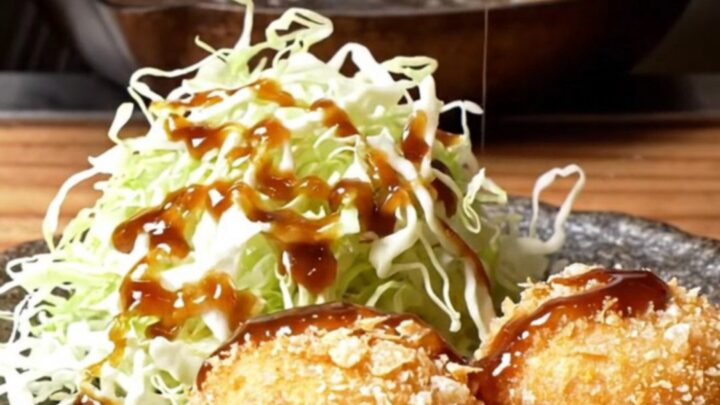
- Rest, slice and drizzleLet the croquettes stand on the rack for 2 minutes so the crust sets. Pile shredded cabbage on plates, set a croquette on top, slice it in half with a sharp knife and drizzle generously with tonkatsu sauce. Serve immediately while the crust still crackles.Look for The knife cuts through with a loud crunch and steam curls from the filling.Tip Slice with one confident stroke rather than sawing, so the crust does not shatter.
Each croquette should emerge deep golden-amber, lighter than it looks, with the panko flakes crisp and separated like tiny sails. Listen: a fresh one crackles faintly as it cools on the rack. Slice one in half to check that steam escapes and the center is hot. The crust should shatter audibly under the knife, the filling should be creamy and moist, and the tonkatsu drizzle should gloss the cut faces before the plate reaches the table.
Common mistakes
The most common failure is a wet mash: potatoes boiled too long in too much water absorb it and glue up, so drain well and steam-dry in the hot pot. The second is soft shaping; croquettes with cracks leak filling into the oil, so press each oval firmly and smooth it.
The third is frying too cold or too crowded, which gives a pale, oil-heavy crust instead of a crisp one. Finally, do not skip the brief rest on the rack; slicing straight from the oil collapses the shell before it sets.
How to tell it’s done
A finished korokke is deep golden-amber on every visible side, with panko flakes that still stand upright and a crust that sounds hollow when tapped lightly. Break one open: steam should pour out, the potato filling should be hot and fluffy to the center, and the beef and onion should look glossy and well combined.
Because the filling is fully cooked before shaping, the fry is about texture, not safety; color and internal heat are the guides. If a croquette feels dense or cool in the middle, return it to 360°F oil for another 30 seconds. The meat itself must have reached 160°F (71°C) during the browning step, which is when it finishes cooking.
- Ground meat: 160°F (71°C) in the thickest part
Up next · Part 3 of 3
4 variations · storage & make-ahead · 5 answers · printable card
Tips, FAQ & printable recipe (Part 3)← Back to the ingredients (Part 1)