Dinner · Part 2 of 3: Instructions
Crispy Teriyaki Salmon Yakisoba in 20 Minutes Step-by-step instructions
- Prep
- Cook
- Total
- Serves
- 2
Before you start
Set up before the pan gets hot, because the cooking itself moves fast. Blot the salmon dry on every surface and leave it on a plate within reach of the stove. Whisk the glaze — mirin, soy sauce, sake, brown sugar and grated ginger — in a small bowl and set it beside the skillet.
Halve or quarter the baby bok choy and rinse it well, since grit hides between the leaves; dry it thoroughly, because wet vegetables steam instead of char. Cut the carrot into thin matchsticks, loosen the yakisoba noodles from their portion, and measure the yakisoba sauce. Put the bonito flakes, sesame seeds and pickled ginger on the counter in small dishes.
Ingredients at a glance (13)
- 2 salmon fillets (6 oz each), skin-on
- 1/4 cup mirin
- 1/4 cup soy sauce
- 2 tbsp sake
- 2 tbsp brown sugar, packed
- 2 tsp grated ginger, freshly grated
- 14 oz fresh yakisoba noodles
- 2 heads baby bok choy, halved or quartered
- 1 carrot, cut into thin matchsticks
- 3 tbsp Worcestershire-soy yakisoba sauce
- Bonito flakes, for serving
- Toasted sesame seeds, for serving
- Pickled ginger, for serving
Instructions
Prep and glaze
- Dry the salmon thoroughlyBlot the salmon fillets dry on all sides with paper towels, pressing gently on the skin to wick away surface moisture. A dry surface is what lets the skin sear into a crisp, crackling layer instead of steaming. Set the fillets on a plate near the stove so they go straight into the hot pan.Look for The skin should look matte and feel tacky-dry, with no beads of water on the flesh.Tip Dry salmon also holds together better when flipped, so the fillets keep their shape.
- Whisk the teriyaki glazeIn a small bowl, whisk the mirin, soy sauce, sake, brown sugar and grated ginger until the sugar dissolves and the mixture looks uniform. Keep it by the stove; this glaze goes into the pan while the salmon is still frying and needs to be ready the moment the skin is golden.Look for The sugar should be fully dissolved, leaving a smooth, deep amber-brown liquid.Tip Grate the ginger finely so it disperses through the glaze instead of pooling in one bite.
At the end of this phase, the salmon sits dry and ready on a plate by the stove, and the teriyaki glaze is a smooth, amber-brown liquid with the sugar fully dissolved and the ginger evenly dispersed. Run a finger through the glaze: it should feel silky, not gritty. The vegetables are cut, the noodles loosened, the garnishes set out, and both pans — skillet for the fish, wok for the noodles — are within reach. Checkpoint passed when nothing left to chop remains and the glaze needs no more whisking; the next phase is nothing but heat and timing.
Sear and glaze the salmon
- Sear the salmon skin-side downSet a large skillet over medium-high heat until a drop of water skitters across the surface. Lay the salmon in skin-side down and press each fillet gently with a spatula for 10 seconds so the skin makes full contact. Cook undisturbed, sliding the fish once or twice so it does not stick, until the skin is deeply golden and crisp.Look for The skin releases cleanly from the pan and the flesh turns opaque two-thirds of the way up the sides.Tip Resist moving the fillets early; the crust forms in the first three quiet minutes.
- Glaze and baste the salmonFlip the fillets flesh-side down, pour in the teriyaki glaze, and let it bubble at a steady simmer, spooning it over the salmon continuously. Cook until the thickest part registers 145°F (63°C) on an instant-read thermometer. The glaze should reduce to a thick, glossy syrup that clings to the fish. Transfer the salmon to a plate and keep the extra glaze in the pan.Look for A thick lacquer coats each fillet and the pan liquid has reduced to a slow, syrupy bubble.Safe temperature 145°F (63°C) internal temperature (fish)Tip If the glaze thickens before the fish is done, add a splash of water to loosen it.
The fillets now carry a deeply golden, crackling skin that releases cleanly from the pan, and the flesh reads 145°F (63°C) at the thickest point. The glaze has reduced to a thick, glossy syrup that clings to the fish and slows to a syrupy bubble in the pan.
The salmon rests on a plate under a shine of lacquer, the kitchen smells of caramelized soy and ginger, and the reserved glaze waits in the skillet for the final spoon-over. Check the temperature before moving on; if it reads short, keep basting for another minute rather than raising the heat.
Noodles, plating, garnish
- Char the bok choy and carrotsWipe out the wok and set it over high heat until it just begins to smoke. Add the bok choy and carrot matchsticks and toss constantly for 2 to 3 minutes, letting the leaves blister and the vegetables take on dark, charred edges while staying crisp inside.Look for Charred, almost blackened spots on the cabbage leaves and a smoky, sweet smell from the wok.Tip Do not crowd the wok; charring needs space and fierce heat, not steam.
- Add the noodles and sauceAdd the yakisoba noodles to the wok, loosening them with tongs as they separate in the heat. Pour the yakisoba sauce over the top and toss vigorously for 1 to 2 minutes, until every strand is coated and the noodles pick up a few sizzled, slightly crisped edges. Scoop half of the noodles onto each warmed bowl.Look for The noodles glisten evenly, smell savory and toasty, and slide freely instead of clumping.Tip Fresh yakisoba noodles need only heating, never boiling, so they stay springy.
- Plate the salmon over the noodlesSet a glazed fillet on top of each mound of noodles, skin facing up so the crisp crust stays intact. Spoon any remaining teriyaki glaze from the pan over and around the salmon, letting a little trickle down into the noodles below.Look for The glaze pools slightly at the base of the noodles and the skin still looks shiny and intact.Tip A warmed bowl keeps everything steaming hot from counter to table.
- Finish with the classic garnishesScatter bonito flakes over the hot salmon so they curl in the rising steam, then shower each bowl with toasted sesame seeds. Tuck a small pile of pickled ginger alongside the fish. Serve immediately, while the skin still crackles and the noodles are steaming.Look for Bonito flakes dancing in the steam and a faint toasty aroma from the sesame.Tip Add the bonito at the very last second so the heat keeps them lively, not limp.
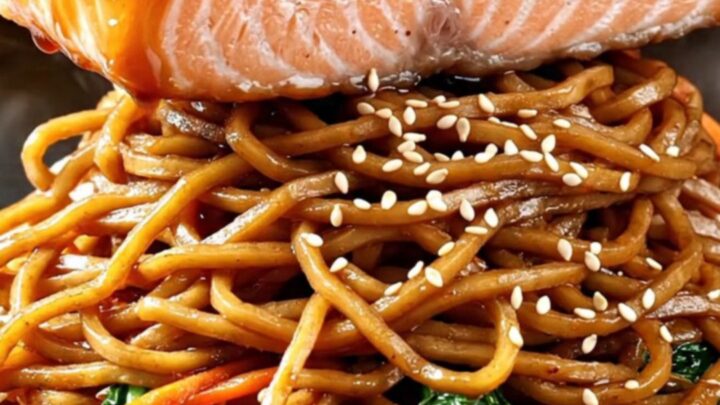
The wok vegetables show blackened, charred edges while their cores stay crisp, and the noodles glisten with sauce, separated and springy, with a few toasted, crisped strands. Each bowl holds a mound of steaming noodles topped by a glazed fillet, skin up, with extra glaze trickling down into the tangle.
Bonito flakes are curling in the steam, sesame seeds cling to the lacquered surface, and pickled ginger sits bright at the side. The test before serving: the skin still crackles, the noodles are hot through, and nothing has sat long enough to lose its gloss.
Common mistakes
The most common failure is wet fish: moisture left on the skin turns the first minutes of searing into steam, and the crust never forms. Blot thoroughly and press the fillets flat at the start. The second is moving the salmon too soon — lift it only when the skin releases on its own. A third is overreducing the glaze; sugar over high heat goes from syrup to burnt fast, so keep the bubble steady and add water if it tightens early. On the noodle side, crowding the wok is the usual error: too many vegetables at once trap steam and kill the char.
How to tell it’s done
The salmon is done when the thickest part of the flesh registers 145°F (63°C) on an instant-read thermometer — insert the probe sideways into the center for an accurate reading. At that temperature the flesh flakes in large, moist layers when nudged with a fork, the color has turned uniformly opaque, and the glaze sits on the surface as a thick, shining lacquer rather than a watery puddle.
The skin should be deeply golden, rigid enough to lift the fillet, and crisp to the bite. The noodles are done when every strand is coated, hot through, and lightly sizzled at the edges; the bok choy stems should bend with a slight snap remaining.
- Fish: 145°F (63°C) in the thickest part
Up next · Part 3 of 3
4 variations · storage & make-ahead · 5 answers · printable card
Tips, FAQ & printable recipe (Part 3)← Back to the ingredients (Part 1)