Dinner · Part 2 of 3: Instructions
Crispy Duck Breast in Thai Green Curry: One-Skillet Showstopper Step-by-step instructions
- Prep
- Cook
- Total
- Serves
- 4
Before you start
Before starting, remove the duck breasts from the refrigerator and let them sit at room temperature for 15 to 30 minutes. Pat them dry thoroughly. Score the fat in a diamond pattern, being careful not to cut into the meat. Season with sea salt.
Measure the green curry paste, coconut cream, bamboo shoots, and lime leaves. Have the Thai basil ready for garnish. Place a large skillet on the stove and keep the duck breasts nearby. A meat thermometer is essential for checking the internal temperature.
Ingredients at a glance (7)
- 2 Moulard duck breasts (about 12 oz each)
- 1 tsp sea salt
- 3 tbsp green curry paste
- 1 can (13.5 oz) coconut cream
- 1/2 cup sliced bamboo shoots
- 4 makrut lime leaves, torn
- 1/4 cup Thai basil leaves
Instructions
Render and Sear
- Score the Duck BreastPat the duck breasts dry with paper towels. Using a sharp knife, score the fat cap in a diamond pattern, cutting through the fat but not into the meat. Season generously on both sides with sea salt.Look for The fat cap shows a neat cross-hatch pattern, with the meat still intact.Tip Chill the duck breasts for 10 minutes before scoring if they are too soft to handle.
- Start in a Cold PanPlace the duck breasts skin-side down in a cold, heavy skillet. Set the heat to medium-low and let the fat render slowly, about 8 to 10 minutes. The skin should turn deep golden and very crisp.Look for The fat pools in the pan and the skin becomes crackling-crisp.Tip Do not rush this step; rendering slowly gives the crispiest skin.
- Flip and Finish CookingOnce the skin is deeply golden, flip the duck breasts and cook for 3 to 4 minutes, until the internal temperature reaches 130°F (54°C) for medium-rare. Transfer to a cutting board and let rest for at least 3 minutes.Look for The meat feels springy and the thermometer reads 130°F (54°C).Safe temperature 130°F (54°C) internal temperature (poultry)Tip The temperature will rise a few degrees during resting.
At the end of this phase, the duck skin is deep golden, shatteringly crisp, and the fat has rendered into the pan. The meat is cooked to 130°F (54°C) for medium-rare. The kitchen fills with the rich aroma of roasted duck.
The pan contains a generous amount of clear, golden duck fat. The duck is resting on a cutting board, the fat is being poured off, and the skillet is ready for the sauce.
Build the Curry
- Make the Green Curry SaucePour off all but 1 tablespoon of duck fat from the skillet. Add the green curry paste and stir over medium heat for 1 minute until fragrant. Pour in the coconut cream, scraping up any browned bits. Add the bamboo shoots and torn makrut lime leaves.Look for The sauce turns emerald green and begins to bubble gently.Tip Stir the curry paste well to release its oils before adding liquid.
- Simmer the SauceBring the sauce to a simmer and cook for 5 to 7 minutes, until slightly thickened. Taste and adjust with salt if needed. Keep warm on low heat.Look for The sauce coats the back of a spoon.Tip If the sauce splits, whisk in a splash of warm water or coconut milk.
The green curry paste sizzles in the duck fat, releasing its fragrant, spicy aroma. The coconut cream is added, turning the sauce a vivid emerald. The sauce bubbles gently, thickening slightly as the bamboo shoots soften. The makrut lime leaves perfume the sauce. The pan is now a pool of silky, aromatic curry, ready to receive the sliced duck.
Slice and Serve
- Slice the Duck BreastSlice the rested duck breast against the grain into 1/4-inch thick slices. The skin should crunch as the knife cuts through.Look for The slices show a crisp golden edge and rosy pink center.Safe temperature 165°F (74°C) internal temperature (poultry)Tip Use a very sharp knife to avoid tearing the crispy skin.
- Serve with Thai BasilSpoon the green curry sauce onto plates or a platter. Arrange the sliced duck breast on top and garnish with fresh Thai basil leaves. Serve immediately.Look for The basil brightens the dish with its anise-like aroma.Tip For extra heat, add sliced fresh chiles along with the basil.
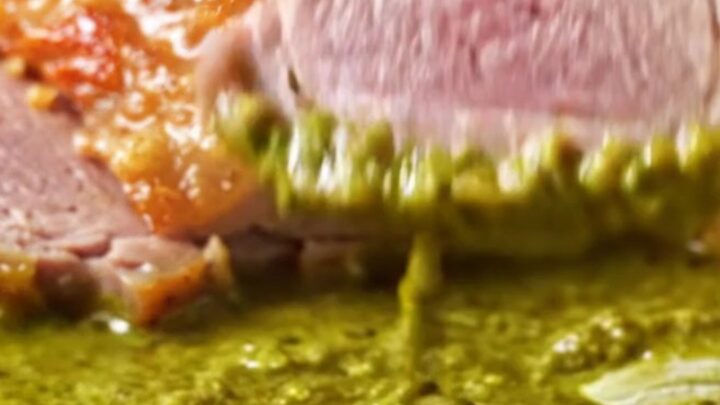
The rested duck is sliced into thick pieces, revealing a rosy pink center and a crisp golden edge. The slices are arranged over the green curry sauce, which is glossy and fragrant. Fresh Thai basil leaves add a bright, herbal note. The dish is ready to serve, with the skin still crackling and the sauce warm and inviting.
Common mistakes
One common mistake is scoring too deeply, cutting into the meat and causing it to dry out during cooking. Another is starting with a hot pan—this causes the fat to render unevenly and the skin to burn.
Do not move the duck while it renders; let it sit undisturbed to develop a golden crust. When making the sauce, avoid boiling it vigorously, which can cause the coconut cream to separate. If the sauce splits, whisk in a splash of warm water.
How to tell it’s done
The duck is done when the internal temperature reaches 130°F (54°C) for medium-rare, or 140°F (60°C) for medium. The skin should be deeply golden and crisp, and the meat should feel firm yet springy to the touch.
After resting, the temperature will rise about 5 degrees. The sauce is ready when it has thickened slightly and coats the back of a spoon. Taste and adjust seasoning with salt.
- Poultry: 165°F (74°C) in the thickest part
Up next · Part 3 of 3
4 variations · storage & make-ahead · 5 answers · printable card
Tips, FAQ & printable recipe (Part 3)← Back to the ingredients (Part 1)