Appetizers · Part 2 of 3: Instructions
Crispy Puff Pastry Pizza Flowers Step-by-step instructions
- Prep
- Cook
- Total
- Serves
- 8
Before you start
Before you start, ensure the puff pastry is thawed but still cold. If using frozen pastry, transfer it to the refrigerator the night before. Take it out about 15 minutes before assembling—just enough to make it pliable.
Have your baking sheet lined with parchment paper and a small bowl of beaten egg ready. Preheat the oven to 400°F (200°C) so it’s hot when the flowers are ready to bake.
Prepare your garlic-herb tomato paste if making your own, and gather a pastry brush and a sharp knife or pizza cutter.
Ingredients at a glance (4)
- 1 package puff pastry sheets, thawed (about 17.3 oz / 490 g)
- 1/4 cup garlic-herb tomato paste
- 1 large egg, beaten
- Dried oregano, for sprinkling, to taste
Instructions
Assembly
- Prepare the Pastry and FillingThaw the puff pastry sheets according to package directions. On a lightly floured surface, unfold the pastry and gently roll out any creases. Cut each sheet into 4 equal squares. Spoon 1 teaspoon of garlic-herb tomato paste into the center of each square, leaving the corners clean.Look for The pastry should be cold but pliable, and the tomato paste should be neatly centered.Tip Keep the pastry chilled until ready to fill—this helps it puff evenly.
- Fold the PinwheelTake one corner of the pastry square and fold it toward the center, pressing gently to seal. Repeat with the opposite corner, then the remaining two corners, creating a pinwheel shape with the filling exposed in the middle. Place the pinwheels on a parchment-lined baking sheet, spacing them 2 inches apart.Look for The pinwheel should have four distinct petals, and the filling should remain visible in the center.Tip Press the corners lightly to help them stick—no need to pinch tightly.
- Chill the Assembled FlowersRefrigerate the assembled pizza flowers for 15 minutes while the oven heats. This step is not shown in the video but ensures the pastry is cold when it hits the heat, which gives the flakiest layers.Look for The pastry should feel firm to the touch after chilling.Tip Chilling prevents the butter from melting too quickly, resulting in a better rise.
At the end of this phase, you should have neat pinwheel shapes on the baking sheet, with the tomato paste centered and the corners folded over. The pastry should feel cool to the touch and hold its shape. If it seems warm, pop it in the fridge for a few minutes before baking.
Baking
- Preheat the OvenPreheat the oven to 400°F (200°C) with a rack in the center position. Line a baking sheet with parchment paper if not already done.Look for The oven should be fully preheated before baking.Tip An accurate oven temperature ensures even browning.
- Brush with Egg WashIn a small bowl, beat the egg with 1 tablespoon of water. Using a pastry brush, lightly brush the exposed pastry petals with the egg wash, avoiding the tomato paste filling. This will give the pastry a golden, glossy finish.Look for The pastry should be evenly coated but not dripping with egg.Tip Brushing only the pastry, not the filling, prevents the filling from burning.
- Bake the Pizza FlowersBake the pizza flowers for 15 minutes, or until the pastry is puffed and deeply golden brown. Rotate the baking sheet halfway through for even browning. The internal temperature of the pastry should reach 160°F (71°C) if checked with an instant-read thermometer, ensuring the egg wash is fully cooked.Look for The pastry should be golden brown and crisp to the touch, with the filling bubbling slightly.Safe temperature 160°F (71°C) internal temperature (egg dishes)Tip Do not open the oven during the first 10 minutes—this can cause the pastry to deflate.
The kitchen will smell of butter and herbs as the pastry puffs and turns golden. After 15 minutes, the flowers should be deeply browned and crisp. The layers should be visibly separated, and the filling should be bubbling. If they’re not golden enough, bake for an additional 2–3 minutes.
Finishing
- Cool SlightlyRemove the baking sheet from the oven and let the pizza flowers cool on the sheet for 5 minutes. This allows the pastry to set and prevents burning your fingers when handling.Look for The pastry should be firm enough to handle without breaking.Tip Cooling on the sheet keeps the bottoms crisp.
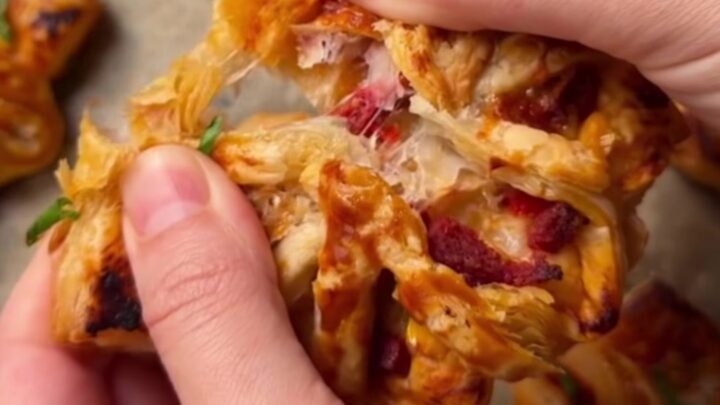
- Sprinkle with Oregano and ServeTransfer the pizza flowers to a serving board or platter. Sprinkle with dried oregano while still warm. Serve immediately, pulling the petals apart to reveal the flaky layers and melted cheese (if using).Look for The oregano should be scattered evenly, and the flowers should be warm and inviting.Tip For extra flair, serve with a side of marinara for dipping.
After cooling slightly, the flowers should be firm enough to handle without breaking. The oregano adds a fragrant, earthy note. Serve them warm on a board, and watch them disappear as guests pull them apart.
Common mistakes
One common mistake is overworking the pastry, which can make it tough. Handle it as little as possible and keep it cold. Another is under-baking—if the pastry isn’t deeply golden, it won’t be crisp. Give it the full 15 minutes, and don’t open the oven too early.
Also, don’t overfill the center; too much tomato paste can make the pastry soggy. Stick to one teaspoon per square. Finally, if the pastry sticks to the board, use a little flour to dust your work surface.
How to tell it’s done
The pizza flowers are done when the pastry is puffed and deeply golden brown, with visible flaky layers. The edges should be crisp to the touch, and the filling should be bubbling slightly.
If you have an instant-read thermometer, insert it into the thickest part of the pastry—it should register at least 160°F (71°C) to ensure the egg wash is fully cooked. Let them cool for a few minutes before serving to avoid burning your mouth, but they are best enjoyed warm.
- Egg dishes: 160°F (71°C) in the thickest part
Up next · Part 3 of 3
4 variations · storage & make-ahead · 5 answers · printable card
Tips, FAQ & printable recipe (Part 3)← Back to the ingredients (Part 1)