Dinner · Part 2 of 3: Instructions
Crispy Parmesan Crusted Salmon with Lemon Butter Asparagus Step-by-step instructions
- Prep
- Cook
- Total
- Serves
- 4
Before you start
Before you begin cooking, gather all your ingredients and prep your workspace to ensure a smooth, seamless process. Start by preheating your oven and trimming the woody ends off the asparagus spears. Grate the fresh parmesan cheese and chop the herbs, keeping them in separate bowls.
Measure out the panko breadcrumbs, butter, and fresh lemon juice. Pat the salmon fillets dry with paper towels and keep them refrigerated until the moment you are ready to apply the crust, which ensures the fish stays fresh and safe.
Ingredients at a glance (8)
- 4 skinless salmon fillets, about 6 ounces each
- 1/2 cup panko breadcrumbs
- 1/2 cup freshly grated parmesan cheese
- 2 tbsp finely chopped herbs
- 2 tbsp unsalted butter, melted
- 1 lb asparagus, trimmed
- 4 tbsp unsalted butter
- 2 tbsp fresh lemon juice
Instructions
Preparation and Crusting
- Prepare the Herb Parmesan MixtureIn a medium mixing bowl, combine the panko breadcrumbs, freshly grated parmesan cheese, and herbs. Pour in two tablespoons of melted unsalted butter and stir the mixture thoroughly with a fork until the breadcrumbs are evenly moistened and resemble wet sand.Look for The mixture should hold together slightly when pressed.Tip Use freshly grated parmesan from a block for the best flavor and texture.
- Crust the SalmonPat the salmon fillets dry with paper towels to remove excess moisture. Place the fillets on a baking sheet, then press the savory breadcrumb herb and parmesan mixture firmly onto the top of each fillet to create a thick, even crust.Look for The crust should adhere well to the fish.Tip Pressing firmly ensures the crust stays intact during cooking.
At the end of this phase, the salmon fillets should be neatly arranged on the baking sheet, topped with a thick, even layer of the herb and cheese mixture.
The topping should be pressed firmly onto the fish, appearing moist and cohesive without any dry, powdery patches of breadcrumbs remaining. The kitchen should smell faintly of herbs and savory parmesan.
Roasting and Broiling
- Roast the Salmon and AsparagusArrange the trimmed asparagus around the salmon fillets on the baking sheet. Drizzle the asparagus with a little melted butter. Place the baking sheet in an oven preheated to 400°F (204°C) and roast for ten to twelve minutes until the salmon is nearly cooked through.Look for The asparagus should begin to soften and turn bright green.Tip Keep the salmon refrigerated until right before prep to ensure food safety.
- Broil to Golden PerfectionSwitch the oven to broil on high. Position the baking sheet on the top rack and broil for two to three minutes, watching closely, until the parmesan crust is bubbling, deeply golden brown, and incredibly crunchy. Verify the salmon has reached a safe internal temperature of 145°F (63°C) before removing it from the oven.Look for The crust must look golden and make an audible crunch when tapped.Safe temperature 145°F (63°C) internal temperature (fish)Tip Do not walk away during broiling as the cheese can burn quickly.
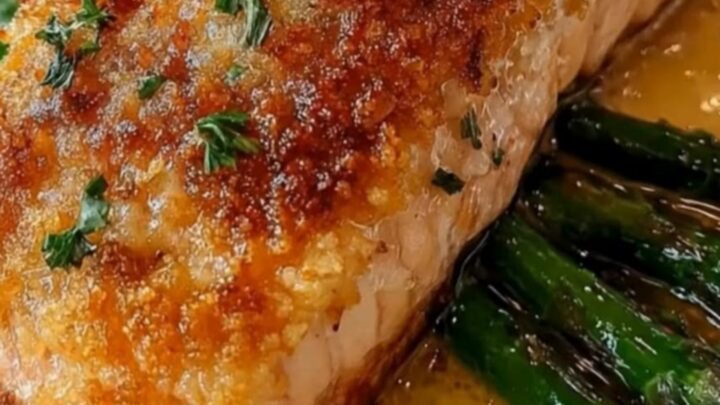
At this point, the salmon crust must be deeply golden brown and bubbling with melted butter, emitting a rich, toasted cheese aroma. When tapped gently with a fork, the crust should feel completely firm and make a distinct, audible crunch. The salmon flesh should look opaque and flake easily, and the asparagus should be tender and vibrant green.
Sauce and Assembly
- Prepare the Lemon Butter SauceIn a small saucepan over medium-low heat, melt the remaining four tablespoons of unsalted butter until it begins to sizzle gently. Whisk in the fresh lemon juice. Cook for one minute, stirring constantly, until the sauce is glossy, emulsified, and warm.Look for The sauce should be smooth and slightly thickened.Tip Keep the heat low to prevent the butter from separating or burning.
- Plate and ServePlace a portion of the roasted asparagus on a warm serving plate. Carefully set a golden, crusted salmon fillet next to the asparagus. Spoon the warm lemon butter sauce over the asparagus and around the salmon, leaving the crunchy parmesan crust dry to preserve its crisp texture.Look for Serve immediately while the salmon is hot and flaky.Tip Spoon the sauce around the fish rather than over the top.
The final checkpoint is met when the warm lemon butter sauce is smooth, glossy, and completely emulsified, with no separation of fat. Once plated, the dish presents a beautiful visual contrast between the golden-brown crusted salmon, the bright green, glossy asparagus, and the pool of rich, light-yellow sauce, ready to be enjoyed immediately.
Common mistakes
The most common mistake when making crusted salmon is overcooking the fish in an attempt to get a brown crust. If you leave the salmon under the broiler for too long, the delicate fats will render out, leaving the fish dry and chalky.
Another frequent error is using pre-shredded cheese, which contains starches that prevent a smooth melt and can result in a powdery, dry topping. Always monitor the broiling process closely, as the transition from perfectly golden to burnt can happen in a matter of seconds.
How to tell it’s done
To determine if the salmon is perfectly cooked, insert an instant-read thermometer into the thickest part of the fillet; it must reach a safe internal temperature of 145°F (63°C).
Visually, the flesh should transition from translucent pink to an opaque, pale pink, and it should yield easily to gentle pressure from a fork. The crust itself should be a uniform golden brown, firm to the touch, and completely crispy, holding its shape without sliding off the fish.
- Fish: 145°F (63°C) in the thickest part
Up next · Part 3 of 3
3 variations · storage & make-ahead · 4 answers · printable card
Tips, FAQ & printable recipe (Part 3)← Back to the ingredients (Part 1)