Desserts · Part 2 of 3: Instructions
Crispy Greek Honey Balls (Loukoumades) in 30 Minutes Step-by-step instructions
- Prep
- Cook
- Total
- Serves
- 4
Before you start
Before starting, measure all ingredients. The water should be warm but not hot, about 110°F (43°C). If using active dry yeast, proof it with the honey and water for 5 minutes until frothy. If using instant yeast, you can skip the proofing and mix directly with the flour.
Set up a frying station with your pot, thermometer, slotted spoon, and a paper towel-lined plate. Toast the walnuts in a dry skillet over medium heat for 3-4 minutes, then crush them roughly. Warm the honey gently on the stove or in the microwave just before serving.
Ingredients at a glance (10)
- 1 3/4 cups all-purpose flour
- 3/4 cup warm water (about 110°F/43°C)
- 2 1/4 tsp active dry yeast (one packet)
- 1 tbsp honey
- 1 tsp ouzo (optional)
- 1/4 tsp salt
- 2 cups vegetable oil, for frying
- 1/2 cup Greek thyme honey
- 1/2 cup walnuts, toasted and crushed
- 1/2 tsp ground cinnamon
Instructions
Rise and Fry
- Make the Yeast DoughIn a large mixing bowl, stir the warm water and honey together. Sprinkle the yeast over the top and let it sit for 5 minutes until frothy. Add the flour, salt, and ouzo (if using). Whisk vigorously until a smooth, thick batter forms. The dough should be too soft to knead, similar to a very thick pancake batter. Cover the bowl with a clean kitchen towel and let it rise in a warm spot for 30 minutes, until doubled in volume and bubbly.Look for The batter is airy, bubbly, and has doubled in size.Tip Warm water should feel like bathwater, not hot, to avoid killing the yeast.
- Heat the OilPour the vegetable oil into a deep, heavy-bottomed pot, filling it at least 2 inches deep. Attach a deep-fry thermometer to the side of the pot. Heat the oil over medium-high heat until it reaches 360°F (182°C). Adjust the heat as needed to maintain this temperature throughout frying.Look for The oil shimmers and a small drop of batter sizzles immediately.Tip Use a thermometer for accuracy; too hot and the balls burn, too cool and they absorb oil.
After 30 minutes, the batter should be airy, bubbly, and have doubled in volume. It will look like a thick, spongy foam. The oil should be at a steady 360°F, with a faint shimmer. When you scoop the dough, it should be light and full of air.
The first ball you drop should sizzle immediately and rise to the surface within seconds. As it fries, it will puff up dramatically, turning from pale to golden brown. The aroma of fried dough and honey will fill the kitchen.
Golden and Puffed
- Shape and Fry the Dough BallsDip a spoon in the hot oil to coat it, then scoop a walnut-sized portion of the risen dough. Use another oiled spoon or your finger to push the dough off the spoon into the hot oil. Fry in batches of 5-6 balls, making sure not to overcrowd the pot. Roll the balls continuously with a slotted spoon so they brown evenly on all sides. Fry for about 3 minutes, until deep golden brown and puffed.Look for The balls puff up, turn golden brown, and float on the surface.Tip Keep the oil at 360°F; between batches, let it come back up to temperature.
- Drain the Fried BallsUsing a slotted spoon, transfer the fried loukoumades to a plate lined with paper towels. Let them drain briefly, about 1 minute, while you fry the remaining dough. Do not let them sit too long, as they will lose their crispness.Look for The paper towels absorb excess oil; the balls stay crisp.Tip Drain in a single layer, not stacked, to keep them crunchy.
After about 3 minutes, the loukoumades will be uniformly golden brown, with a crisp, crackly exterior. They will feel lightweight and hollow. The paper towel-lined plate will show only a faint oil stain, indicating they are not greasy. The honey syrup should be warm and thin, with a glossy sheen. The walnuts should be toasted and fragrant. Everything is ready for the final assembly.
Honey and Crunch
- Warm the Honey SyrupIn a small saucepan, gently warm the Greek thyme honey over low heat until it is runny and fragrant. Do not let it boil. Stir in the ground cinnamon. Keep the honey warm while you finish frying.Look for The honey is thin, glossy, and smells intensely floral.Tip Warming the honey makes it easier to drizzle and soak into the balls.
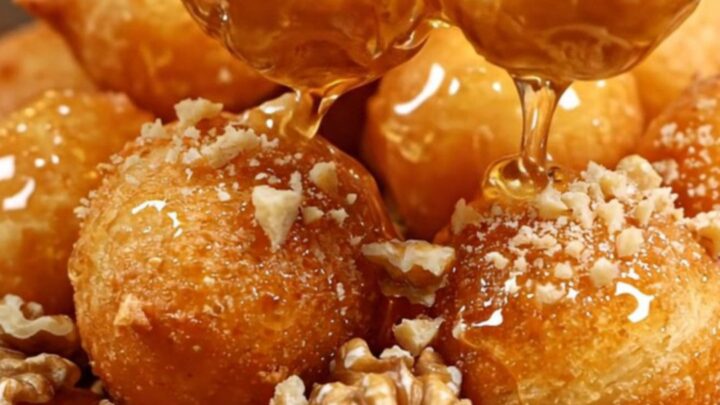
- Drench and ServePlace the warm loukoumades on a serving platter. Drizzle generously with the warm honey syrup, making sure each ball is coated. Sprinkle with the crushed walnuts and a final dusting of cinnamon. Serve immediately while still warm and crisp.Look for The honey glistens on the golden balls, and the walnuts add crunch.Tip For the best texture, serve within 10 minutes of frying.
The final dish should be a mound of golden balls glistening with honey, speckled with crushed walnuts and a dusting of cinnamon. The honey should be evenly distributed, pooling slightly at the bottom of the plate. The walnuts add a satisfying crunch against the soft interior. Serve immediately, as the balls will soften as they sit in the syrup.
Common mistakes
One common mistake is overcrowding the pot, which lowers the oil temperature and results in soggy balls. Fry in small batches, leaving plenty of space. Another error is using cold water or water that is too hot, which can kill the yeast or prevent it from activating.
Always proof the yeast in warm water with a bit of honey. Finally, do not skip the resting period—it is essential for a light texture. If the dough is too stiff, add a tablespoon of warm water; if too loose, add a tablespoon of flour, but be cautious.
How to tell it’s done
The loukoumades are done when they are deep golden brown on all sides and have puffed up to about double their original size. They should feel light and hollow when lifted with a slotted spoon. The oil temperature is key: maintain 360°F (182°C) throughout frying.
If the oil is too cool, the balls will be greasy and dense; if too hot, they will brown too quickly and remain doughy inside. A quick test: drop a tiny bit of batter into the oil; it should sizzle and float to the surface immediately.
Up next · Part 3 of 3
4 variations · storage & make-ahead · 5 answers · printable card
Tips, FAQ & printable recipe (Part 3)← Back to the ingredients (Part 1)