Appetizers · Part 2 of 3: Instructions
Crispy Duchess Potato Swirls with Parmesan Step-by-step instructions
- Prep
- Cook
- Total
- Serves
- 4
Before you start
Before you begin, ensure your potatoes are boiled until fork-tender but not falling apart. Drain them well and let them steam dry in the colander for a few minutes; excess moisture is the enemy of a crisp Duchess potato.
Have your baking sheet prepared with parchment paper and ensure your oven is fully preheated to 425°F (220°C). Gather all ingredients and have your piping bag ready to go. Working with the potatoes while they are still warm makes them easier to rice and ensures the butter and cheese incorporate smoothly.
Ingredients at a glance (9)
- 700 g Russet potatoes, peeled and boiled
- 60 g melted butter
- 50 ml heavy cream
- 3 large egg yolks
- 50 g finely grated Parmigiano-Reggiano
- 1/4 tsp ground nutmeg
- 2 tbsp clarified butter, for brushing
- for serving micro-parsley
- for serving flaky salt
Instructions
Creating the potato base
- Prepare the potato basePass the boiled Russet potatoes through a ricer into a large bowl to ensure a smooth, lump-free texture. Add the melted butter, heavy cream, egg yolks, grated Parmigiano-Reggiano, and nutmeg. Beat the mixture thoroughly until completely combined and smooth, then transfer to a star-tipped piping bag.Look for The mixture should be thick enough to hold its shape when piped.Tip Do not overwork the potatoes after adding the eggs to keep the texture light.
The potato mixture should be smooth, thick, and uniform in color. When you lift a spoonful, it should hold its shape without sliding off immediately. The Parmesan should be fully incorporated, and the mixture should smell buttery and aromatic. If it feels too stiff to pipe, add a tiny splash of warm cream, but be careful not to make it too loose. Check that no large lumps remain after ricing, as these will clog your star tip during the piping phase.
Piping the rosettes
- Pipe and shape the rosettesLine a baking sheet with parchment paper. Pipe the potato mixture into 5cm tall swirling rosettes onto the baking sheet. Use consistent pressure to create distinct, sharp ridges on each swirl, which will crisp up beautifully in the oven.Look for The swirls should be uniform in height and width for even baking.Tip Keep the piping bag vertical to achieve the best spiral definition.
The rosettes should be consistent in height and width, with clearly defined star ridges. Aim for a height of about 5cm. If the mixture is at the right temperature, the swirls should hold their form perfectly on the parchment paper without spreading.
If they seem to be drooping, let the mixture cool slightly before continuing. Ensure there is enough space between each rosette on the baking sheet to allow for even heat circulation, which is crucial for achieving that all-around crispy texture.
Baking to perfection
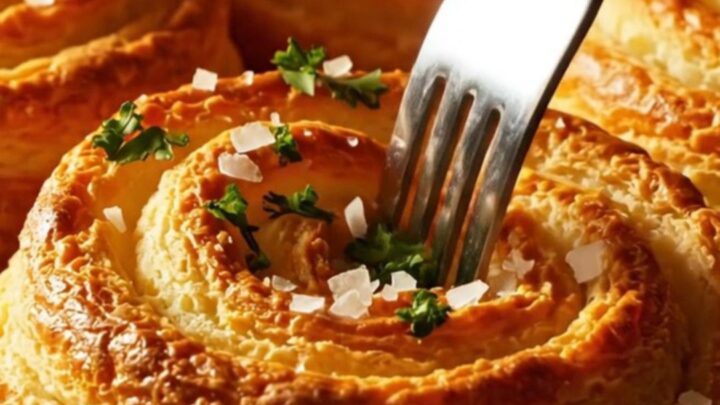
- Brush and bakePreheat your oven to 425°F (220°C). Gently brush the surface of each piped rosette with the clarified butter. Bake for 22 minutes until the ridges turn a deep mahogany-gold and become crisp. Ensure the internal temperature reaches 160°F (71°C) to safely cook the eggs. Remove from the oven, garnish with micro-parsley and flaky salt, and let rest for 5 minutes before serving.Look for Look for a deep, golden-brown color on all the ridges of the potato swirls.Safe temperature 160°F (71°C) internal temperature (egg dishes)Tip Place the baking sheet on the middle rack for the most even browning.
The potatoes are finished when the ridges are deep golden-brown and crisp. The aroma of toasted Parmesan and butter should fill the kitchen. The rosettes should be firm to the touch. Take a moment to check the internal temperature of a center rosette to ensure it reaches 160°F (71°C). Once finished, remove them from the oven and let them rest on the sheet for 5 minutes to stabilize. The final result should be a beautiful, golden-brown swirl with a crunchy exterior and a soft, airy interior.
Common mistakes
A common mistake is using potatoes that are too wet. If the potato mixture is runny, the rosettes will lose their shape and flatten out in the oven. Another pitfall is over-mixing the potato base; once the eggs are added, mix only until combined.
Over-mixing can make the starch gummy rather than fluffy. Finally, ensure the oven is fully preheated. If the oven is not hot enough, the potatoes will dry out before they have a chance to turn golden and crispy, resulting in a dull color and a less satisfying texture.
How to tell it’s done
The Duchess potatoes are ready when they are a deep, uniform mahogany-gold color, especially along the piped ridges. The edges should be noticeably crisp to the touch, and the centers should feel firm but yield slightly when pressed.
The internal temperature must reach 160°F (71°C) to ensure the eggs are fully cooked. Let them rest on the baking sheet for 5 minutes after removing them from the oven to allow the structure to set, which makes them easier to transfer to a serving platter without losing their shape.
- Egg dishes: 160°F (71°C) in the thickest part
Up next · Part 3 of 3
2 variations · storage & make-ahead · 3 answers · printable card
Tips, FAQ & printable recipe (Part 3)← Back to the ingredients (Part 1)