Dinner · Part 2 of 3: Instructions
Crispy Beer-Battered Baja Fish Tacos with Garlic-Lime Sauce Step-by-step instructions
- Prep
- Cook
- Total
- Serves
- 4
Before you start
Before the oil goes on the stove, set up the full station: a heavy Dutch oven, a deep-fry thermometer clipped to its side, a wire rack over a sheet pan for draining, and bowls for the dry mix and the batter. Pat the cod dry, cut it into 1-inch strips, and return it to the refrigerator so it stays very cold. Chill the lager if it is not already, and measure every ingredient now, because once the batter is mixed the clock runs fast. Shred the cabbage, have the pico de gallo and the garlic-lime sauce ready, and stir nothing else until the thermometer reads 375°F.
Ingredients at a glance (11)
- 1 cup all-purpose flour
- 2 tbsp cornstarch
- 1 tsp baking powder
- 1 tsp Mexican oregano
- 1 cup ice-cold Mexican lager
- 1 lb Atlantic cod, cut into 1-inch strips
- 6 cups vegetable oil, for frying
- 8 corn tortillas, warmed, for serving
- 2 cups shredded cabbage
- 1 cup pico de gallo
- 1 cup creamy white garlic-lime sauce, store-bought or made ahead
Instructions
Batter and station
- Set the frying stationSet a heavy Dutch oven on the stove and place a wire rack over a sheet pan beside it. Pat the cod completely dry with paper towels, cut it into strips about 1 inch wide and 4 inches long, and keep the strips in the refrigerator until the batter is mixed.Look for The fish should feel firm, cold, and dry to the touch, with no moisture beading on the surface.Tip Dry, cold fish gives the batter something to grip, so the coating stays attached instead of sliding off in the oil.
- Whisk the seasoned flourIn a wide mixing bowl, whisk the flour, cornstarch, baking powder, and Mexican oregano until evenly combined. Whisking the leavening through the dry mix now means every strip of fish gets the same lift once the liquid hits.Look for The blend should look uniform, pale, and slightly powdery, with the oregano flecks evenly scattered throughout.Tip Cornstarch weakens the gluten and crisps the shell, so take a moment to distribute it fully before any liquid goes in.
- Add the cold lagerPour in the ice-cold lager straight from the refrigerator and whisk gently just until a thin, smooth, slightly lumpy batter forms, about 30 seconds. Stop as soon as the flour disappears; a few small lumps are fine, and overmixing will make the coating tough instead of crisp.Look for The batter should coat a spoon thinly and drip in a steady ribbon, thin enough to see the fish through it.Tip Cold batter hitting hot oil is what creates the blistered, glassy shell, so chill the bowl for 10 minutes if the kitchen is warm.
At the end of this phase, the batter should be thin, smooth, and cold, coating a spoon in a see-through ribbon, and the cod strips should be dry, uniformly cut, and still chilled. Check three things before moving on: the oil thermometer reads a steady 375°F, the batter was mixed less than two minutes ago, and the rack-and-sheet-pan setup is within arm's reach of the pot.
If the batter has thickened while waiting, whisk in a splash more cold lager. Everything here should feel organized and unhurried, because the frying phase rewards calm hands and a clean sequence.
Fry the fish
- Heat the oil to 375°FAdd the vegetable oil to the Dutch oven, attach the thermometer to the side, and heat over medium-high until it reaches 375°F. Adjust the flame to hold that temperature steady; a stable reading is the single biggest factor in a shell that puffs instead of soaking up oil.Look for The oil should shimmer but never smoke, and the thermometer should hold at 375°F for a full minute before frying.Tip No thermometer means no control; the wood-chip test is unreliable, so borrow or buy one before making this recipe.
- Dip the cod stripsWorking with one strip at a time, submerge a piece of cod in the batter, lift it, and let the excess drip off for 3 seconds. Lower it gently into the oil away from you. Fry 4 to 5 strips per batch so the temperature never dips below 350°F.Look for Each strip should hit the oil with an immediate, vigorous sizzle and bubbles racing around it within 2 seconds.Tip Crowding the pot drops the temperature and the batter drinks oil, so patience here is what delivers the shatter.
- Fry until golden and cooked throughFry each batch for 3 1/2 minutes, turning the strips once halfway, until puffed, blistered, and deep golden brown. The cod is safely cooked when it reaches an internal temperature of 145°F (63°C); check the thickest piece with an instant-read thermometer through the batter.Look for Listen for a loud, steady crackle and look for a shell that has ballooned with blisters and turned even amber gold.Safe temperature 145°F (63°C) internal temperature (fish)Tip Fry in small batches at a rolling, consistent sizzle; the fish cooks through long before the batter risks burning at 375°F.
- Drain on a rackLift the fried strips from the oil with tongs, letting them drain for a moment above the pot, then transfer them to the wire rack set over the sheet pan. Skip the paper towels; a rack keeps steam from softening the underside.Look for The shells should sound hollow and brittle when tapped with tongs, with no dark, saturated spots on the bottom.Tip Hold the finished batches in a 200°F oven, uncovered, while the last batch fries so every taco is served hot and crisp.
The fried strips should emerge puffed and blistered, deep golden brown with glassy bubbles across the surface, and they should crackle audibly as they land on the rack. The oil should return to 375°F between batches, and each batch should take a steady 3 1/2 minutes with one flip at the midpoint.
Verify doneness on the thickest piece: an instant-read thermometer through the batter should read 145°F (63°C), and the flesh should flake into snowy layers. If the shells are darkening before the time is up, lower the heat slightly. Hold the finished batches uncovered in a 200°F oven while the final batch fries.
Build the tacos
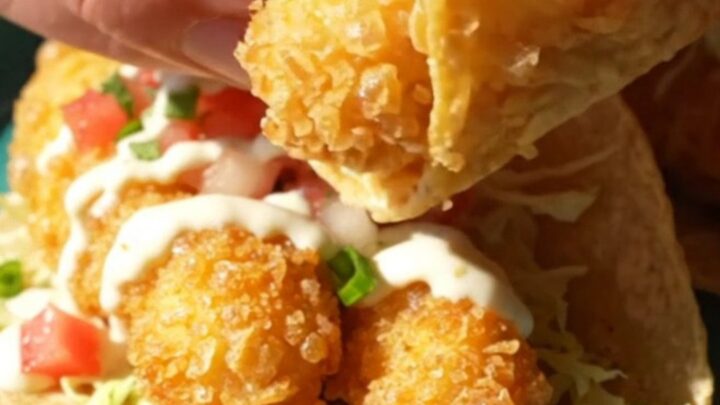
- Warm tortillas and build the tacosWarm the tortillas directly over a gas flame or in a dry skillet for 20 seconds per side until pliable and lightly charred. Fill each with cabbage, 2 or 3 pieces of cod, a spoonful of pico de gallo, and a generous drizzle of the creamy garlic-lime sauce. Serve immediately.Look for The tortillas should fold without cracking and carry faint toasted spots; the sauce should drape, not run.Tip Sauce the fish just before serving, never in advance, or the steam will eat through the crisp shell in minutes.
The finished tacos should look layered and generous: warm, lightly charred tortillas holding a bed of cabbage, two or three golden fillets, a bright spoonful of pico de gallo, and a thick drizzle of white garlic-lime sauce. Lift one and listen; the shell should crackle under the fork, and the steam rising from the fish should be immediate.
The tortillas must fold cleanly without cracking, and the sauce should drape rather than pool. Serve within two minutes of building, straight from the board, with lime wedges alongside. Anything that sits longer loses the contrast between hot, brittle shell and cool, creamy sauce that defines a proper Baja taco.
Common mistakes
The most common failure is frying at too low a temperature, which yields pale, oil-logged shells; trust the thermometer over any visual guess. The second is overmixing the batter, which develops gluten and produces a tough, doughy coat instead of a brittle one.
Crowding the pot drops the temperature 30 degrees in seconds, so fry four or five strips at a time. Skipping the wire rack for paper towels traps steam against the crust and softens it. Finally, do not sauce the tacos early; the garlic-lime drizzle is delicious, but it will dissolve the crisp shell if it sits more than a minute or two.
How to tell it’s done
The fish is done when the batter is puffed, blistered, and deep golden brown after 3 1/2 minutes, and when an instant-read thermometer inserted through the shell into the thickest strip reads 145°F (63°C), the safe temperature for fish. The flesh beneath should flake into clean, snowy layers and look opaque from edge to edge. Sound is a real signal here: a finished strip crackles audibly as it drains and rings faintly when tapped with tongs. The sauce is ready when it is thick enough to coat the fish without running off.
- Fish: 145°F (63°C) in the thickest part
Up next · Part 3 of 3
4 variations · storage & make-ahead · 5 answers · printable card
Tips, FAQ & printable recipe (Part 3)← Back to the ingredients (Part 1)