Desserts · Part 2 of 3: Instructions
Crispy Antep Pistachio Baklava with Forty Phyllo Layers Step-by-step instructions
- Prep
- Cook
- Total
- Serves
- 24
Before you start
Before starting, make the syrup and let it cool completely. Grind the pistachios to a fine powder. Clarify the butter if using whole butter: melt it slowly, skim off the foam, and pour off the clear liquid, leaving the milk solids behind.
Have all ingredients measured and the pan ready. Preheat the oven to 340°F (170°C). Keep the phyllo sheets stacked and covered with a lightly dampened towel. Set up a work area with the butter, pastry brush, and pan within reach.
Ingredients at a glance (6)
- 40 sheets tissue-thin baklava phyllo dough
- 1 1/2 cups clarified butter, melted
- 2 1/2 cups finely ground Antep pistachios
- 2 cups granulated sugar
- 1 cup water
- 1 tbsp fresh lemon juice
Instructions
Layer and Assemble
- Prepare the Syrup and PistachiosIn a small saucepan, combine the sugar and water. Bring to a boil over medium heat, stirring until the sugar dissolves. Reduce the heat and simmer for 10 minutes. Remove from heat and stir in the lemon juice. Let the syrup cool completely to room temperature. Meanwhile, grind the pistachios in a food processor until very fine, but not pasty.Look for Syrup is clear and slightly thickened; pistachios are powdery with no large pieces.Tip Cool the syrup completely before using; warm syrup makes the phyllo soggy.
- Layer the First Twenty Phyllo SheetsPreheat the oven to 340°F (170°C). Brush the bottom and sides of a large round or rectangular baking pan with some of the clarified butter. Lay one sheet of phyllo in the pan, pressing it gently into the corners. Brush the entire sheet with clarified butter. Repeat with 19 more sheets, brushing each one generously with butter.Look for All 20 sheets are stacked evenly, each one thoroughly brushed with butter.Tip Keep unused phyllo covered with a damp towel to prevent drying.
- Add the Pistachio LayerSprinkle the finely ground pistachios evenly over the top of the 20 phyllo layers, spreading them to the edges. Gently press the pistachios down with your hands or a flat spatula to create an even, compact layer.Look for Pistachios cover the entire surface in a thin, even layer.Tip Press lightly so the nuts adhere without tearing the phyllo.
- Top with the Remaining Twenty Phyllo SheetsLayer the remaining 20 phyllo sheets on top of the pistachios, brushing each sheet with clarified butter exactly as before. Ensure the top sheet is well-brushed so it browns evenly.Look for The stack is even, with all 40 sheets in place and the top glistening with butter.Tip Gently smooth out any air bubbles with your hands as you layer.
At the end of this phase, you have a neat stack of forty phyllo sheets with a pistachio layer in the middle. The top should be glistening with butter, and the edges should be even.
The phyllo should feel pliable, not dry or cracked. The pistachios are evenly spread, and the cuts are clean and uniform. This is the foundation for the crisp, layered texture.
Cut and Bake
- Cut Diamond ShapesUsing a very sharp knife, cut the assembled baklava into diamond shapes. First, cut vertical lines about 1 1/2 inches apart, then cut diagonal lines crossing them to form diamonds. Cut all the way through to the bottom layer.Look for Clean, even diamond cuts that reach the bottom of the pan.Tip Wipe the knife clean between cuts for neat edges.
- Pour Butter Over the CutsPour the remaining clarified butter evenly over the entire surface, making sure it seeps into all the cut lines. Let the baklava sit for a few minutes so the butter soaks into the cuts.Look for Butter fills every cut line and coats the surface.Tip Use a spoon to drizzle butter directly into the cuts if needed.
- Bake Until Golden AmberBake in the preheated oven for 50 minutes, or until the top is deep golden amber and the layers look crisp and puffed. Rotate the pan halfway through for even browning.Look for The top is evenly golden, and the edges are slightly darker.Tip If the top browns too quickly, tent loosely with foil.
After baking, the baklava should be deep golden amber, with visible layers that have puffed and separated. The butter should have bubbled and crisped the edges. The cuts should be distinct, and the whole pan should look glossy and inviting. The aroma of toasted butter and nuts fills the kitchen. Let it cool for a minute or two before adding the syrup.
Syrup and Rest
- Pour Cooled Syrup Over Hot BaklavaRemove the baklava from the oven and immediately pour the cooled syrup evenly over the hot pastry. Listen for the sizzle as the syrup hits the hot layers. Let the baklava absorb the syrup for at least 30 minutes before serving.Look for The syrup sizzles and is absorbed quickly; the baklava glistens.Tip Pour slowly and evenly to ensure every piece gets syrup.
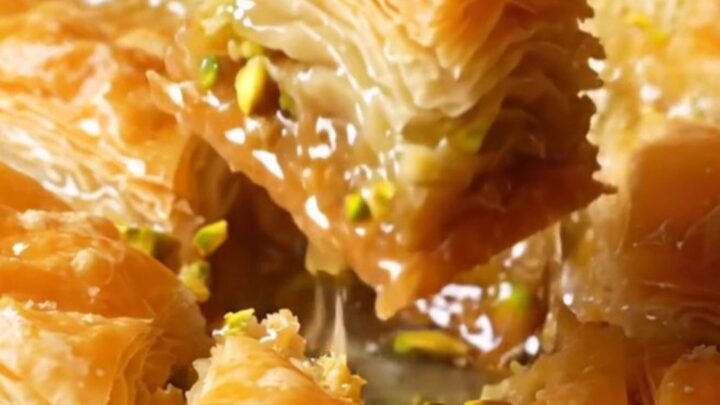
When the syrup is poured, you hear a loud sizzle, and the syrup is absorbed quickly. The baklava glistens with syrup, and the top becomes slightly translucent. After resting, the layers are crisp and the syrup has soaked in evenly. A fork lifted from a piece should show distinct, shattering layers. The baklava is ready to serve.
Common mistakes
One common mistake is using warm syrup on hot baklava, which makes the phyllo soggy. Always cool the syrup completely before pouring. Another is not brushing each phyllo sheet thoroughly with butter, leading to dry, tough layers. Take the time to brush every sheet evenly.
Cutting the baklava before baking is essential; if you cut after baking, the layers will shatter and crumble. Use a very sharp knife and cut all the way through to the bottom. Finally, do not skip the resting time after pouring the syrup; it allows the syrup to distribute evenly and the layers to crisp up.
How to tell it’s done
The baklava is done when the top is a deep golden amber and the edges look slightly darker and crisp. The layers should appear puffed and separated, and the butter should be bubbling gently. To check, gently lift one piece with a fork; the phyllo should feel firm and shatter easily.
If it seems soft or pale, bake for a few more minutes. After the syrup is poured, the baklava should absorb it within 30 minutes, and the top should look glossy and wet. Let it cool completely before serving to allow the layers to set.
Up next · Part 3 of 3
4 variations · storage & make-ahead · 5 answers · printable card
Tips, FAQ & printable recipe (Part 3)← Back to the ingredients (Part 1)