Breakfast · Part 2 of 3: Instructions
Crème Brûlée Stuffed Brioche French Toast Step-by-step instructions
- Prep
- Cook
- Total
- Serves
- 4
Before you start
Before beginning, ensure all ingredients are measured and ready. If the brioche is fresh, slice it and let it sit on a wire rack for an hour to dry out slightly. Prepare the pastry cream and keep it refrigerated in a piping bag.
Ensure the skillet is clean and the blowtorch is filled with fuel, and have a heat-proof surface ready for the final caramelization step. Having all components organized allows for a seamless transition from filling the bread to searing and finally torching the sugar.
Ingredients at a glance (6)
- 4 slices 2-inch thick brioche bread
- 80 g chilled vanilla bean pastry cream
- 4 eggs
- 200 ml heavy cream
- 2 tbsp salted butter
- 25 g raw sugar
Instructions
Stuffing the Brioche
- Prepare the stuffed briocheUsing a serrated knife, carefully cut a horizontal pocket into the center of each 2-inch thick brioche slice, taking care not to cut through the sides. Transfer the chilled vanilla bean pastry cream into a piping bag and fill each brioche pocket generously. Ensure the filling is contained within the bread to prevent leakage during the subsequent soaking and cooking phases.Look for The brioche should feel slightly weighted and full without tearing the bread edges.Tip Keep the pastry cream chilled until the moment of piping to ensure it holds its structure inside the bread.
The brioche pockets should be neatly cut and securely filled with the pastry cream. Check that the edges of the bread are intact so the filling remains contained during the soaking and cooking phases. The bread should feel substantial and well-filled, with no visible gaps where the cream might escape when the bread is dipped into the egg mixture.
Searing the French Toast
- Soak and pan-searIn a wide bowl, whisk together the eggs and heavy cream until smooth. Dip each stuffed brioche slice into the custard, ensuring the bread absorbs the liquid without becoming soggy. Melt the salted butter in a large skillet over medium-low heat at 325°F (163°C). Place the slices in the pan and sear for 4 minutes per side until golden brown. To ensure the eggs are thoroughly cooked through, continue cooking until the internal temperature reaches 160°F (71°C).Look for The French toast should be golden brown on both sides and firm to the touch.Safe temperature 160°F (71°C) internal temperature (egg dishes)Tip Do not rush the searing process, as medium-low heat allows the custard to set deep inside the bread.
The bread should be golden brown on both sides. The custard should be fully absorbed into the bread, and the center should be warm and set, indicating that the eggs are thoroughly cooked. The toast should feel firm when pressed gently with a spatula, and the edges should be crisp, providing a sturdy base for the final sugar layer.
Torching the Crust
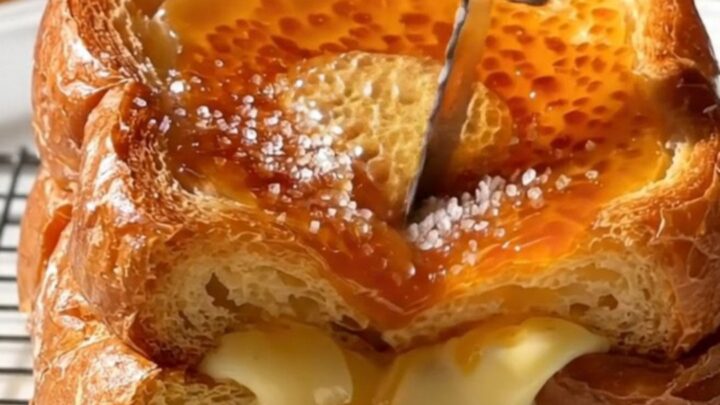
- Caramelize the crustRemove the French toast from the skillet and place on a heat-proof serving plate. Evenly sprinkle the raw sugar over the top surface of each slice. Using a kitchen blowtorch, carefully melt and caramelize the sugar until it forms a deep amber, glassy, and hardened crust. Move the torch in a consistent circular motion to ensure even caramelization across the entire surface of the toast without burning the sugar or the bread beneath.Look for The sugar will bubble, turn deep amber, and harden into a smooth, glass-like layer.Tip Move the torch in a circular motion to ensure even caramelization without burning the sugar.
The sugar should be transformed into a smooth, amber-colored glass layer. Watch closely to ensure the sugar melts evenly without scorching, creating that iconic crackling effect over the warm toast.
The finished crust should be uniform in color and texture, offering a satisfying snap when broken with a spoon, which is the signature experience of this classic dessert-inspired breakfast dish.
Common mistakes
Avoid using bread that is too thin, as it will break when stuffed. Do not overcrowd the skillet, as this lowers the temperature and prevents the toast from searing properly. Never skip the custard soak, as it provides the necessary moisture, but do not soak for too long or the bread will become mushy and fall apart in the pan.
Additionally, ensure the heat is not too high during the searing process, as this will burn the exterior of the brioche before the custard in the center has a chance to heat through.
How to tell it’s done
The French toast is ready when the exterior is deep golden brown and the custard in the center of the brioche is fully set. The internal temperature of the egg-rich custard should reach at least 160°F (71°C) to ensure safety.
The final caramel crust should be hard to the touch and sound hollow when gently tapped with a spoon. If the center feels too soft or the bread seems to collapse, it may require an additional minute of gentle heat in the skillet to ensure the custard is properly cooked.
- Egg dishes: 160°F (71°C) in the thickest part
Up next · Part 3 of 3
2 variations · storage & make-ahead · 3 answers · printable card
Tips, FAQ & printable recipe (Part 3)← Back to the ingredients (Part 1)