Dinner · Part 2 of 3: Instructions
Creamy Chicken Linguine with Onions and Spinach Step-by-step instructions
- Prep
- Cook
- Total
- Serves
- 4
Before you start
Before beginning the cooking process, organize all ingredients to ensure a smooth workflow. Slice the chicken breasts into even strips and place them back in the refrigerator until ready to cook.
Peel and thinly slice the yellow onion, and wash the fresh spinach thoroughly, patting it dry to remove excess moisture. Measure out the heavy cream and shred the cheese. Bring a large pot of water to a rolling boil so the pasta can cook concurrently with the chicken and sauce preparation.
Ingredients at a glance (6)
- 8 oz linguine
- 1 lb boneless, skinless chicken breasts, sliced into strips
- 1 medium yellow onion, sliced
- 1 cup heavy cream
- 2 cups fresh spinach
- 1 cup shredded cheese
Instructions
Boiling Pasta and Searing Chicken
- Boil the LinguineBring a large pot of water to a boil. Add the linguine and cook according to the package instructions until al dente. Drain the pasta, reserving a half cup of pasta water, and set aside.Look for The pasta should be tender but still have a slight bite in the center.Tip Do not rinse the cooked pasta, as the natural starches help the sauce cling to the strands.
- Sear the ChickenAdd the sliced chicken breasts to a hot skillet. Sear the chicken for 5 to 7 minutes, stirring occasionally, until golden brown and cooked through to an internal temperature of 165°F (74°C). Transfer the chicken to a plate.Look for The chicken should have a beautiful golden-brown crust on all sides.Safe temperature 165°F (74°C) internal temperature (poultry)Tip Avoid overcrowding the skillet so the chicken sears rather than steams.
At the end of this first phase, the linguine is cooked to a perfect al dente texture, drained, and set aside. The chicken strips are beautifully seared with a golden-brown crust, fully cooked to a safe internal temperature, and resting on a clean plate.
The kitchen should smell highly savory from the caramelized chicken proteins, and the skillet should have a thin layer of flavorful browned bits stuck to the bottom.
Sautéing Onions and Simmering Cream Sauce
- Sauté the OnionsIn the same skillet over medium heat, add the sliced yellow onion. Sauté for 4 to 5 minutes, scraping up the browned bits from the bottom of the pan, until the onion is soft and translucent.Look for The onions should be fragrant, soft, and lightly caramelized.Tip Use a wooden spoon to scrape the flavorful browned chicken bits off the bottom of the skillet.
- Simmer the Cream and SpinachPour the heavy cream into the skillet with the onions and bring to a gentle simmer over medium-low heat. Add the fresh spinach and stir continuously for 1 to 2 minutes until the spinach is completely wilted into the cream.Look for The cream should bubble gently and the spinach should shrink and turn dark green.Tip Keep the heat on medium-low to prevent the heavy cream from boiling too rapidly and separating.
By the end of the second phase, the onions have softened and turned a translucent, light golden color, picking up the savory bits from the bottom of the pan. The heavy cream has been added and brought to a gentle simmer, bubbling slowly and thickening slightly. The fresh spinach is tossed in and wilted completely, turning a vibrant dark green and dispersing evenly throughout the rich, bubbling cream.
Combining Pasta and Melting Cheese
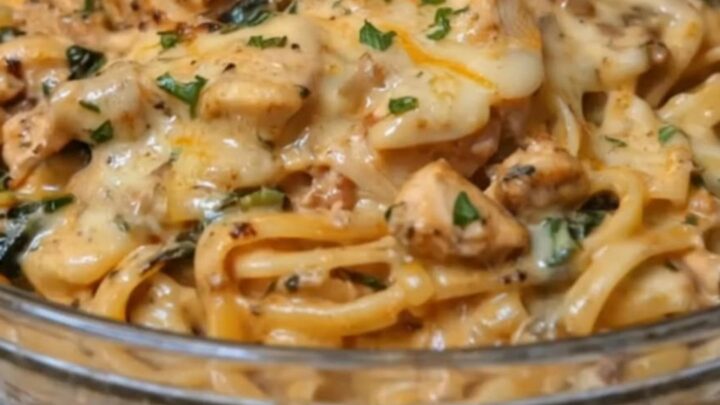
- Combine and Melt the CheeseReturn the cooked chicken and cooked linguine to the skillet. Sprinkle the shredded cheese over the top. Toss everything together over low heat for 1 to 2 minutes until the cheese is completely melted and forms glossy strings coating the pasta.Look for The cheese should be fully melted, creating long, dramatic strings when lifted.Tip If the sauce is too thick, splash in a little reserved pasta water to loosen it up.
In this final phase, the hot linguine, cooked chicken, and shredded cheese are thoroughly incorporated into the simmering sauce. The cheese melts completely, creating long, glossy, elastic strings when the pasta is lifted. The sauce should coat every single strand of linguine in a thick, uniform glaze, and there should be no pooled liquid or separated oil visible in the bottom of the skillet.
Common mistakes
One common mistake is overcrowding the skillet when searing the chicken, which causes the meat to steam in its own juices rather than developing a golden crust. Another error is boiling the heavy cream over high heat, which can cause the sauce to split or curdle; always maintain a gentle simmer.
Lastly, adding the cheese to a sauce that is boiling too rapidly can result in a grainy texture. Remove the skillet from direct high heat before tossing in the cheese to ensure a smooth melt.
How to tell it’s done
The chicken is fully cooked and safe to consume when it reaches an internal temperature of 165°F (74°C) measured with a digital meat thermometer. The linguine is perfectly done when it is al dente, meaning it is tender but still has a slight, pleasant bite in the center.
The cream sauce is finished when it coats the back of a spoon and clings tightly to the pasta, pulling into long, dramatic melted cheese strings when lifted with a fork.
- Poultry: 165°F (74°C) in the thickest part
Up next · Part 3 of 3
2 variations · storage & make-ahead · 3 answers · printable card
Tips, FAQ & printable recipe (Part 3)← Back to the ingredients (Part 1)