Dinner · Part 2 of 3: Instructions
Creamy Baked Salmon Casserole with Golden Cheese Crust Step-by-step instructions
- Prep
- Cook
- Total
- Serves
- 4
Before you start
Set the cream cheese on the counter first — softened cream cheese whisking smooth in 30 seconds is the difference between a silky sauce and a lumpy one. Shred the mozzarella and grate the Parmesan from blocks, mince the garlic, chop the dill, and measure the cream so assembly is a two-minute job.
Cut the salmon into chunks about 2 inches across, pat them thoroughly dry with paper towels, and check for pin bones while the surface is exposed. Butter the baking dish before anything else goes near it; a dry dish makes the cheesy crust stick and tear.
Ingredients at a glance (10)
- 1 1/2 lb skinless salmon fillets, cut into large chunks
- 1 tsp kosher salt, plus more to taste
- 1/2 tsp freshly ground black pepper
- 2 cloves garlic, minced
- 4 oz cream cheese, softened
- 3/4 cup heavy cream
- 1 cup shredded mozzarella
- 1/2 cup grated Parmesan
- 1 tbsp butter, for the baking dish
- 2 tbsp chopped fresh dill, plus more for serving
Instructions
Prep and sauce
- Heat the oven and butter the dishHeat the oven to 400°F (200°C) with a rack in the center. Butter a 9x13-inch baking dish all over, including the corners, so the creamy sauce never sticks and the cheese crust lifts away cleanly when scooping. Set the dish near the stove so assembly moves quickly.Look for The butter should coat the dish in a thin, even, glossy film with no dry patches.Tip Softened butter spreads faster than cold; leave it out while the oven heats.
- Season the salmon chunksPat the salmon chunks dry with paper towels, then season all over with the kosher salt and black pepper. Dry fish holds its shape and keeps the sauce from turning watery, so do not skip this step. Keep the chunks large, about 2 inches, so they stay juicy.Look for The surface of each piece should look matte and dry, not shiny or wet.Tip Check for pin bones by running a finger along each piece; pull any out with tweezers.
- Make the creamy sauceIn a mixing bowl, whisk the softened cream cheese until completely smooth, about 30 seconds. Pour in the heavy cream a little at a time, whisking until the mixture is silky and pourable, then stir in the minced garlic and half the dill. Season with a pinch of salt and taste before moving on.Look for The sauce should be smooth and thick enough to coat a spoon, with no cream cheese lumps.Tip Cold cream cheese leaves lumps; microwave it for 10 seconds to soften if needed.
By the end of this phase the oven is at 400°F (200°C), the buttered dish glistens evenly, and the sauce in the bowl looks completely smooth — thick enough to coat a spoon, glossy, with no cream cheese lumps and a visible fleck of dill and garlic throughout. The salmon chunks are dry to the touch, evenly seasoned, and free of pin bones. Taste the sauce before moving on: it should taste slightly saltier than ideal on its own, because the unseasoned fish will balance it once baked.
Assemble the casserole
- Layer the salmon in the dishArrange the seasoned salmon chunks in the buttered baking dish in a single snug layer, leaving small gaps between pieces so the sauce can flow around each one. Crowding the pieces tightly steams them unevenly, while too much space dries the edges, so aim for a comfortable fit.Look for Every piece should touch the dish bottom and sit level, not stacked or tilted.Tip Thicker tail-end pieces belong at the edges, where heat is gentler.
- Pour the sauce over the fishPour the creamy sauce evenly over the salmon, nudging it with a spatula so it settles into the gaps without washing the seasoning off the top. Leave the highest points of the fish peeking above the sauce; they will brown nicely and give the casserole texture.Look for The sauce should come about two-thirds of the way up the salmon pieces.Tip Tap the dish once on the counter to settle the sauce into every gap.
- Add the cheese crustScatter the shredded mozzarella evenly over the sauce, then finish with the grated Parmesan, concentrating it slightly in the center where browning is strongest. Keep the layer even rather than piled high, so it melts into one cohesive golden crust instead of separate blobs.Look for No sauce should show through the cheese layer before baking.Tip Grate the cheeses fresh; pre-shredded blends carry anti-caking starch that resists melting.
The assembled dish should look layered and intentional: salmon in one snug layer with narrow gaps, sauce rising about two-thirds of the way up the fish, and a full, even blanket of cheese with no sauce peeking through. Shake the dish gently — nothing should slide or shift, which would mean the sauce is thin or the layer is too deep.
The top should look dry with cheese rather than wet with cream. If sauce shows through the cheese, scatter a little more mozzarella over the bare spots before the dish goes into the oven, since exposed sauce will not brown.
Bake, check, serve
- Bake until golden and bubblingBake at 400°F (200°C) for 22 to 28 minutes, until the crust is deep golden and the sauce bubbles at the edges. For an evenly browned top, rotate the dish once halfway through. If the crust colors before the fish is done, tent it loosely with foil and keep baking.Look for Listen for gentle bubbling at the edges and watch for a uniformly bronzed crust.Tip Position the dish so the center sits over the rack, not one end, for even browning.
- Check the internal temperatureInsert an instant-read thermometer into the thickest salmon piece: it should register 145°F (63°C), the safe temperature for fish, with the flesh flaking easily at a gentle nudge. If it reads lower, return the dish to the oven for 3-minute intervals and retest until it reaches temperature.Look for The flesh should flake into large, moist petals but still hold a slight translucence at the very center.Safe temperature 145°F (63°C) internal temperature (fish)Tip Angle the thermometer into the thickest part, avoiding the cheese crust, for a true reading.
- Rest, then serveScatter the remaining fresh dill over the hot casserole and let it rest 5 minutes before scooping. The sauce thickens slightly as it stands, and the cheese crust sets enough to lift in satisfying, cheesy portions. Serve straight from the dish with a spatula, scooping down to the flaky salmon beneath.Look for After resting, the sauce should cling to a spoon rather than pool thin behind it.Tip Cool leftovers no more than 2 hours before covering and refrigerating.
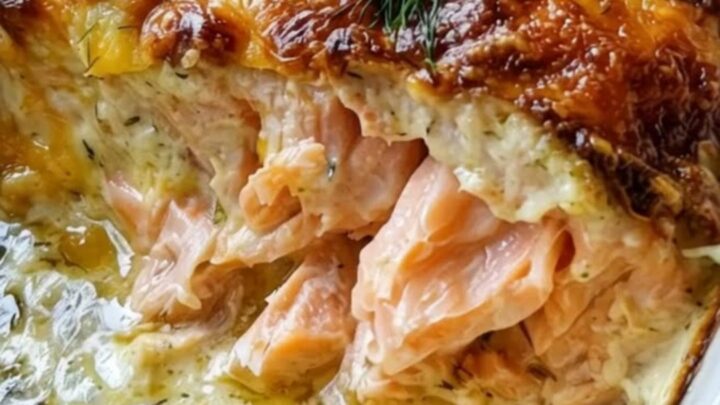
Done right, the casserole emerges deep golden and bubbling at the edges, smelling of browned cheese and cream with dill riding on top. The thermometer reads 145°F (63°C) in the thickest piece, and the flesh flakes under light pressure into large moist petals.
After 5 minutes of rest, a spatula should lift a portion cleanly, the sauce clinging rather than running, with a stretchy cheese pull as it rises. If the sauce still pools thin behind the spatula, give the dish 2 or 3 more minutes to set — a hot, freshly baked sauce always firms up faster than instinct suggests.
Common mistakes
The most common failure is watery sauce, and it almost always traces back to wet salmon or cold cream cheese. Pat the fish dry and whisk the cream cheese fully smooth before the cream goes in. The second mistake is overbaked fish, which happens when the dish stays in the oven on faith instead of a thermometer — start checking at 22 minutes and trust the 145°F reading. A third issue is a pale, rubbery crust caused by pre-shredded cheese coated in anti-caking starch; block-grated cheese solves it.
How to tell it’s done
Two signals tell the truth about this casserole, and they should arrive together. First, the crust: deep golden across the surface, darker at the edges, with sauce bubbling visibly around the rim of the dish. Second, the fish: an instant-read thermometer in the thickest chunk reads 145°F (63°C), the safe internal temperature for fish, and a gentle nudge flakes the flesh into large moist petals.
The center of a properly cooked piece may look faintly translucent between the flakes — that is cooked salmon, not undercooked salmon. If the crust browns before the fish reaches temperature, tent it with foil and continue.
- Fish: 145°F (63°C) in the thickest part
Up next · Part 3 of 3
4 variations · storage & make-ahead · 5 answers · printable card
Tips, FAQ & printable recipe (Part 3)← Back to the ingredients (Part 1)