Desserts · Part 1 of 3: Ingredients
Creamy Baked Cornmeal Custard Cake with a Golden Crust
- Prep
- Cook
- Total
- Serves
- 9
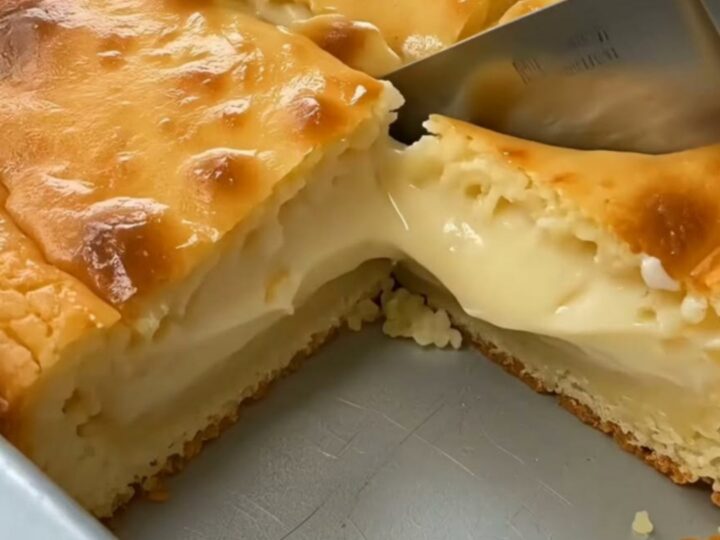
A slice lifted warm from the pan tells the whole story before the first bite: a thin golden crust giving way to a center that pools like spooned custard. This baked cornmeal cake walks the line between dessert and pudding — cornmeal for gentle texture, eggs and dairy for richness, butter for edges that turn crisp in the oven. It mixes in one bowl, bakes in about forty-five minutes, and asks for nothing more than a fork and a quiet moment at the table.
This baked cornmeal custard cake sits in a happy spot between cornbread and flan. The batter takes five minutes of whisking: eggs and sugar until pale, warm milk and cream stirred in, then cornmeal, salt and baking powder whisked straight into the same bowl. Into the oven it goes, where something quietly remarkable happens.
The cornmeal hydrates and settles, the eggs set into a genuine custard, and the buttered edges bake into a thin, crisp golden crust that holds everything together. Cut into it warm and the center yields like pudding; let it cool completely and it slices into neat, portable squares. Either way, it is a humble, old-fashioned dessert that costs little, uses pantry staples, and reliably earns second helpings from everyone at the table.
Ingredients
- 1/2 cup unsalted butter, melted, plus more for the pan
- 4 large eggs, at room temperature
- 3/4 cup granulated sugar
- 2 cups whole milk, warmed
- 1 cup heavy cream
- 2 tsp vanilla extract
- 1 cup finely ground yellow cornmeal
- 1/2 tsp kosher salt
- 2 tsp baking powder
Why this recipe works
The texture comes from a simple ratio rather than technique. Cornmeal holds about three times its weight in liquid, so the two-plus cups of warm dairy in this batter hydrate every grain during the bake instead of leaving it gritty. Meanwhile the four eggs, whisked with sugar until pale, provide exactly enough protein to set the surrounding liquid into custard at 160°F.
Because the batter contains no flour, nothing competes with that custard structure — there is no gluten network to toughen it, only cornstarch-free tenderness. The baking powder looks out of place in a custard, but its small lift keeps the crumb from compressing into a dense block as it cools.
The crust is not an accident; it is engineered by the pan. Butter brushed generously up the sides fries the outermost layer of batter as it bakes, forming a shell that behaves like a ramekin around the custard. Baking at a moderate 350°F rather than a hotter temperature lets the center climb slowly to the set point while the edges brown, so the two textures arrive together instead of one racing the other. The 15-minute rest matters just as much: custard continues to set as it cools, and the crust firms from fragile to sliceable during that window on the rack.
Notes and substitutions
Choose fine-ground yellow cornmeal, often labeled corn flour or finely milled cornmeal on the shelf. Medium and coarse grinds stay suspended, then sink and collect as a gritty layer at the bottom of the bake. Whole milk and heavy cream give the custard its body; lower-fat dairy works but produces a noticeably firmer, less silky center.
Pure vanilla extract is worth using here because there are so few flavors in the batter that anything synthetic shows immediately. Kosher salt goes further than table salt by volume; if swapping, use a scant quarter teaspoon of fine table salt instead.
An 8-inch square metal pan is the right vessel: it gives the batter enough depth for a proper custard layer while still producing a crust on all four sides. Glass runs cooler and needs several extra minutes; dark nonstick runs hot and browns the crust before the center sets.
An instant-read thermometer is the single most useful tool for this recipe, since visual cues alone cannot tell a set center from a nearly set one. For substitutions, 2% milk and half-and-half both work in place of the dairy listed, and light brown sugar can replace the granulated sugar for a deeper flavor.
- whole milk: Use 2% milk if that is what the refrigerator holds; the center will be a shade less creamy but bakes exactly the same.
- heavy cream: Half-and-half works in its place, though the custard loses some of its silky body.
- granulated sugar: Swap in an equal amount of packed light brown sugar for a deeper, almost caramel flavor and a slightly darker crust.
Equipment
- 8-inch square metal baking pan
- large mixing bowl
- small saucepan
- wire whisk
- rubber spatula
- instant-read thermometer
- thin metal spatula
- wire cooling rack
Up next · Part 2 of 3
8 steps · 45 min of cooking · what to look for at each stage
Step-by-step instructions (Part 2)