Desserts · Part 2 of 3: Instructions
Classic New York Cheesecake with Strawberry Compote Step-by-step instructions
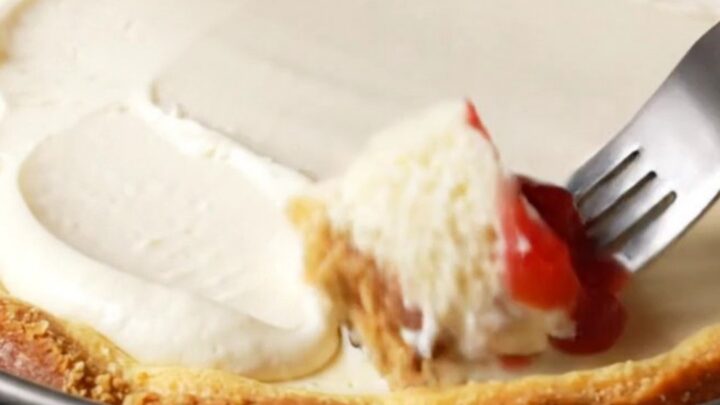
- Prep
- Cook
- Total
- Serves
- 12
Before you start
Before beginning, ensure your oven rack is positioned in the center. Bring the cream cheese, sour cream, and eggs to room temperature for at least one hour.
Prepare your springform pan by wrapping the exterior tightly with at least two layers of heavy-duty aluminum foil to create a waterproof seal.
Preheat your oven to 325 degrees Fahrenheit (163 degrees Celsius) and have a large roasting pan ready to act as the water bath vessel. Gather all ingredients and measure them accurately before starting the mixing process to ensure a smooth workflow.
Ingredients at a glance (6)
- 300 g toasted honey graham cracker crumbs
- 1 kg full-fat Philadelphia cream cheese
- 250 g granulated sugar
- 30 ml vanilla bean paste
- 200 g tangy sour cream
- 250 g sweetened sour cream topping
Instructions
Blending the Batter
- Prepare the Crust and FillingPress the toasted honey graham cracker crumbs firmly into the bottom of a foil-wrapped springform pan. In a stand mixer fitted with a paddle attachment, blend the cream cheese, sugar, vanilla bean paste, and sour cream on low speed until the mixture is perfectly smooth and combined.Look for The mixture should look creamy and uniform without any large lumps of cream cheese remaining.Tip Ensure all ingredients are at room temperature to prevent lumps in the batter.
The batter should be completely smooth, thick, and uniform. Ensure there are no streaks of sour cream or small lumps of cream cheese visible in the bowl. The consistency should resemble a heavy, velvety paste that coats the back of a spoon without dripping quickly.
Water Bath Baking
- Bake in a Water BathPour the filling over the prepared crust. Place the springform pan into a large roasting pan and add hot water to the roasting pan until it reaches halfway up the sides of the springform. Bake at 325 degrees Fahrenheit (163 degrees Celsius) for 70 minutes until the center barely wobbles.Look for The edges should be set while the center remains slightly jiggly like gelatin.Safe temperature 160°F (71°C) internal temperature (egg dishes)Tip Use multiple layers of heavy-duty foil to ensure the water bath does not leak into the crust.
The cheesecake should look set around the perimeter of the pan, with a slight golden hue. The center will have a delicate, gentle wobble. The surface should appear smooth and dry to the touch, indicating that the proteins have coagulated properly during the slow baking process.
Cooling and Topping
- Cool and FinishRemove the cheesecake from the oven and carefully lift it from the water bath. Allow it to cool completely on a wire rack. Spread the sweetened sour cream topping evenly over the surface using an offset spatula. Refrigerate for at least three hours before serving to ensure the structure is set.Look for The topping should be smooth and glossy, and the cheesecake should feel firm to the touch.Tip Run a knife around the edge of the pan after cooling to prevent cracking as it contracts.
The cheesecake must be completely cool before the sour cream topping is applied. The texture should feel firm and stable when gently pressed. The final topping should be spread into a perfectly flat, glossy layer that covers the entire surface, creating a professional-looking finish.
Common mistakes
A common mistake is over-mixing the batter, which introduces excess air. This causes the cheesecake to puff up and then sink, leading to cracks. Another error is failing to wrap the pan properly, allowing water to leak into the crust and make it soggy.
Finally, cooling the cheesecake too quickly by moving it to the refrigerator immediately after baking can cause thermal shock, which almost guarantees cracks across the surface.
How to tell it’s done
The cheesecake is done when the edges are set and slightly puffed, but the center still has a slight, uniform wobble when the pan is gently shaken. The internal temperature of the custard should reach 160 degrees Fahrenheit (71 degrees Celsius) to ensure the eggs are fully cooked.
Avoid overbaking, as this will lead to a dry texture and surface cracks. The cheesecake will continue to firm up significantly as it cools and chills in the refrigerator.
- Egg dishes: 160°F (71°C) in the thickest part
Up next · Part 3 of 3
2 variations · storage & make-ahead · 3 answers · printable card
Tips, FAQ & printable recipe (Part 3)← Back to the ingredients (Part 1)