Desserts · Part 2 of 3: Instructions
Classic Chocolate Swiss Roll with Whipped Cream Step-by-step instructions
- Prep
- Cook
- Total
- Serves
- 8
Before you start
Before beginning, ensure all components are prepared and ready for assembly. The chocolate sponge cake should be fully cooled to room temperature, as any residual heat will soften the whipped cream and cause it to lose its airy texture.
Have your parchment paper cut to size, and ensure your ganache is warmed to a pourable consistency.
Having an offset spatula and a sharp serrated knife within reach will make the process much smoother. Clear a large space on your counter for rolling and glazing, and verify that you have enough room in the refrigerator to chill the final roll if needed.
Ingredients at a glance (3)
- 1 layer chocolate sponge cake, store-bought or made ahead
- 1 cup heavy cream, whipped
- 1/2 cup chocolate ganache, warm
Instructions
Filling the Sponge
- Prepare the fillingPlace the chocolate sponge cake on a sheet of parchment paper. Spread the whipped heavy cream evenly over the surface of the cake, leaving a small border at the edges to prevent the cream from squeezing out during the rolling process.Look for The cream is spread into a smooth, even layer across the entire cake surface.Tip Ensure the cake is completely cooled before adding the whipped cream to maintain its structure.
The cake is covered with a uniform layer of whipped cream, ensuring it is spread close to the edges. The surface looks smooth and consistent, with no air pockets or thin spots that would compromise the structure of the finished roll.
Rolling the Cake
- Roll the cakeCarefully lift one edge of the parchment paper and begin rolling the sponge cake tightly. Use the parchment paper to guide the roll, ensuring it stays compact as it forms. Once rolled, wrap the parchment paper around the cake to hold its shape.Look for The cake forms a tight, uniform cylinder shape without any large gaps inside.Tip Rolling while the cake is slightly warm can prevent cracking, but the cream must be added only when fully cool.
The cake is tightly rolled into a compact cylinder. The parchment paper has been used to maintain the shape, and the roll feels firm and secure. There are no visible cracks or tears in the sponge, and the cream remains contained inside.
Glazing and Finishing
- Glaze and finishPlace the rolled cake on a cooling rack or clean surface. Pour the warm chocolate ganache over the top of the roll, allowing it to cascade down the sides naturally. To ensure the egg-based cream filling is safe, heat the ganache to 160°F (71°C) before pouring. Let the ganache set slightly before slicing and serving the finished dessert.Look for The ganache is glossy and covers the cake surface evenly with a smooth, rich finish.Safe temperature 160°F (71°C) internal temperature (egg dishes)Tip For a cleaner look, trim the ends of the roll with a sharp serrated knife before applying the final glaze.
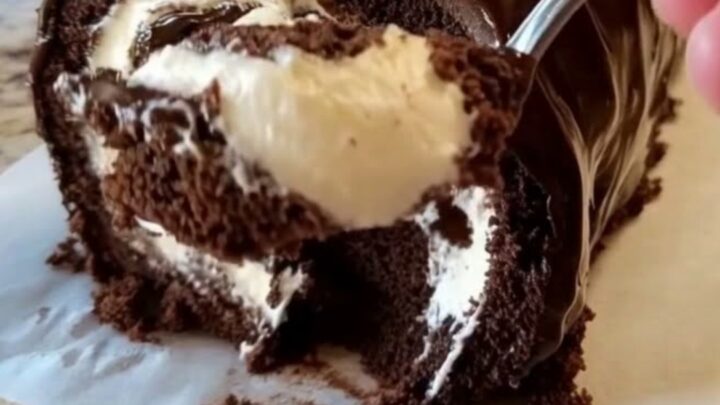
The ganache has been poured over the roll, creating a smooth, reflective coating that covers the top and sides. The glaze is set, and the roll is ready to be sliced, revealing the beautiful spiral pattern inside the sponge.
Common mistakes
Common mistakes include rolling the cake while it is still hot, which causes the cream filling to melt and lose its volume. Another error is over-whipping the cream, which can result in a grainy texture instead of a smooth, luxurious finish.
Additionally, failing to trim the ends of the roll can lead to an uneven appearance. Ensure the ganache is not too hot when pouring, as it might become too thin and drip away, failing to coat the cake effectively.
How to tell it’s done
The cake is considered done when it is firm to the touch and holds its rolled shape securely. The ganache should be set enough that it does not run off the cake entirely, providing a thick, glossy coating.
If you have any concerns about the texture, a brief chill in the refrigerator will firm up the cream and ganache, making it easier to slice cleanly. The internal structure should be consistent, with distinct layers of sponge and cream visible.
- Egg dishes: 160°F (71°C) in the thickest part
Up next · Part 3 of 3
2 variations · storage & make-ahead · 3 answers · printable card
Tips, FAQ & printable recipe (Part 3)← Back to the ingredients (Part 1)