Desserts · Part 1 of 3: Ingredients
Chocolate Wacky Cake: One-Pan, Egg-Free and Ready in an Hour
- Prep
- Cook
- Total
- Serves
- 9
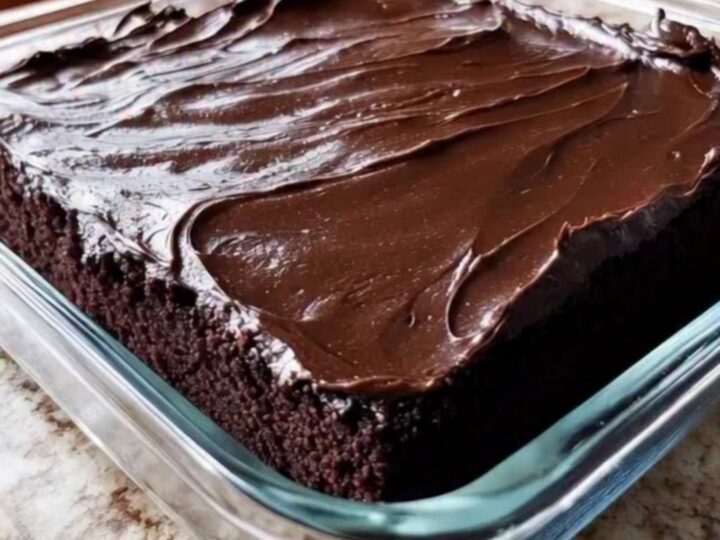
This is the chocolate cake that needs almost nothing from the pantry and even less from the cook. No eggs, no butter in the batter, no mixer, no bowls stacked in the sink: everything stirs together right in the baking dish, bakes into a deep, moist chocolate crumb, and finishes under a thick swirl of glossy fudge frosting. One pan in, one pan out, and an hour later the kitchen smells like the best kind of afternoon.
Wacky cake — sometimes called crazy cake or war cake — dates back to the lean years when eggs, butter and milk were scarce, and bakers discovered that a splash of vinegar and a spoonful of baking soda could do the work of both.
The chemistry still holds up beautifully today. Cocoa, flour and sugar are sifted straight into the baking dish, three wells are pressed into the dry mix, and water, oil, vinegar and vanilla pour in before a fork stirs everything into a thin, glossy batter.
Thirty minutes in the oven, the crumb sets tender and dark, and a quick cocoa frosting goes on thick with dramatic swirls. It is the rare cake that tastes like it took far more effort than it did, ideal for last-minute guests, bake sales or an ordinary weeknight that deserves dessert.
Ingredients
Cake
- 1 1/2 cups all-purpose flour
- 1 cup granulated sugar
- 3 tbsp unsweetened cocoa powder
- 1 tsp baking soda
- 1/2 tsp kosher salt
- 1 cup water
- 1/3 cup vegetable oil
- 1 tbsp white vinegar
- 1 tsp vanilla extract
Frosting
- 6 tbsp unsalted butter, softened
- 1/3 cup unsweetened cocoa powder
- 2 cups confectioners' sugar, sifted
- 3-4 tbsp whole milk
- 1 tsp vanilla extract
Why this recipe works
The method works because of a simple acid-base reaction. Baking soda needs an acid to release its gas, and the tablespoon of vinegar provides it the moment water hits the pan.
Because the batter is stirred quickly and goes straight into a hot oven, that lift is captured at its strongest, giving the cake a surprisingly open, tender crumb without a single egg to toughen it. Oil, rather than butter, coats the flour proteins more completely, which keeps the crumb soft for days and lets the chocolate flavor come through cleanly.
Mixing in the pan itself is not just a shortcut; it changes the texture for the better. There is no risk of overbeating, so the gluten stays relaxed and the crumb stays fine and moist.
Sifting the dry ingredients directly into the dish aerates them evenly, so the cocoa disperses without streaks and the soda finds the vinegar uniformly across the whole cake. The thin batter also self-levels in the glass dish, which is why the top bakes flat and even, ready for frosting without any trimming or fuss.
Notes and substitutions
Use natural unsweetened cocoa powder for a brighter, sharper chocolate note, or Dutch-processed for a darker, smoother one; both work here because the leavening comes from soda and vinegar rather than cocoa acidity alone. Neutral vegetable oil lets the chocolate lead, though melted coconut oil adds a faint sweetness. Whole milk in the frosting gives the cleanest, glossiest finish, but any plain unsweetened milk alternative spreads just as well.
An 8x8-inch square glass baking dish is the classic vessel and the one shown here; it heats gently and lets the thin batter self-level. If the only dish is dark metal, lower the oven to 325°F (165°C) and start checking five minutes early. A fine-mesh sieve does the sifting, an offset spatula builds the swirls, and a simple hand mixer handles the frosting — no stand mixer required anywhere in this recipe.
- white vinegar: Apple cider vinegar or fresh lemon juice works the same way, reacting with the baking soda to lift the cake.
- vegetable oil: Any neutral oil such as canola, sunflower or melted coconut oil keeps the crumb moist without adding flavor.
- whole milk: Heavy cream thinned with a little water, or a plain unsweetened soy or oat milk, loosens the frosting to a spreadable consistency.
- unsweetened cocoa powder: Dutch-processed cocoa gives a darker color and a smoother, less sharp chocolate flavor in both the cake and the frosting.
Equipment
- 8x8-inch square glass baking dish
- fine-mesh sieve
- whisk
- measuring cups and spoons
- electric hand mixer
- offset spatula
- wire cooling rack
- serrated knife
Up next · Part 2 of 3
10 steps · 30 min of cooking · what to look for at each stage
Step-by-step instructions (Part 2)