Dinner · Part 2 of 3: Instructions
Cheesy Funeral Potatoes with Crispy Cornflake Topping Step-by-step instructions
- Prep
- Cook
- Total
- Serves
- 10
Before you start
Get everything staged before the bowl comes out, because assembly moves fast. Thaw the hashbrowns completely — overnight in the refrigerator is easiest — then press them in a colander or blot with paper towels to remove surface moisture.
Grate the cheddar from a block, slice the green onions, and measure the sour cream, soup and butter. Set out the greasing butter or nonstick spray, the 9x13-inch dish, a large mixing bowl, a small bowl for the topping, and a zip-top bag with a rolling pin for the cornflakes.
Ingredients at a glance (8)
- 2 lb frozen diced hashbrowns, thawed
- 1 cup sour cream
- 1 cup cream of chicken soup
- 4 tbsp unsalted butter, melted
- 2 1/2 cups sharp cheddar, grated
- 1/3 cup sliced green onions
- 3 cups cornflakes, lightly crushed
- 3 tbsp salted butter, melted
Instructions
Prep and oven setup
- Heat the oven and prep the dishSet a rack in the center of the oven and heat it to 350°F (175°C). Butter a 9x13-inch baking dish lightly, or spray it with nonstick spray. Thawed hashbrowns hold a lot of moisture, so press them gently in a colander or with paper towels to wick away excess liquid — a drier base means a creamier, not watery, sauce.Look for The oven reads 350°F on the dial or thermometer, and the hashbrowns feel cool and dry rather than icy or wet.Tip Thaw the hashbrowns in the refrigerator overnight; a quick microwave thaw works too, but blot them well afterward.
- Crush the cornflakesPut the cornflakes in a zip-top bag and crush them with a rolling pin or the bottom of a measuring cup until you have a mix of small flakes and coarse crumbs — not powder. Some texture is what makes the topping crackle. Tip them into a small bowl and keep them dry until assembly.Look for The flakes are broken into pieces roughly the size of oats, with no fine flour-like dust at the bottom of the bag.Tip Crush by hand or with a rolling pin, never in a food processor; blades turn flakes into dust that burns before it crisps.
By the end of the prep phase, the oven has held 350°F (175°C) for several minutes, the buttered dish waits ready, and the cornflakes sit crushed in their bag — coarse, irregular pieces ranging from oat-sized flakes to small crumbs, with no fine dust. The hashbrowns are fully thawed, cool to the touch, and noticeably drier than when they came out of the bag: press a paper towel against them and it should come away nearly clean. Nothing is mixed yet, and that is fine — this phase is pure setup.
Mix and fill the dish
- Build the creamy potato baseIn a large bowl, combine the sour cream, cream of chicken soup, and melted butter and stir until completely smooth. Add the grated sharp cheddar, sliced green onions, a good pinch of salt and a few grinds of black pepper, and stir again so the cheese is evenly distributed before the potatoes go in.Look for The sauce is thick, pale and uniform, with cheddar flecks spread throughout and no streaks of plain sour cream.Tip Grate the cheddar yourself from a block; pre-shredded cheese is coated with starch and melts less smoothly into the sauce.
- Fold in the hashbrownsAdd the thawed, blotted hashbrowns to the bowl and fold with a rubber spatula until every piece is coated in the creamy cheddar sauce. Work gently so the potatoes keep their shape, but be thorough — a dry pocket of hashbrowns will bake up bland. Scrape the bottom of the bowl to catch any uncoated potatoes.Look for No plain white potatoes peek through; the whole mixture looks coated and moundable, holding together loosely on the spatula.Tip Fold in two additions rather than all at once; it coats the potatoes evenly with far less stirring.
- Fill the dishSpoon the potato mixture into the prepared baking dish and spread it into an even layer with the spatula, reaching into the corners. Smooth the top so the cornflake crust sits level and toasts uniformly. An even layer also bakes at the same rate edge to center, so no corner stays cool.Look for The surface is level and even, and the dish looks filled to about the same depth across its whole length.Tip Press very lightly with the spatula to compact the surface just enough for the topping to cling.
The mixed base should look thick, pale-gold and completely uniform — sour cream, soup and melted butter stirred into one smooth sauce, with orange cheddar shreds and green onion slices distributed evenly throughout rather than clumped.
Folded in, the hashbrowns should be fully coated, with no plain white potato showing anywhere and no puddle of loose sauce at the bottom of the bowl; when lifted on the spatula, the mixture should mound and hold loosely. Spread in the dish, the surface should be level from corner to corner, about the same depth everywhere, with the top smoothed just enough for the crust to cling.
Top, bake and rest
- Butter the cornflake toppingPour the melted salted butter over the crushed cornflakes and toss with a fork until every piece glistens. The butter is what turns the flakes from merely toasted to deep golden and audibly crisp, so take a moment to coat them evenly rather than pooling the butter in one spot.Look for Each flake looks glossy and separate, not soggy or clumped into buttery lumps at the bottom of the bowl.Tip Toss with a fork rather than a spoon; it separates flakes instead of crushing them further.
- Top and bake until bubblingScatter the buttered cornflakes evenly over the potatoes, covering the surface edge to edge. Bake at 350°F (175°C) for about 40 minutes, until the cheese sauce bubbles vigorously up through the crust, the cornflakes are deep golden brown, and the center reaches 165°F (74°C) on an instant-read thermometer. If the topping colors too fast, lay a sheet of foil loosely over the dish for the last 10 minutes.Look for Bubbles of cheese sauce break through the crust at the edges and center, and the cornflakes are golden brown, not pale.Safe temperature 165°F (74°C) internal temperature (poultry)Tip Set the dish on a rimmed baking sheet to catch any bubbling overflow and make carrying it to the table easier.
- Rest, then serve hotLet the casserole rest on a wire rack for about 10 minutes before scooping. The sauce thickens slightly as it settles, so portions hold together and the crust stays crisp instead of steaming under a loose spoonful. Serve straight from the dish, hot, breaking through the cornflake canopy at the table.Look for The sauce no longer bubbles actively, the edges pull slightly from the dish, and a spoonful holds its shape.Tip Leftovers cool for no more than 2 hours on the counter before going into the refrigerator.
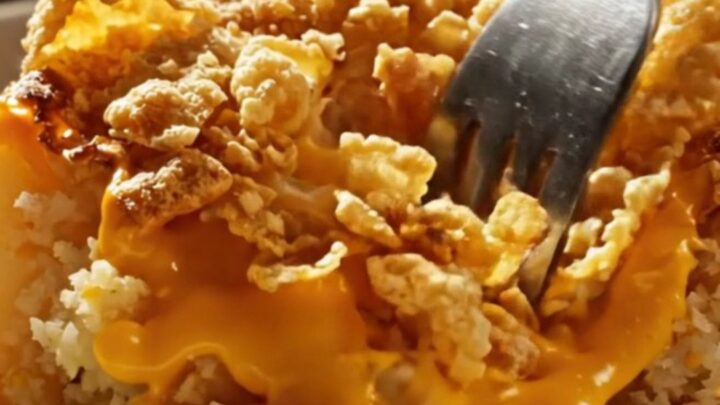
Out of the oven, the casserole should be actively bubbling — thick cheese sauce breaking through the crust at the edges and center — with a cornflake topping that is deep golden brown and visibly buttered, darker at the rim. The smell is toasty, buttery and savory, with no scorched note.
After the 10-minute rest, the bubbling stops, the edges pull slightly from the dish, and a spoonful holds its shape with a creamy, tender interior rather than running loose. Break into the crust with a fork: it should crackle loudly and stay attached to the layer beneath instead of sliding off.
Common mistakes
The most common failure is a watery base, and it almost always traces back to hashbrowns that went into the dish still cold, icy or unblotted — thaw them fully and squeeze out the meltwater. The second mistake is crushing the cornflakes too fine; powder burns before it crisps, so aim for coarse flakes and crumbs. Third, skimping on the topping butter: uncoated flakes toast unevenly and stay pale and chewy instead of shattering.
How to tell it’s done
The casserole is done when three signs line up. First, the cheese sauce bubbles vigorously up through the cornflake crust at the edges and the center — slow, thick blisters, not just a shimmer of steam. Second, the topping is deep golden brown across its whole surface, with darker edges and no pale, butter-logged patches.
Third, an instant-read thermometer in the center reads 165°F (74°C), and a knife inserted there meets no resistance; the potatoes should be tender all the way through, never chalky or cool in the middle.
- Poultry: 165°F (74°C) in the thickest part
Up next · Part 3 of 3
4 variations · storage & make-ahead · 5 answers · printable card
Tips, FAQ & printable recipe (Part 3)← Back to the ingredients (Part 1)