Breakfast · Part 1 of 3: Ingredients
Blistered Sourdough Boule with Crackling Crust
- Prep
- Cook
- Total
- Serves
- 10
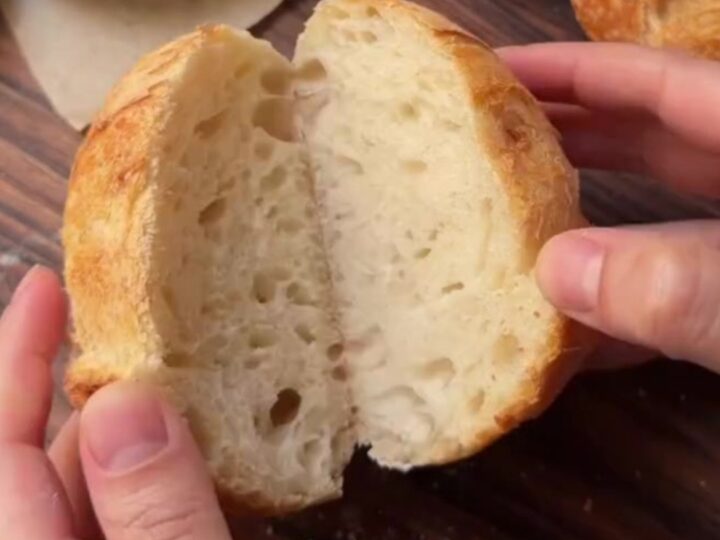
That first slice into a blistered sourdough boule—hear the crust shatter and see the steam rise. This recipe builds a crackling, caramelized crust and an airy, open crumb with just four ingredients and a hot Dutch oven. The method is straightforward: mix a shaggy dough, let it ferment with a few folds, shape it, and bake it covered then uncovered. The result is a bakery-worthy loaf that fills the kitchen with that unmistakable sourdough aroma.
This blistered sourdough boule is the bread to bake when you want a dramatic, crackling crust and a tender, open crumb. The video shows the essentials: a bubbly starter, bread flour, water, and salt, mixed into a shaggy dough, then shaped and baked in a screaming-hot Dutch oven.
The high heat and trapped steam create that deep golden, blistering crust that shatters when you slice it. The interior stays moist and airy, perfect for slathering with butter. The process takes time, but the hands-on work is minimal—mostly waiting and letting the dough do its thing. The payoff is a loaf that looks and tastes like it came from a professional bakery.
Ingredients
- 100 g active bubbly sourdough starter
- 350 g warm water
- 500 g bread flour
- 10 g sea salt
for serving
- salted butter, softened, for serving
Why this recipe works
The combination of a hot Dutch oven and a covered bake creates a steamy environment that keeps the crust supple while the bread expands. This steam is what allows the dough to rise fully in the oven, producing a light, open crumb with large irregular holes.
Once the lid comes off, the remaining moisture evaporates, and the crust turns deep brown and blistered. The high heat also caramelizes the sugars in the flour, adding a subtle sweetness and that satisfying crackle.
The long, cold proof in the refrigerator develops flavor and makes the dough easier to handle. During this time, enzymes break down starches and proteins, creating a more complex taste and a better structure.
The cold dough also holds its shape better when scored, allowing the blade to create a clean cut that opens into a dramatic 'ear.' The result is a loaf with a shattering crust, a chewy crumb, and a tangy, well-rounded sourdough flavor.
Notes and substitutions
The success of this bread hinges on an active, bubbly sourdough starter. It should be recently fed and doubled in volume before you mix the dough. If your starter is sluggish, the bread will be dense and less flavorful. Bread flour provides the necessary gluten strength for a tall, open crumb, though all-purpose flour can be substituted with slightly less rise. Use warm water, not hot, to wake up the starter without killing it.
A Dutch oven is essential for creating the steamy environment that gives this bread its blistered crust. Any heavy pot with a tight-fitting lid works, such as a cast-iron or enameled cast-iron Dutch oven.
A razor blade or a very sharp knife is crucial for scoring; a dull blade will drag and deflate the dough. Parchment paper makes transferring the dough easy and prevents sticking. A proofing basket is optional—a bowl lined with a floured towel works just as well.
- bread flour: All-purpose flour can be used, though the crumb will be slightly less open and the crust a bit less crackly.
- sea salt: Kosher salt works well; use the same weight, not volume, for accurate seasoning.
- active sourdough starter: A bubbly, recently fed starter is essential; a sluggish starter will yield a denser loaf.
- salted butter: Unsalted butter with a pinch of flaky salt on top is equally delicious.
Equipment
- Large mixing bowl
- Dutch oven with lid
- Parchment paper
- Razor blade or sharp knife
- Kitchen towel
- Cooling rack
Up next · Part 2 of 3
8 steps · 45 min of cooking · what to look for at each stage
Step-by-step instructions (Part 2)