Dinner · Part 2 of 3: Instructions
Biang Biang Noodles with Sizzling Chili Oil in 40 Minutes Step-by-step instructions
- Prep
- Cook
- Total
- Serves
- 2
Before you start
Before touching the dough, set up the whole station: a large pot of water on for later, a small saucepan for the oil, a heatproof serving bowl, tongs, and a cutting board for the aromatics.
Mince the garlic, slice the scallions, grind the Sichuan peppercorns, and measure the cumin and chili flakes into one bowl while the dough rests, because the final pour moves fast and there is no time to chop once the oil starts smoking.
Ingredients at a glance (13)
- 2 cups all-purpose flour, plus more for dusting
- 3/4 cup warm water
- 1/2 tsp kosher salt
- 2 tbsp vegetable oil, for the dough
- 4 baby bok choy, halved
- 1 tbsp ground cumin
- 2 tbsp crushed red pepper flakes
- 1 tsp Sichuan peppercorns, finely ground
- 4 cloves garlic, minced
- 3 scallions, thinly sliced
- 1/4 cup canola oil (60 ml), heated to 400°F
- 3 tbsp Chinkiang black vinegar
- 3 tbsp soy sauce
Instructions
Phase 1: Build and rest the dough
- Mix the noodle doughStir the kosher salt into the warm water until dissolved. Put the flour in a large mixing bowl, pour in the salted water a little at a time, and mix with chopsticks or a wooden spoon until shaggy clumps form. Press the clumps together into a rough, stiff ball with your hands, adding a spoonful of water only if dry crumbs remain.Look for The dough should look shaggy and feel stiff, with no loose dry flour left in the bowl.Tip Biang Biang dough is stiffer than pasta dough; resist adding extra water early, since it hydrates as it kneads.
- Knead until smoothKnead the dough on the counter for 8 to 10 minutes, folding the far edge over and pushing away with the heel of your hand. It starts rough and resistant, then turns smooth and slightly elastic. Shape it into a log, brush all over with the vegetable oil, and wrap it tightly in plastic or cover the bowl.Look for The surface turns smooth and matte, and the dough springs back slowly when poked.Tip A short rest halfway through kneading relaxes the gluten and makes the second half far easier.
- Rest the doughLet the oiled, covered dough rest at room temperature for 30 minutes. The pause relaxes the gluten so the belts stretch long and wide instead of snapping back. While it rests, mince the garlic, slice the scallions, grind the Sichuan peppercorns, and measure the cumin and chili flakes into one small bowl so the sizzle step moves fast.Look for After resting, the dough dents easily when pressed and no longer fights when stretched.Tip Keep the dough covered the entire time; a dried surface will tear when pulled.
At the end of this phase the dough is a smooth, oiled ball that has rested a full 30 minutes and dents easily under a fingertip without springing back hard.
The toppings are prepped and staged: garlic minced, scallions sliced, spices measured into one bowl, bok choy halved and rinsed. Check the dough by lifting the edge of the cover; the surface should look slightly glossy from the oil, never dry or cracked.
Phase 2: Pull and boil the belts
- Portion and flatten the doughCut the rested log into 4 equal pieces. Working one piece at a time and keeping the others covered, roll each into a thick cigar about 4 inches long, then flatten it into a wide oval with your palms and a rolling pin, about 1/4 inch thick. Press a chopstick firmly down the center to mark a fold line.Look for Each oval should be wide and even, with the center crease clearly visible.Tip Dust lightly with flour only if sticking; too much flour makes the surfaces slip while pulling.
- Pull and slap the beltsHold an oval at both ends, stretch it gently outward, then slap it down against the counter once or twice so it lengthens. Continue pulling and slapping until you have a ribbon 2 inches wide and roughly 2 feet long, then tear it down the center crease or leave it whole. The slap is what gives the noodle its signature bounce.Look for The belt stretches thin and even, glistening slightly, without tearing at the edges.Tip Stretch between slaps, never all at once; gravity and momentum do most of the work.
- Boil noodles and bok choyBring a large pot of water to a rolling boil. Drop in the pulled noodles one by one and stir so they do not stick; they cook in 2 to 3 minutes and float when done. Add the halved bok choy for the final minute, then lift everything out with a spider and transfer straight to a heatproof serving bowl, shaking off excess water.Look for The noodles turn glossy and translucent at the edges and float to the surface.Tip Boil in two batches if the pot feels crowded; noodles need room to move.
This phase ends with every belt boiled and the bok choy blanched, all piled into the heatproof serving bowl and still steaming. The noodles should be wide, even ribbons with a glossy, elastic look, floating within 2 to 3 minutes of entering the water.
Taste one: it should bounce back when chewed, with no raw, chalky core. If any belt is thicker than a pencil in the middle, it needs another 30 seconds in the pot.
Phase 3: Sizzle, season and serve
- Mound the spices on topScatter the cumin, chili flakes, ground Sichuan peppercorns, minced garlic and sliced scallions evenly over the hot noodles, piling them in the center so the oil will hit them all at once. Keep the pile compact; a wide, thin scattering blooms unevenly and can scorch at the edges of the bowl.Look for The spice mound sits centered and damp-looking on the steaming noodles.Tip Do this while the noodles are still dripping hot; the steam keeps the garlic from catching.
- Heat the oil to smokingPour the canola oil into a small saucepan and heat over medium-high until it shimmers, thins out and just begins to smoke, about 400°F (205°C), 3 to 4 minutes. Work at the stove with the serving bowl nearby, because the pour must happen the moment the oil is ready for the boldest bloom.Look for Wisps of smoke rise and the oil ripples instantly when the pan is tilted.Tip Use a small, deep pan; it pours in a clean, controlled stream with no drips.
- Pour the sizzleStand back slightly and pour the smoking oil in a slow, steady stream directly over the spice mound. It will crackle violently and bloom into a deep red, fragrant chili oil in seconds. Let the sizzling settle for about 15 seconds before touching the bowl, and tilt it once so every noodle glistens.Look for Loud crackling, a rising cloud of spice-scented steam and bubbling red oil.Tip Pour across the center of the mound, not one spot, so all the spices bloom evenly.
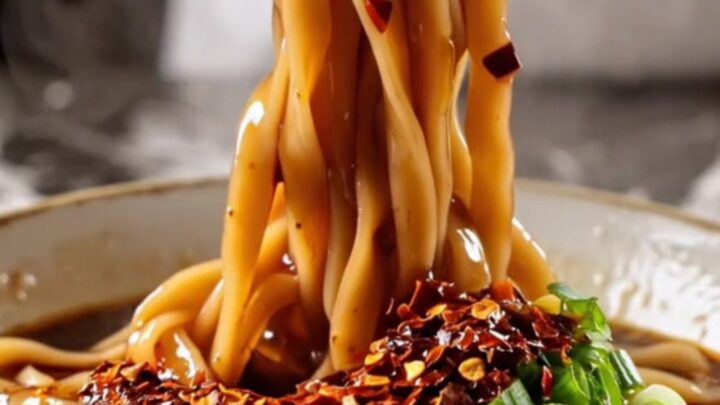
- Season, toss and serveDrizzle the black vinegar and soy sauce down the sides of the bowl, then toss everything with tongs or chopsticks until every wide belt is coated in glossy red oil. Serve immediately, twirling the noodles high with chopsticks while the steam is still rising and the bok choy is bright green.Look for Each belt shines evenly, the bok choy stays crisp-tender, and the aroma is smoky and tangy.Tip Toss from the bottom up so the vinegar and soy pool evenly instead of sitting at the base.
The final phase is the fastest and loudest. The oil should have been visibly smoking when poured, and the spices should have crackled violently and turned a deep, even red within seconds.
After the sizzle settles, the vinegar and soy go down the sides, and a quick toss leaves every belt uniformly coated and glossy, with the bok choy bright green against the red oil.
Common mistakes
The most common failure is a dough that snaps back: it was not rested long enough, or its surface dried out while waiting. Keep it covered at every moment and give it the full 30 minutes. Tearing belts usually means stretching too fast; pull a little, slap, then pull again, letting momentum do the work.
How to tell it’s done
The noodles are done when they float to the surface of the boiling water and turn glossy, with a translucent edge and a firm, elastic bite, usually 2 to 3 minutes after they go in. The bok choy is ready when the leaves are wilted and bright green but the white stems still resist slightly.
Up next · Part 3 of 3
4 variations · storage & make-ahead · 5 answers · printable card
Tips, FAQ & printable recipe (Part 3)← Back to the ingredients (Part 1)