Dinner · Part 2 of 3: Instructions
Quick Italian Piadina with Squacquerone and Prosciutto Step-by-step instructions
- Prep
- Cook
- Total
- Serves
- 4
Before you start
Before starting, take the squacquerone cheese out of the refrigerator so it can soften. Measure the flour, salt, and lard. Have warm water ready.
Clear a work surface and dust it with flour. Prepare a clean kitchen towel to cover the cooked piadine. Set up your griddle or skillet so it can preheat while you roll the dough.
Ingredients at a glance (7)
- 2 cups all-purpose flour, plus more for dusting
- 1/4 cup lard or shortening, at room temperature
- 1 tsp fine salt
- 3/4 cup warm water
- 8 oz squacquerone cheese or soft creamy cheese like stracchino or crescenza
- 4 oz prosciutto crudo, thinly sliced
- 2 cups wild arugula, washed and dried
Instructions
Make and Rest the Dough
- Make the DoughIn a large bowl, combine the flour, salt, and lard. Rub the lard into the flour with your fingertips until the mixture looks like coarse crumbs. Pour in the warm water and stir with a fork until a shaggy dough forms. Turn the dough out onto a lightly floured surface and knead for about 5 minutes, until smooth and elastic. Cover with a damp towel and let rest for 30 minutes.Look for The dough should be soft and slightly tacky but not sticky.Tip If the dough feels dry, add a teaspoon of water at a time.
- Divide and Roll the DoughDivide the dough into 4 equal pieces. On a lightly floured surface, roll each piece into a thin round about 8 inches in diameter and about 1/8 inch thick. Keep the unrolled pieces covered while working.Look for The rounds should be thin enough to see your hand through them.Tip Roll from the center outward, rotating the dough as you go.
The dough should be smooth and elastic after kneading, with a soft, slightly tacky texture. After resting, it will be easier to roll. The kitchen will smell of fresh bread and lard, a warm and inviting aroma. The dough should not stick to your hands or the work surface when rolled.
Cook the Flatbreads
- Cook the PiadinaHeat a cast-iron griddle or flat skillet over medium-high heat until a drop of water sizzles and evaporates immediately. Place one rolled dough round on the hot surface and cook for 1 to 2 minutes, until bubbles form and the bottom is blistered with golden spots. Flip and cook the other side for another minute. Transfer to a plate and cover with a clean towel while cooking the remaining rounds.Look for The flatbread should puff slightly and have charred spots.Tip Do not overcrowd the pan; cook one at a time.
- Warm the CheeseWhile the last piadina is still on the griddle, spread a quarter of the squacquerone cheese over the hot surface. Let it melt for about 30 seconds, until it becomes creamy and starts to blister.Look for The cheese should be melted and bubbling.Tip If the cheese doesn't melt, cover the pan for a few seconds.
The piadine should be puffed and blistered with golden spots, and they should look like rustic flatbreads from a street market.
The surface will be slightly charred in places, and the aroma will be toasty and rich. They should be pliable, not crispy, and each one will take only a few minutes to cook.
Fill and Fold
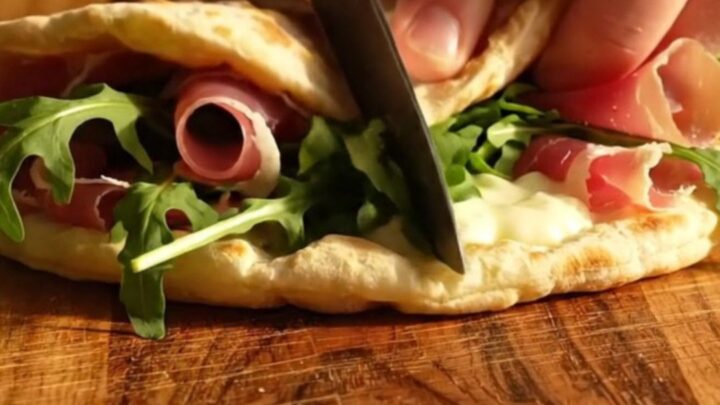
- Assemble the PiadinaRemove the piadina from the griddle and place it on a cutting board. Pile a quarter of the prosciutto and a handful of arugula on one half of the flatbread. Fold the other half over to form a half-moon. Slice in half crosswise and serve immediately.Look for The cheese should be oozing out slightly.Tip Serve right away while the cheese is warm and the arugula is crisp.
The cheese should be melted and creamy, spreading easily over the hot bread. The prosciutto should be slightly warmed by the residual heat, and the arugula should be crisp and fresh. When folded, the piadina forms a neat half-moon. Slicing it in half reveals the layers of cheese, meat, and greens.
Common mistakes
One common mistake is rolling the dough too thick, which makes the piadina doughy and undercooked in the center. Another is cooking at too low a heat, which dries out the bread before it blisters. Be sure to preheat the griddle well.
Also, don't overload the filling — a thin layer of cheese and a few slices of prosciutto are enough. Overfilling makes folding messy and can tear the bread. Finally, serve the piadina warm; it loses its charm when it cools.
How to tell it’s done
The piadina is done when it is puffed and blistered with golden-brown spots on both sides. The cheese should be fully melted and creamy when spread. The prosciutto and arugula are added fresh, so they don't need cooking.
The flatbread should be soft and pliable, not crackly. If you want to check the temperature, the center of the cheese should be at least 165°F (74°C) for food safety, but since the cheese is not a raw protein, it's more about texture. Serve immediately.
Up next · Part 3 of 3
4 variations · storage & make-ahead · 5 answers · printable card
Tips, FAQ & printable recipe (Part 3)← Back to the ingredients (Part 1)