Dinner · Part 2 of 3: Instructions
Apple Cider Honey Hickory Baby Back Ribs: Slow-Cooker Fall-Off-the-Bone Step-by-step instructions
- Prep
- Cook
- Total
- Serves
- 6
Before you start
Before you start, pat the ribs dry with paper towels and, if desired, remove the thin membrane from the back of each rack. This helps the seasoning and sauce penetrate the meat. Core and slice the apples into 1/4-inch-thick wedges; no need to peel them.
Measure the apple cider and barbecue sauce so everything is ready to dump into the slow cooker. Have a 6-quart or larger slow cooker on hand — the ribs should fit in a single layer as much as possible.
Ingredients at a glance (4)
- 4 lb pork baby back ribs
- 2 Honeycrisp apples, cored and sliced
- 1 cup unfiltered apple cider
- 1 1/2 cups honey hickory barbecue sauce
Instructions
Layer and Sauce
- Layer the Ribs and ApplesPlace the pork baby back ribs in the bottom of a 6-quart slow cooker, arranging them side by side so they fit in a single layer as much as possible. Scatter the sliced Honeycrisp apples over the ribs, then pour the unfiltered apple cider around the edges of the pot, avoiding washing the apples off the meat.Look for The ribs should be nestled together with apples mounded on top and cider pooling around the sides.Tip If the ribs are too long, cut the racks in half to fit comfortably in the slow cooker.
- Add the Barbecue SauceSqueeze the honey hickory barbecue sauce generously over the entire surface of the ribs and apples, using a spoon or spatula to spread it evenly. Make sure every rib is coated with sauce, but do not stir the contents of the slow cooker.Look for The top of the meat and apples should be completely covered in a thick layer of barbecue sauce.Tip For extra coverage, turn the ribs once to coat both sides with sauce before layering.
The slow cooker should contain a single layer of ribs, topped with apple slices, with cider pooled around the edges and a thick blanket of barbecue sauce covering everything. The sauce may look thick and uneven, but it will melt into a braising liquid as the slow cooker heats. The apples should be mounded over the meat, not packed underneath, so they soften and meld into the sauce rather than turning to mush.
Slow Cook
- Slow-Cook Until TenderCover the slow cooker and cook on LOW for 6 to 8 hours, or on HIGH for 3 to 4 hours, until the meat is fork-tender and easily pulls away from the bone. The internal temperature of the pork should read at least 145°F (63°C) in the thickest part, but for fall-off-the-bone texture, cook until the meat is very tender. Let it rest for 3 minutes before slicing.Look for The sauce will be bubbling, the apples soft and caramelized, and the meat will have pulled back from the bone ends.Safe temperature 145°F (63°C) internal temperature (steaks, chops and roasts)Tip Avoid opening the lid during cooking; each peek lets out steam and adds 20 minutes of cooking time.
After 6 to 8 hours on LOW, the kitchen will smell like sweet barbecue and baked apples. The sauce will have thinned and then thickened again, bubbling gently around the edges.
The apples will have collapsed into a soft, caramelized mass, and the meat will have shrunk back from the bone ends. A fork inserted into the thickest part should twist easily with no resistance. The liquid should be glossy and deeply browned.
Broil and Rest
- Finish Under the BroilerPreheat the broiler. Using tongs, carefully transfer the ribs to a baking sheet lined with foil. Spoon some of the cooking liquid and apples over the top. Broil 3 to 4 minutes until the sauce is sticky and caramelized in spots. Let the ribs rest at least 3 minutes before serving.Look for The surface of the ribs should be glossy and lightly charred in places.Safe temperature 145°F (63°C) internal temperature (steaks, chops and roasts)Tip Watch the ribs closely under the broiler; sugar in the sauce can burn quickly.
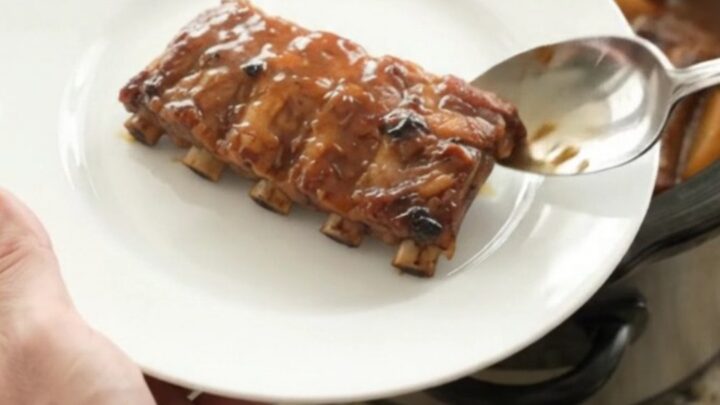
After broiling, the ribs should have a sticky, caramelized surface with a few darker spots from the high heat. The meat will be glistening and tender, and the apples will be soft and jammy. Let the ribs rest for at least 3 minutes before serving; this allows the juices to redistribute so the meat stays moist. The sauce should cling to the ribs rather than pooling on the plate.
Common mistakes
One common mistake is lifting the lid to check on the ribs too often, which releases heat and extends cooking time. Another is using a barbecue sauce with too much sugar, which can burn or turn bitter during the long cook; if your sauce is very sweet, reduce the amount or dilute with a little cider.
Also, don't skip removing the membrane — it can make the ribs tough and chewy. Finally, resist the urge to stir the pot; stirring can break up the meat and apples into mush.
How to tell it’s done
The ribs are done when the meat is fork-tender and has pulled back from the ends of the bones, exposing about 1/4 inch of bone. A fork should slide into the thickest part of the meat with almost no resistance.
For food safety, the internal temperature must reach at least 145°F (63°C), but for fall-off-the-bone texture, you'll likely cook well beyond that. If the meat still clings to the bone, continue cooking in 30-minute increments until it yields easily.
- Steaks, chops and roasts: 145°F (63°C) in the thickest part, then a 3-minute rest
Up next · Part 3 of 3
4 variations · storage & make-ahead · 5 answers · printable card
Tips, FAQ & printable recipe (Part 3)← Back to the ingredients (Part 1)