Desserts · Part 2 of 3: Instructions
Whole Lemon Cake with Citrus Glaze Step-by-step instructions
- Prep
- Cook
- Total
- Serves
- 8
Before you start
Before you begin, make sure you have all the ingredients at room temperature, especially the eggs and milk—this helps them emulsify smoothly with the oil. Preheat the oven and line your loaf pan with parchment paper.
Wash the lemon thoroughly, even if it's organic, to remove any dirt or residue. Cut it into wedges, removing any seeds you find. Having a blender, a large mixing bowl, a whisk, and a spatula ready will make the process seamless. The glaze ingredients can be measured out while the cake bakes.
Ingredients at a glance (10)
- 1 whole seeded organic lemon, cut into wedges
- 3 large eggs
- 1 cup granulated sugar (200g)
- 1/2 cup milk (100ml)
- 1/2 cup vegetable oil (100ml)
- 2 cups all-purpose flour
- 10 g baking powder
- 1 tsp vanilla extract
- 1 cup powdered sugar
- 2 tbsp fresh lemon juice
Instructions
Blend and Mix
- Blend the citrus basePreheat the oven to 350°F (175°C). Line a 9x5-inch loaf pan with parchment paper, leaving some overhang on the long sides for easy lifting. Cut the whole seeded organic lemon into wedges. Place the lemon wedges, eggs, sugar, milk, and oil in a blender. Blend on high until completely smooth, about 30 seconds. The mixture will be pale yellow and slightly frothy.Look for The mixture is smooth and no large lemon pieces remain.Tip Use a ripe, thin-skinned lemon for the best flavor and less bitterness.
- Whisk the dry ingredientsPour the blended citrus mixture into a large mixing bowl. Sift the all-purpose flour and baking powder over the wet mixture. Add the vanilla extract. Gently whisk until just combined, being careful not to overmix. The batter should be smooth and thick, with a ribbon-like consistency when the whisk is lifted.Look for The batter is thick and falls in a ribbon from the whisk.Tip Sifting the flour ensures a lump-free batter and a tender crumb.
- Transfer to the panPour the batter into the prepared loaf pan. Smooth the top with a spatula, making sure the batter is evenly distributed. Tap the pan gently on the counter a few times to release any air bubbles.Look for The batter is level and the pan is about three-quarters full.Tip Tapping the pan helps prevent large air pockets in the baked cake.
At the end of this phase, you should have a smooth, pale yellow liquid with a frothy top. The dry ingredients are sifted in and whisked until the batter is thick and ribbon-like.
The batter should be uniform in color, with no streaks of flour. The lemon pieces are completely broken down, and the mixture smells bright and citrusy. The batter is ready to pour into the prepared pan.
Bake and Cool
- Bake the cakePlace the loaf pan in the preheated oven and bake for 42 minutes, or until the top is golden brown and a toothpick inserted into the center comes out clean. The cake will rise and crack down the center, which is characteristic of this loaf. If the top browns too quickly, tent loosely with foil for the last 10 minutes.Look for The cake is tall, cracked, and golden; a toothpick comes out clean.Safe temperature 160°F (71°C) internal temperature (egg dishes)Tip Rotate the pan halfway through baking for even browning.
- Cool the cakeRemove the cake from the oven and let it cool in the pan for 10 minutes. Then, using the parchment overhang, lift the cake out of the pan and transfer to a wire rack. Let it cool completely, about 1 hour, before glazing.Look for The cake is firm and has pulled slightly away from the pan sides.Tip Cooling completely prevents the glaze from melting into the cake.
The cake will rise in the oven, developing a golden-brown top that cracks in the center. The aroma of baking lemon fills the kitchen. After cooling, the cake should be firm to the touch and easily lift out of the pan. A toothpick inserted comes out clean. The cake is now ready to be glazed.
Glaze and Finish
- Make the glazeIn a small bowl, whisk together the powdered sugar and fresh lemon juice until smooth. The glaze should be thick but pourable, similar to heavy cream. If it is too thick, add a few drops of lemon juice; if too thin, add a little more powdered sugar.Look for The glaze is smooth, white, and coats the back of a spoon.Tip For a thicker glaze, use less lemon juice; for a thinner one, add more.
- Glaze the cakePlace the cooled cake on a serving plate. Drizzle the glaze generously over the top, letting it cascade down the sides. Use a spoon or piping bag to create decorative zigzag lines, if desired. Let the glaze set for about 10 minutes before slicing.Look for The glaze is opaque and drips down the sides of the cake.Tip For a neat finish, glaze the cake on a wire rack set over a baking sheet.
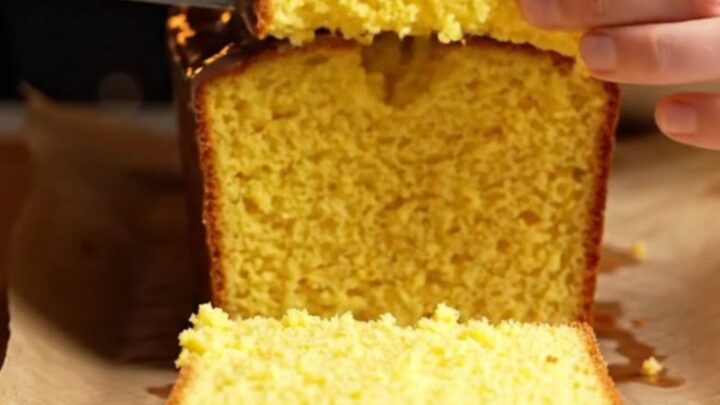
- Slice and serveSlice the cake with a serrated knife into thick slices. Press down gently on a slice to show the moist, fragrant crumb. Serve at room temperature, with the glaze adding a sweet-tart contrast to the tender cake.Look for The crumb is moist and yellow, with a fragrant lemon aroma.Tip Use a serrated knife to cut clean slices without tearing the crumb.
The glaze is smooth and white, with a pourable consistency. When drizzled over the cake, it flows down the sides, creating an opaque, glossy coating. The glaze sets slightly, becoming firm but not hard. The cake is ready to be sliced, revealing a moist, yellow crumb with a fragrant citrus aroma.
Common mistakes
One common mistake is overmixing the batter after adding the flour, which can develop too much gluten and result in a tough, dense cake. Mix only until the flour is incorporated—a few lumps are fine. Another pitfall is not blending the lemon enough, leaving chunks that can be bitter and unpleasant.
Blend until the mixture is completely smooth. Also, be sure to use a pan that is not too small; if the batter overflows, the cake will be misshapen. Finally, don't skip the cooling time before glazing, or the glaze will melt into the cake.
How to tell it’s done
The cake is done when a toothpick inserted into the center comes out clean, with no wet batter clinging to it. The top should be deep golden brown and may have a natural crack down the middle.
The internal temperature of the cake should reach at least 200°F (93°C) for a fully baked crumb. If you gently press the top, it should spring back. Let the cake cool completely before glazing to ensure the glaze sets properly.
- Egg dishes: 160°F (71°C) in the thickest part
Up next · Part 3 of 3
4 variations · storage & make-ahead · 5 answers · printable card
Tips, FAQ & printable recipe (Part 3)← Back to the ingredients (Part 1)