Desserts · Part 2 of 3: Instructions
Warm Baked Tahini Halva Skillet with Lemon: Turkish Fırın Helva Step-by-step instructions
- Prep
- Cook
- Total
- Serves
- 4
Before you start
Before starting, preheat the oven to 400°F (200°C). Gather all ingredients: plain tahini halva, whole milk, unsalted butter, lemon, and walnuts. Crush the walnuts if needed, and melt the butter. Have a small clay baking dish or ramekin ready.
The prep is quick, so everything should be at hand before mixing. If the halva is very firm, let it soften at room temperature for a few minutes. This recipe comes together in minutes, so organization helps the process go smoothly.
Ingredients at a glance (6)
- 10 1/2 oz plain tahini halva, crumbled
- 1/2 cup whole milk
- 2 tbsp unsalted butter, melted
- 1 tbsp fresh lemon juice
- 1 tsp lemon zest
- 1/4 cup crushed roasted walnuts
Instructions
Crumble and Mix
- Crumble the HalvaCrumble the tahini halva into a mixing bowl. Use your fingers or a fork to break it into fine crumbs. The halva should be in small, even pieces so it blends smoothly with the milk and butter.Look for The halva is crumbly and sandy, with no large lumps.Tip If the halva is very firm, let it sit at room temperature for a few minutes before crumbling.
- Add Milk, Butter, and LemonPour the warm milk, melted butter, lemon juice, and lemon zest over the crumbled halva. Stir with a fork until everything is well combined and the mixture forms a thick, smooth, velvety paste.Look for The mixture is thick, glossy, and uniform, with no dry patches.Tip Warm the milk slightly before adding to help the halva soften faster.
- Transfer to Baking DishSpoon the halva mixture into a small clay baking dish (güveç) or a ramekin. Smooth the top with the back of a spoon so it bakes evenly.Look for The dish is filled evenly, with a smooth surface.Tip Choose a dish that holds the mixture snugly; a wider dish gives more caramelized surface.
At the end of phase 1, the halva should be crumbled into fine pieces and mixed with the milk, butter, and lemon until it forms a thick, smooth, velvety paste. The mixture should be uniform, with no dry patches of halva.
It will look like a thick batter or a soft dough. The lemon zest should be evenly distributed, and the aroma of sesame and citrus should be fragrant. The mixture should easily spoon into the baking dish.
Bake and Caramelize
- Bake Until CaramelizedPlace the dish in a preheated oven at 400°F (200°C) and bake for 10 minutes, until the top is caramelized, blistered, and golden brown with dark spots. The edges should be bubbling and slightly crispy.Look for The top is deeply golden with blistered spots and the edges are bubbling.Tip Every oven is different; start checking at 8 minutes if your oven runs hot.
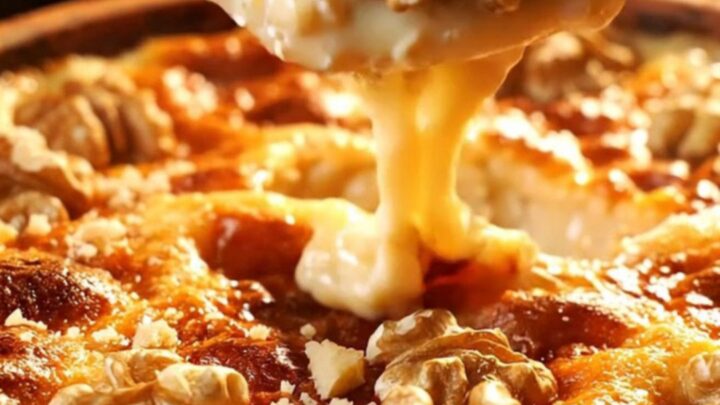
After baking, the top should be golden brown with darker blistered spots, and the edges should be bubbling with caramelized bits. The kitchen will smell of toasted sesame and butter. The surface should be crisp to the touch, while the center remains soft and creamy. If the top is not browned enough after 10 minutes, leave it for another 2 minutes, watching carefully to avoid burning.
Garnish and Serve
- Scatter Walnuts and ServeRemove the dish from the oven and immediately scatter the crushed roasted walnuts over the bubbling surface. Let it sit for a minute or two, then scoop out warm spoonfuls while the dessert is still bubbling and hot.Look for The walnuts cling to the caramelized top, and steam rises as you scoop.Tip Serve right away for the best texture contrast between the crisp top and creamy interior.
Once the walnuts are scattered over the hot surface, they should stick to the caramelized top. The dessert should be bubbling and steaming as it is served. Scoop out warm spoonfuls, ensuring each serving has some crispy top and creamy interior. The walnuts add a crunchy contrast, and the lemon aroma should come through. Serve immediately while hot.
Common mistakes
A common mistake is overmixing the halva and milk into a completely smooth paste; a few small lumps are fine and add texture. Another is using a dish that is too large, which makes the layer too thin and the halva dry out.
Conversely, a dish that is too small will make the center undercooked. Also, do not skip the lemon — it balances the sweetness and brightens the flavor. Finally, do not overbake; the top should caramelize, but the center must remain creamy.
How to tell it’s done
The fırın helva is done when the top is deeply golden brown with blistered spots and the edges are bubbling. The center should look set but still moist and creamy.
If using a thermometer, the internal temperature should be at least 160°F (71°C), though this is a dessert without eggs, so it is mainly about texture. The top should be crisp to the touch, and the filling should be hot and molten. Remove from the oven and let it rest for a minute before serving.
Up next · Part 3 of 3
4 variations · storage & make-ahead · 5 answers · printable card
Tips, FAQ & printable recipe (Part 3)← Back to the ingredients (Part 1)