Breakfast · Part 1 of 3: Ingredients
Ultra-Jiggly Japanese Soufflé Pancakes
- Prep
- Cook
- Total
- Serves
- 2
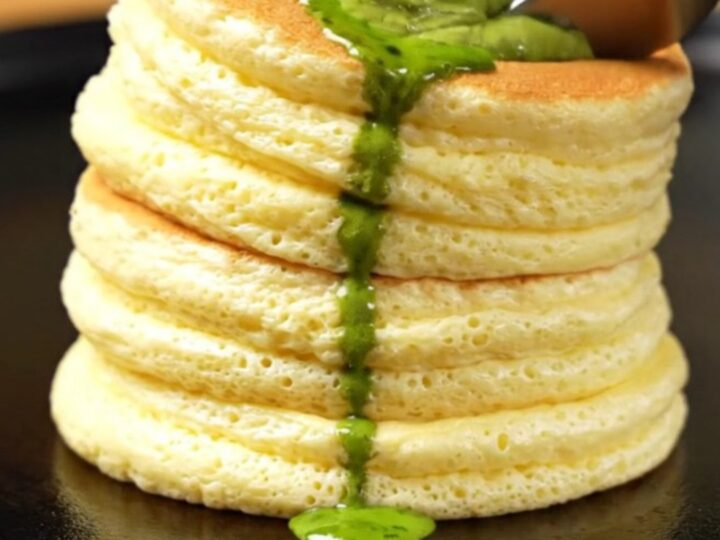
Imagine cutting into a pancake that is impossibly tall, golden, and quivering like a custard. These Japanese soufflé pancakes are exactly that: a cloud-soft interior with a delicate crust, steamed on a griddle until they reach towering heights.
The recipe uses a simple meringue method to create a batter that puffs up dramatically, and the gentle steam keeps the center moist and tender. Topped with a melting quenelle of whipped matcha butter and warm maple syrup, each bite is a warm, pillowy dream.
Japanese soufflé pancakes have taken the breakfast world by storm, and for good reason. They are ethereally light, with a texture that is part soufflé, part pancake, and wholly delightful. This recipe breaks down the process into simple, foolproof steps: a silky yolk base, a glossy meringue, and a gentle steam-cook on a griddle.
The result is a pancake that jiggles when you tap it, yet is fully cooked through. Serve them warm with whipped matcha butter and maple syrup for a café-style treat at home. Whether for a weekend brunch or a special breakfast, these pancakes are sure to impress.
Ingredients
- 2 large egg yolks
- 20 ml whole milk
- 35 g cake flour
- 3 large egg whites
- 25 g caster sugar
- 10 ml water
Topping
- whipped matcha butter, for serving
- warm maple syrup, for serving
Why this recipe works
The secret to these pancakes lies in the meringue. Whipping the egg whites with caster sugar to stiff, glossy peaks creates a stable foam that traps air. When folded into the yolk mixture, this air expands during cooking, causing the pancakes to rise dramatically. The sugar also helps stabilize the meringue, so it holds its shape long enough to set on the griddle.
Steam is the second key. Cooking the pancakes covered with a little water creates a humid environment that cooks the batter gently and evenly. This steam sets the exterior while keeping the interior moist and tender, preventing the center from becoming dense or dry. The result is a pancake that is golden on the outside and cloud-like within.
Notes and substitutions
Cake flour is essential for the lightest texture, as it has lower protein than all-purpose flour, resulting in less gluten development. If you only have all-purpose flour, you can substitute with a mix of all-purpose and cornstarch.
Caster sugar, which is finer than granulated sugar, dissolves more easily into the egg whites, creating a smoother meringue. Regular granulated sugar works in a pinch but may yield a slightly less glossy meringue.
A sturdy electric mixer is important for whipping the egg whites to stiff peaks. A hand mixer works well, but a stand mixer is even more convenient.
Use a large nonstick skillet or an electric griddle with a lid; if your skillet lacks a lid, use a baking sheet or another skillet to cover. A kitchen thermometer is useful for checking the griddle temperature and the internal temperature of the pancakes.
- cake flour: All-purpose flour: use 30 g all-purpose flour plus 5 g cornstarch, sifted together. The texture will be slightly less tender.
- caster sugar: Granulated sugar: pulse in a food processor for a few seconds to make it finer, or use as is; the meringue may be slightly less stable.
- whole milk: 2% or skim milk: the batter will be a touch thinner, so fold gently and cook as directed.
- whipped matcha butter: Whipped regular butter or a dollop of whipped cream: the flavor will be different but still delicious.
Equipment
- Electric griddle or large nonstick skillet
- Stand mixer or hand mixer
- Rubber spatula
- Mixing bowls
- Lid for the skillet or griddle
- Offset spatula
- Kitchen thermometer
Up next · Part 2 of 3
7 steps · 12 min of cooking · what to look for at each stage
Step-by-step instructions (Part 2)