Desserts · Part 2 of 3: Instructions
Earthy Uji Matcha Crème Brûlée with a Shattering Sugar Crust Step-by-step instructions
- Prep
- Cook
- Total
- Serves
- 6
Before you start
Before beginning, ensure that all your ingredients are at room temperature to allow for easier mixing. Prepare your water bath by preheating your oven to 300°F (149°C) and boiling a kettle of water.
Have your ramekins clean and dry, and ensure you have a fine mesh sieve ready to sift your matcha.
Clear a space in your refrigerator for the ramekins to chill after they have finished baking, as they will need at least four hours to set completely before the final caramelization step.
Ingredients at a glance (5)
- 18 g ceremonial grade matcha powder, sifted
- 500 ml heavy cream
- 5 large egg yolks
- 90 g caster sugar
- 6 tbsp superfine sugar
Instructions
Mixing the matcha custard
- Prepare the custard baseSift the ceremonial matcha into a large bowl to ensure there are no lumps. Gradually whisk in the heavy cream, caster sugar, and egg yolks until the mixture is completely smooth and vibrant green. Ensure the ingredients are fully incorporated without creating excess foam on the surface of the custard mixture.Look for The mixture should be a uniform, vibrant jade green color with no visible matcha clumps remaining.Tip Sifting the matcha is essential for a silky texture.
The mixture should be perfectly smooth, vibrant green, and free of any foam or matcha lumps. Ensure the sugar is fully dissolved into the cream and egg yolk mixture before pouring into the ramekins for the best final texture and color consistency.
Baking the custards
- Bake in a water bathPour the custard mixture into ramekins. Place the ramekins in a deep baking pan and add hot water to the pan until it reaches halfway up the sides of the ramekins. Bake at 300°F (149°C) for 40 minutes until the centers are set but still have a slight wobble. Once cooked to 160°F (71°C), remove from the oven and allow to cool before chilling.Look for The custard should be just set at the edges but retain a gentle, uniform wobble when the ramekin is nudged.Safe temperature 160°F (71°C) internal temperature (egg dishes)Tip The water bath prevents the custard from curdling.
The custards are ready when they have reached 160°F (71°C) and show a gentle, consistent wobble. They should look opaque and set at the edges. Remove them from the water bath carefully to avoid splashing water into the ramekins, as this will affect the surface.
Chilling and caramelizing
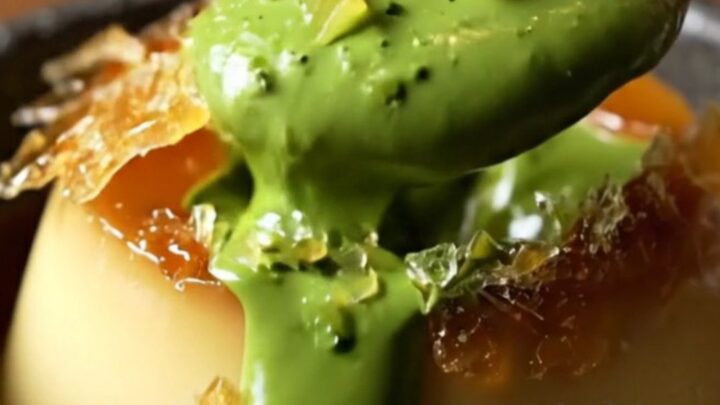
- Chill and caramelizeChill the ramekins in the refrigerator for at least 4 hours to firm up. Just before serving, sprinkle a thin, even layer of superfine sugar over the top of each chilled custard. Use a kitchen torch to melt and caramelize the sugar until it forms a hard, golden-brown amber glass crust.Look for The sugar should bubble and turn a deep amber color, hardening instantly into a glass-like shell.Tip Work quickly with the torch to avoid heating the custard underneath.
The custard must be completely cold, having chilled for at least 4 hours. When torching, the sugar should transform from a granulated layer into a smooth, liquid amber sheet that hardens almost immediately into a brittle, glass-like topping ready for service.
Common mistakes
A common mistake is failing to sift the matcha, which leads to lumps that settle at the bottom of the ramekins. Another error is neglecting the water bath, which causes the custard to cook too quickly and curdle.
Avoid using too much sugar on the top; a thin, even layer is crucial for achieving a glass-like crust. If the layer is too thick, it will remain chewy rather than shattering, and you will likely overheat the custard while trying to melt the sugar.
How to tell it’s done
The custard is done when it reaches an internal temperature of 160°F (71°C) and appears set around the edges while maintaining a slight, uniform wobble in the center when gently shaken.
Do not overbake, as the eggs will continue to firm up slightly while they cool. Once chilled, the custard should be firm enough to hold its shape when lifted with a spoon, while the sugar topping should be hard and sound brittle when tapped with a metal spoon.
- Egg dishes: 160°F (71°C) in the thickest part
Up next · Part 3 of 3
2 variations · storage & make-ahead · 3 answers · printable card
Tips, FAQ & printable recipe (Part 3)← Back to the ingredients (Part 1)