Breakfast · Part 2 of 3: Instructions
Turkey Sausage, Apple and Cheddar Breakfast Strata (Make-Ahead) Step-by-step instructions
- Prep
- Cook
- Total
- Serves
- 8
Before you start
Before assembling, get every component within arm's reach of the baking dish. Cube the sourdough into even 1-inch pieces — uneven cubes soak at different rates and bake unevenly. Have the cooked turkey sausage crumbles measured and ready, then dice the apple last so the pieces stay bright.
Crack the eggs into a large bowl and measure the milk, but whisk them together just before pouring so the custard stays smooth. Shred the cheddar if it is not already shredded; pre-shredded cheese is fine, though a block grated on the large holes melts a little more smoothly.
Ingredients at a glance (6)
- 8 cups sourdough bread cubes, day-old, cut into 1-inch pieces
- 12 oz cooked turkey sausage, crumbled
- 1 large apple, peeled if preferred and diced
- 8 large eggs, beaten
- 2 cups whole milk
- 2 cups shredded sharp cheddar
Instructions
Build the base layer
- Heat the oven and set up the dishSet a rack in the center of the oven and heat it to 350°F (175°C). Have a 9x13-inch ceramic or glass baking dish ready on the counter. A dish this size gives the strata enough depth to soak evenly while still leaving room for the top to puff and brown.Look for The oven is fully preheated and the dish sits ready within easy reach of the cutting board.Tip Position the rack early so the dish bakes in the middle, where the top browns without the edges drying out.
- Layer the bread and sausageCut the sourdough into 1-inch cubes, leaving the crusts on for texture, and scatter them across the baking dish. Distribute the cooked crumbled turkey sausage evenly over the bread so every square picks up some savory pieces as it bakes. Press the layer down gently with your hands to settle it into an even bed.Look for The bread and sausage form one fairly level layer that reaches every corner of the dish.Tip Day-old bread absorbs the custard better than fresh; if the loaf is soft, dry the cubes in a 300°F oven for 10 minutes.
- Scatter the diced appleDice the apple into small, even pieces, about half an inch, and drop them over the bread and sausage. Tuck the pieces down between the cubes so they stay moist as they bake rather than drying out on the surface. Aim for an even scatter so sweetness shows up in every slice.Look for Apple pieces are spread edge to edge, mostly nestled into the bread layer rather than sitting on top.Tip A firm, tart apple holds its shape in the bake; a very soft variety will melt into the custard.
At the end of this phase, the baking dish holds a level bed of sourdough cubes with turkey sausage crumbles distributed evenly through it and diced apple tucked down between the pieces. Nothing should be piled in one spot; the surface should look varied but even, like a patchwork of bread, meat and fruit.
Press the layers down gently so the dish is settled and there are no tall peaks at the edges. If the apple pieces are still sitting on top, push them into the gaps — exposed fruit dries out in the oven while buried fruit steams soft and sweet.
Custard and cheese on top
- Whisk the egg custardCrack the eggs into a large mixing bowl and beat them until the yolks and whites are fully combined and the mixture looks uniform and slightly frothy. Pour in the whole milk and whisk again until the custard is smooth and one pale, even color, with no streaks of white or yolk left.Look for The custard is completely smooth, pale gold, and flows in a thin, even stream off the whisk.Tip Whisk thoroughly but stop short of whipping in a lot of air; large bubbles can make the bake uneven.
- Pour the custard over the layersPour the egg-and-milk custard slowly and evenly over the bread, sausage and apple, working from the center outward so every corner is reached. Press the bread down gently with a spatula so the cubes sink and start drinking in the custard. Give the dish a moment for any dry pockets on top to soak.Look for All the bread is moistened and a shallow pool of custard sits on the surface before it sinks in.Tip Pour in two passes with a short pause between them; the bread drinks the second half more slowly and evenly.
- Top with cheddar and let it soakPile the shredded sharp cheddar evenly over the top, covering the bread from edge to edge. Let the assembled dish rest at room temperature for 10 minutes so the cubes absorb the custard, or cover and refrigerate it overnight for a deeper soak. Either way, the bread should look saturated, not dry.Look for The surface is fully covered in cheese and the bread underneath looks moist and swollen.Tip Covering the top completely helps the cheese shield the bread and brown into one connected, golden crust.
This phase ends with the dish transformed. The custard has been poured slowly and evenly, and after a gentle press with a spatula the bread looks swollen and saturated, no pale dry cubes floating on the surface. A brief pause after pouring lets any remaining pockets drink before the cheese goes on. The shredded cheddar covers the entire top in an even layer, reaching the corners, with no bread visible through it. The overall look is a full, heavy dish with a neat, uniform lid of cheese.
Bake, rest and serve
- Bake until puffed and setBake on the center rack for 45 to 50 minutes, until the strata is puffed, deep golden on top and bubbling at the edges. Check the internal temperature in the middle of the dish: the eggs are safely cooked through at 160°F (74°C). If the top browns early, tent it loosely with foil for the last stretch.Look for The center is puffed and set, the top is deep gold, and bubbles break slowly at the edges.Safe temperature 160°F (71°C) internal temperature (egg dishes)Tip Rotate the dish once halfway through baking if the oven runs hot at the back.
- Rest, then slice and serveTake the dish from the oven and let the strata rest for 10 minutes before cutting. The custard finishes setting as it stands, so the squares hold clean edges instead of slumping. Cut into eight squares, lift each one out with a spatula, and serve while the cheddar on top is still glossy and warm.Look for A knife or spatula comes out clean between squares, and each piece keeps its layered shape.Tip Resting is not optional here; those 10 minutes are the difference between tidy squares and a collapsed scoop.
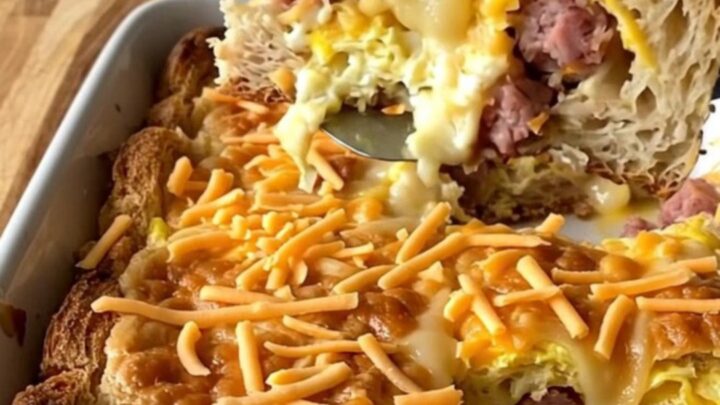
Out of the oven, the strata is puffed well above the rim, deep golden on top with the cheese bubbling at the edges. The center reads 160°F (74°C) on an instant-read thermometer, confirming the eggs are cooked through.
After a 10-minute rest the dome settles slightly and the custard finishes setting, so a spatula cuts clean squares that hold their layers of bread, sausage, apple and melted cheddar. The edges offer crisp, browned bread; the middle is tender and creamy. Serve the squares straight from the dish while the cheese is still glossy.
Common mistakes
The most common misstep is rushing the soak. Bread that has only skimmed the custard bakes into a dry layer with a wet gap underneath, so give the dish its 10-minute rest — or the overnight rest if the schedule allows. The second mistake is uneven layering: sausage and apple dumped in clumps leave some slices all bread and others all filling, so take a moment to scatter each ingredient edge to edge. Under-seasoning the custard is easy to do; eggs and milk need salt or the whole dish tastes flat.
How to tell it’s done
The strata is done when three signals agree. First, the top: deep golden across the whole surface, with the cheese melted into one connected, glossy layer and bubbles breaking slowly at the edges of the dish. Second, the shape: the center should be puffed and hold its dome, with no wet-looking or sunken patches in the middle.
Third, and most reliably, the temperature: insert an instant-read thermometer into the center of the dish, and look for 160°F (74°C), the temperature at which the eggs are fully cooked through. The custard should feel set but tender, yielding like a firm bread pudding rather than a dry quiche.
- Egg dishes: 160°F (71°C) in the thickest part
Up next · Part 3 of 3
4 variations · storage & make-ahead · 5 answers · printable card
Tips, FAQ & printable recipe (Part 3)← Back to the ingredients (Part 1)