Desserts · Part 2 of 3: Instructions
Triple Chocolate Mousse Cake for Elegant Dessert Parties Step-by-step instructions
- Prep
- Cook
- Total
- Serves
- 8
Before you start
Before beginning the assembly, ensure all components are prepared and at the correct temperature. The sponge should be fully cooled, and the mousses should be at a spreadable consistency but not runny.
Prepare the springform pan by lining the bottom and sides with parchment paper to allow for easy unmolding. Verify that there is enough space in the refrigerator for the cake to sit perfectly level during the chilling process, as any tilt could compromise the symmetry of the layers.
Ingredients at a glance (6)
- 1 layer chocolate sponge cake, store-bought or made ahead
- 2 cups white chocolate mousse, prepared
- 2 cups milk chocolate mousse, prepared
- 1/2 cup dark chocolate glaze
- 1 cup whipped cream
- 2 tbsp chocolate curls
Instructions
Base and White Mousse
- Layering the basePlace the prepared chocolate sponge cake layer at the bottom of an 8-inch springform pan. Spread the white chocolate mousse evenly over the sponge, smoothing the top with an offset spatula to create an even surface for the next layer.Look for Surface is smooth and levelTip Ensure the sponge is completely cool before adding the mousse to prevent melting.
The first layer of white chocolate mousse should be spread evenly to the edges of the pan. Check that the surface is perfectly flat and free of large air pockets before proceeding to the next layer. The sponge should remain securely at the bottom of the pan throughout the spreading process.
Milk Chocolate Layering
- Adding milk chocolate mousseCarefully spread the milk chocolate mousse over the set white chocolate layer. Use an offset spatula to ensure the edges meet the sides of the pan cleanly. Chill the cake for at least 4 hours to allow the layers to set properly.Look for Mousse feels firm to the touchTip Tap the pan gently on the counter to remove any trapped air bubbles.
The milk chocolate mousse must be added carefully to avoid disturbing the white layer beneath. Ensure the top surface is smoothed with an offset spatula, creating a level foundation for the final glaze.
The cake should now look uniform in height and ready for the extended chilling period required for setting.
Glazing and Final Presentation
- Glazing and decoratingPour the dark chocolate glaze over the chilled cake, tilting the pan to ensure full coverage. Once the glaze is set, pipe rosettes of whipped cream around the perimeter and top with chocolate curls before serving.Look for Glaze is glossy and setSafe temperature 160°F (71°C) internal temperature (egg dishes)Tip Use a warm, dry knife for clean slices through the chocolate layers.
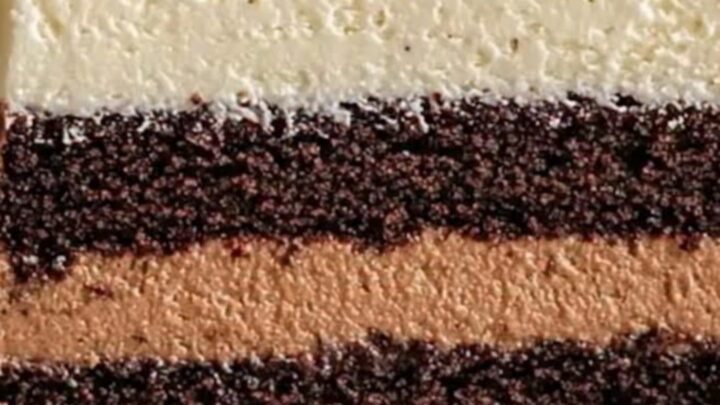
The final glaze should be smooth, shiny, and completely opaque. Verify that the glaze has stopped dripping before applying the whipped cream rosettes. The finished cake should look professional, with clear, defined layers visible from the side and a pristine, glossy top surface that reflects light evenly.
Common mistakes
A common mistake is failing to allow enough time for the mousse to set between layers, which can lead to the layers bleeding into one another. Another frequent error is using a sponge that is too warm, which will melt the mousse and ruin the airy texture.
Ensure the glaze is cooled to room temperature before pouring; if it is too hot, it will melt the top layer of mousse and ruin the smooth, glossy finish of the cake.
How to tell it’s done
The cake is considered done when the mousse layers are firm to the touch and hold their shape when the springform ring is removed. The glaze should be set and glossy, showing no signs of running or pooling at the base.
A warm knife will glide through the layers cleanly, revealing the distinct white, milk, and sponge sections. The internal temperature of the egg-based components should be handled according to safety guidelines, ensuring the finished mousse is stable and firm.
- Egg dishes: 160°F (71°C) in the thickest part
Up next · Part 3 of 3
2 variations · storage & make-ahead · 3 answers · printable card
Tips, FAQ & printable recipe (Part 3)← Back to the ingredients (Part 1)