Desserts · Part 2 of 3: Instructions
Matilda-Style Triple Chocolate Fudge Cake: Ultra-Moist Step-by-step instructions
- Prep
- Cook
- Total
- Serves
- 12
Before you start
Before starting, measure all ingredients and bring the eggs and buttermilk to room temperature for a smoother batter. Preheat the oven to 300°F (150°C) and position a rack in the center. Grease two 9-inch round cake pans with butter and dust with cocoa powder or flour, tapping out the excess.
Set up a cooling rack. For the frosting, chop the dark chocolate into small, uniform pieces and cube the butter so they melt evenly. Have the sour cream at room temperature to prevent the frosting from seizing. Prepare a serving plate or cake stand.
Ingredients at a glance (10)
- 2 cups all-purpose flour
- 2 cups granulated sugar
- 1 cup Dutch-processed cocoa powder
- 1 cup buttermilk
- 1/2 cup vegetable oil
- 2 large eggs
- 1 cup boiling espresso
- 12 oz dark chocolate, chopped
- 1/2 cup unsalted butter, cubed
- 1/2 cup sour cream
Instructions
Batter and Bake
- Make the Ultra-Liquid BatterHeat the oven to 300°F (150°C). Grease and flour two 9-inch round cake pans. In a large bowl, whisk together the flour, sugar, and Dutch cocoa. Add the buttermilk, vegetable oil, and eggs, and beat with an electric mixer on medium speed until smooth, about 2 minutes. With the mixer on low, slowly stream in the boiling espresso. The batter will be very thin and glossy; scrape the sides and whisk by hand to ensure everything is incorporated.Look for The batter is loose and shiny, with no lumps of cocoa or flour.Tip Boiling espresso intensifies the chocolate flavor and helps bloom the cocoa.
- Divide and Level the BatterDivide the batter evenly between the prepared pans. Tap each pan on the counter a few times to release air bubbles. The batter will be very thin, so level it gently with a spatula. Place both pans on the center rack of the oven, leaving space between them for air to circulate.Look for The pans are about two-thirds full; the batter is even and smooth.Tip Use a kitchen scale to divide the batter for perfectly even layers.
The batter is thin, glossy, and dark, with a strong chocolate aroma. After baking, the cakes are flat, moist, and spring back lightly. A toothpick inserted in the center comes out with a few moist crumbs. The edges are slightly pulled away from the pan, and the kitchen smells intensely of chocolate and coffee. The cakes should be completely cool before moving to the next phase.
Frosting and Assembly
- Bake at Low Temperature for Zero DomeBake the cakes at 300°F (150°C) for 35 minutes, or until a toothpick inserted into the center comes out with a few moist crumbs. The low temperature prevents a dome from forming, giving you flat, even layers. Let the cakes cool in the pans on a wire rack for 15 minutes, then turn them out onto the rack to cool completely. The cakes will be very moist and tender.Look for The tops are flat and spring back lightly when touched.Safe temperature 160°F (71°C) internal temperature (egg dishes)Tip Do not overbake; the center should be just set, not dry.
- Cool the Layers CompletelyAllow the cakes to cool completely on the wire rack, about 30 minutes. Do not frost warm cakes, as the frosting will melt and slide off. If the cakes have any slight domes, level them with a serrated knife. The layers should be cool to the touch and firm enough to handle.Look for The cakes are room temperature, with no residual warmth in the center.Tip Wrap the cooled layers in plastic wrap and refrigerate for 20 minutes for easier frosting.
The frosting is thick, glossy, and spreadable, with a shiny surface. It holds its shape when lifted with a spatula. The assembled cake is fully covered, with a smooth top and sides.
The frosting has a rich, dark color and a velvety texture. The cake looks towering and inviting, with no bare spots. The frosting should set slightly at room temperature, but remain soft and luscious.
Final Shine
- Make the Sour Cream Fudge FrostingIn a medium saucepan, melt the dark chocolate and butter over low heat, stirring constantly, until smooth. Remove from heat and let cool for 5 minutes. Whisk in the sour cream until the frosting is glossy and thick. It should be spreadable but not runny. If it becomes too thick, add a splash of warm water or milk.Look for The frosting is shiny, thick, and holds its shape on a spoon.Tip Use high-quality dark chocolate (60-70% cacao) for the best flavor.
- Assemble the Cake LayersPlace one cake layer on a serving plate or cake stand. Spread a generous amount of the fudge frosting over the top, about 1/2 cup, and smooth it with an offset spatula. Place the second layer on top, flat side up. Press gently to adhere. Spread the remaining frosting over the top and sides of the cake, creating a thick, glossy coating. Use a bench scraper for smooth sides if desired.Look for The cake is fully covered with a thick layer of glossy fudge.Tip For a professional look, use a turntable and an offset spatula.
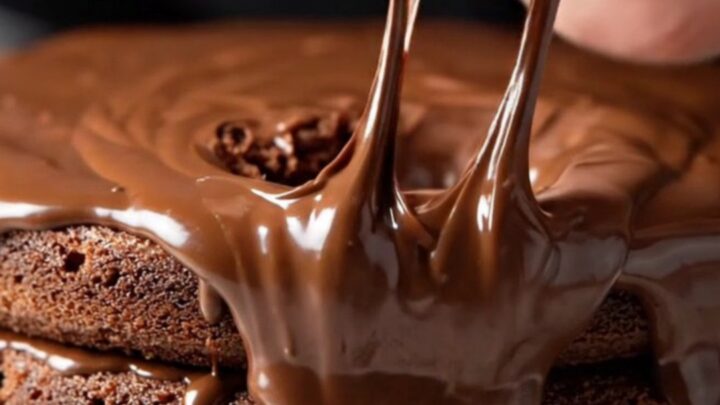
- Finish with a Mirror ShineFor a mirror-like shine, warm the remaining frosting slightly (about 10 seconds in the microwave) and pour it over the top of the cake, letting it drip down the sides. Use a spatula to smooth it gently. Let the cake set at room temperature for 30 minutes before slicing. The frosting will firm up slightly but remain luscious.Look for The surface is glossy and smooth, with a slight sheen.Tip Do not overheat the frosting; it should be pourable but not hot.
The final cake has a mirror-like shine on the top, with frosting dripping elegantly down the sides. The surface is smooth and glossy, with no streaks or bubbles. The cake is stable and holds its shape when sliced. The frosting is set but still tender, and the layers are moist and dark. The finished cake is a dramatic centerpiece, ready to be devoured.
Common mistakes
One common mistake is overbaking the cake, which dries out the crumb. Since the batter is so moist, it is better to err on the side of underbaking; the center should be just set. Another mistake is adding the boiling espresso too quickly, which can splash and cause lumps.
Stream it in slowly while mixing on low. For the frosting, overheating the chocolate and butter can cause it to separate; melt over low heat and stir constantly. If the frosting becomes too thick, add a splash of warm water or milk. Avoid frosting warm cakes, as the frosting will slide.
How to tell it’s done
The cakes are done when a toothpick inserted into the center comes out with a few moist crumbs, not wet batter. The edges will pull slightly away from the pan, and the top will spring back when pressed gently.
Because the batter is very liquid, the cakes may sink slightly in the center as they cool; this is normal and can be leveled. The internal temperature of the cake should reach at least 160°F (71°C) to ensure the eggs are fully cooked. Let the cakes cool completely before frosting; warm cakes will melt the frosting.
- Egg dishes: 160°F (71°C) in the thickest part
Up next · Part 3 of 3
4 variations · storage & make-ahead · 5 answers · printable card
Tips, FAQ & printable recipe (Part 3)← Back to the ingredients (Part 1)