Desserts · Part 2 of 3: Instructions
Traditional Turkish Revani Semolina Cake with Lemon Syrup Step-by-step instructions
- Prep
- Cook
- Total
- Serves
- 9
Before you start
Preheat the oven to 350°F (175°C) and grease a 9-inch square baking pan. Gather all ingredients: eggs, sugar, yogurt, oil, semolina, flour, lemon zest, and for the syrup, sugar, water, and lemon juice.
Have the crushed pistachios and shredded coconut ready for topping. Make sure the eggs are at room temperature for better volume when whipping.
Ingredients at a glance (12)
- 3 large eggs
- 1/2 cup granulated sugar
- 1/2 cup plain yogurt
- 1/2 cup vegetable oil
- 1 cup coarse semolina
- 1 cup all-purpose flour
- 1 tbsp lemon zest
- 2 cups granulated sugar
- 2 cups water
- 2 tbsp fresh lemon juice
- 1/4 cup crushed pistachios
- 1/4 cup shredded coconut
Instructions
Batter and Bake
- Prepare the BatterPreheat the oven to 350°F (175°C). Grease a 9-inch square baking pan. In a large bowl, whip the eggs with the sugar until pale and fluffy, about 3-4 minutes. Add the yogurt, vegetable oil, semolina, flour, and lemon zest. Mix until just combined, being careful not to overmix.Look for The batter should be smooth, pourable, and slightly thick. It will look like a soft cake batter.Tip Whipping the eggs thoroughly helps give the cake a light, airy texture. Use an electric mixer for best results.
- Bake the CakePour the batter into the prepared pan and smooth the top. Bake for 25-30 minutes, or until the top is golden brown and a toothpick inserted into the center comes out clean. The cake should be springy to the touch.Look for The cake will be puffed, golden, and fragrant. The edges will pull away slightly from the pan.Safe temperature 160°F (71°C) internal temperature (egg dishes)Tip Start checking at 25 minutes to avoid overbaking. The cake should be moist, not dry.
The batter should be smooth and pourable, with a slight thickness from the semolina. The cake bakes to a golden brown and fills the kitchen with a warm, lemony aroma. A toothpick inserted in the center comes out clean, and the top is springy to the touch.
Syrup and Soak
- Make the Lemon SyrupWhile the cake bakes, combine the sugar, water, and lemon juice in a saucepan. Bring to a boil, then reduce to a simmer. Let it simmer for 15 minutes, until slightly thickened. Remove from heat and let cool to room temperature.Look for The syrup will be clear and slightly syrupy. It should coat the back of a spoon lightly.Tip Cooling the syrup completely is essential—pouring hot syrup on hot cake can make it soggy.
- Soak the CakeOnce the cake is out of the oven and still hot, slowly pour the cool syrup over the entire surface. Let it absorb completely. The cake will hiss and bubble as it soaks up the syrup. Allow it to rest for at least 30 minutes so the syrup distributes evenly.Look for The syrup will be fully absorbed, leaving a glossy, moist surface. The cake will look shiny and feel heavy.Tip Pour the syrup gradually, letting each addition soak in before adding more. This ensures even saturation.
The syrup simmers until slightly thickened and clear. When poured over the hot cake, it sizzles and is absorbed quickly.
The cake becomes glossy and moist, and the surface looks shiny. Let it rest so the syrup distributes evenly, creating a uniformly tender crumb.
Top and Finish
- Top and ServeSprinkle the crushed pistachios and shredded coconut evenly over the top of the soaked cake. Cut into squares and serve at room temperature. The cake is best enjoyed the same day, but it keeps well for several days.Look for The topping adds a vibrant green and white contrast against the golden cake. The cake is moist and tender.Tip For cleaner slices, use a sharp knife and wipe it between cuts. Serve with Turkish tea or coffee.
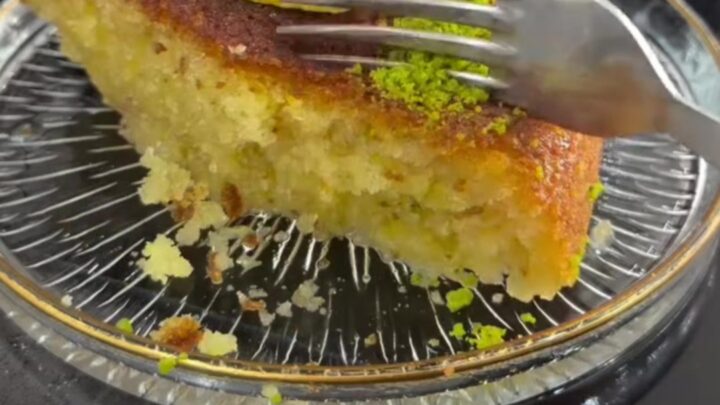
The pistachios and coconut create a vibrant topping against the golden cake. The cake is moist, tender, and fragrant with lemon. Cut into squares and serve at room temperature. The texture is soft and syrupy, with a crunchy nutty contrast.
Common mistakes
One common mistake is overmixing the batter, which can make the cake tough. Mix just until the ingredients are combined. Another issue is pouring hot syrup over a cold cake, which will result in uneven absorption.
Always pour cool syrup over a hot cake. Also, be sure to let the syrup soak in completely before adding more, or the cake may become overly wet in spots.
How to tell it’s done
The cake is done when it is golden brown on top and a toothpick inserted into the center comes out clean. The internal temperature should reach 160°F (71°C) to ensure the eggs are fully cooked.
The cake will feel springy to the touch and the edges will have pulled away slightly from the pan. Allow it to cool for 5 minutes before pouring the syrup.
- Egg dishes: 160°F (71°C) in the thickest part
Up next · Part 3 of 3
4 variations · storage & make-ahead · 5 answers · printable card
Tips, FAQ & printable recipe (Part 3)← Back to the ingredients (Part 1)