Breakfast · Part 2 of 3: Instructions
Tortilla-Crust Chorizo Quiche — No Pie Crust Needed Step-by-step instructions
- Prep
- Cook
- Total
- Serves
- 4
Before you start
Get everything in place before the oven door opens. Heat the oven to 375°F (190°C) with the rack centered, and set an 8-inch pie dish on the counter. Crumble the cooked chorizo into small, even pieces, chop the spinach, and shred the Monterey Jack if it is not already shredded — room-temperature and dry ingredients blend into the custard far better than cold ones.
Crack the five eggs into the mixing bowl and have the heavy cream measured alongside. Press the tortilla into the dish and pleat the rim now, before hands are messy with custard.
Ingredients at a glance (9)
- 1 large flour tortilla (10 inches)
- 5 large eggs, whisked
- 1/4 cup heavy cream
- 4 oz Mexican chorizo, cooked and crumbled
- 1/2 cup spinach, chopped
- 1 cup shredded Monterey Jack
- Sliced avocado, for serving
- Crumbled cotija, to taste
- Hot sauce, to taste
Instructions
Build the crust and fill it
- Heat the ovenSet a rack in the center of the oven and heat it to 375°F (190°C). Positioning the rack in the middle puts the tortilla crust close enough to the heating elements to brown and crisp on the rim while the custard below cooks evenly. Give the oven a full fifteen minutes to come to temperature before the dish goes in.Look for The oven display reads 375°F (190°C) and the preheat signal sounds.Tip An oven thermometer confirms the true temperature, since many ovens run hot or cold.
- Line the dish with the tortillaPress the 10-inch flour tortilla into an 8-inch pie dish, easing it down the center and up the sides. Fold any overhang into pleats around the rim so the edge stands a little proud of the dish. The pleats turn flaky and crisp in the oven and give every wedge a ruffled, golden border.Look for The tortilla sits flush against the bottom with an even pleated rim.Tip Press the pleats firmly so they hold their shape once the filling is poured in.
- Cook the chorizo throughAlready-cooked chorizo can go straight into the filling. If using fresh Mexican chorizo instead, crumble it into a skillet over medium heat and cook, stirring and breaking it up, until browned and it reaches 160°F (71°C) on an instant-read thermometer, 6 to 8 minutes. Drain it well on paper towels so the filling stays savory rather than greasy.Look for The chorizo is browned in small crumbles and reads 160°F (71°C) at the center.Safe temperature 160°F (71°C) internal temperature (ground meat)Tip Render fresh chorizo slowly so the spices bloom in its own fat without scorching.
- Whisk the custardCrack the eggs into a mixing bowl, add the heavy cream, and whisk for about thirty seconds until the mixture is completely uniform, pale, and glossy with no streaks of white remaining. Thorough whisking distributes the yolks evenly and traps a little air, which helps the quiche rise into that puffed, golden dome as it bakes.Look for The mixture is one smooth, pale yellow color with no visible whites.Tip Whisk in a steady circle rather than beating hard, so the foam stays fine and even.
- Layer the fillingScatter the crumbled cooked chorizo over the tortilla bottom, then add the chopped spinach and finish with the shredded Monterey Jack, spreading each layer evenly. Keeping the heavier chorizo low anchors it in the custard, while the cheese on top melts into a molten blanket that browns lightly where it meets the oven heat.Look for The tortilla bottom is covered edge to edge with an even layer of filling.Tip Pat the spinach dry first so it does not release water into the custard.
- Pour in the custardSlowly pour the egg-and-cream mixture over the filling, aiming for the center so it seeps evenly between the chorizo, spinach, and cheese without disturbing the layers. Fill until the custard reaches just below the pleated tortilla rim. Give the dish a gentle tap on the counter to release any trapped air pockets.Look for The custard rises to just under the pleated edge with no overflow.Tip Pouring low and slow keeps the cheese layer neat and on top.
At the end of this phase the tortilla is pressed into the dish with a firm, even pleated rim, the chorizo, spinach, and Jack are layered edge to edge, and the custard sits just below the folds with no air pockets.
Everything should look level and evenly distributed, with the cheese visible on top. Check that no filling has piled against one side and that the rim still stands proud of the dish — that is what will crisp. If the custard level looks low, it is correct; it rises as it bakes.
Bake until puffed and golden
- Bake until puffed and setBake at 375°F (190°C) for 22 minutes, until the custard is fully set and the internal temperature reaches 160°F (71°C) at the center — the temperature at which the eggs are cooked all the way through. The top should be puffed and golden, the tortilla rim flaky and crisp, and the cheese lightly browned in spots.Look for The center is puffed, golden, and reads 160°F (71°C) on a thermometer.Safe temperature 160°F (71°C) internal temperature (egg dishes)Tip If the rim browns early, shield it with a strip of foil for the last minutes.
Twenty-two minutes in, the quiche should have transformed: the custard is puffed into a gentle dome, deep gold across the melted cheese, and the pleated rim is flaky and crisp with browned tips. The kitchen smells of toasted tortilla and savory chorizo.
Before leaving the oven, confirm the center temperature reads 160°F (71°C) and the middle of the custard feels set with only a slight give — no glossy sheen at the surface. If the top has color but the temperature is short, bake two or three minutes more.
Rest and finish with toppings
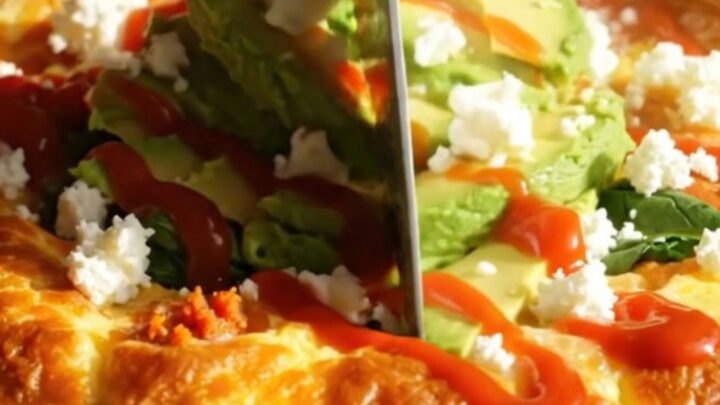
- Rest, then topLet the quiche rest in the dish for 5 minutes so the custard settles and slices cleanly. Then arrange the sliced avocado over the top, scatter the crumbled cotija across it, and finish with a drizzle of hot sauce. The residual heat warms the toppings through while the crisp crust keeps its bite.Look for The surface no longer steams actively and a knife tip comes out clean.Tip Slice the avocado just before serving so it stays bright green.
- Slice and serveCut the quiche into wedges with a sharp knife, wiping the blade between cuts for clean edges. Lift each wedge with a spatula so the crispy tortilla bottom stays intact, and serve warm while the cheese is still glossy. The contrast of crackly crust, tender custard, and cool avocado is what makes this dish.Look for Each wedge holds its shape with a crisp golden rim and set center.Tip A thin spatula slid under the crust keeps the first wedge picture-perfect.
After five minutes of rest the custard has settled from its puff and slices cleanly, the crust base crackles under a spatula, and the surface is warm but no longer steaming hard. The avocado goes on in neat overlapping slices, the cotija in crumbles that cling to the warmth, and the hot sauce in thin ribbons across the top. Before cutting, check that a knife slips through without resistance and comes out clean, and that the wedge edges hold their shape.
Common mistakes
The most common slip is underbaking in a rush: pull the quiche before the center reaches temperature and the slices slump instead of standing. Use the thermometer. The second is skipping the pleats — a tortilla draped loosely over the rim browns unevenly and collapses inward, so press each fold firmly. Overloading the dish is another trap: more than the listed filling will spill past the rim and soak the crust. Pour the custard low and slow so the cheese stays on top instead of sinking.
How to tell it’s done
The quiche is done when three signs agree. First, the center is puffed and golden, risen above the tortilla rim with a lightly browned cheese surface. Second, the pleated tortilla edge looks dry and flaky, deep gold at the folds rather than pale and soft.
Third, and most reliably, an instant-read thermometer inserted into the middle of the custard reads 160°F (71°C), the temperature at which egg custards are fully cooked through and safe. The center should feel firm with a gentle give, and a knife inserted halfway in should come out clean.
- Egg dishes: 160°F (71°C) in the thickest part
- Ground meat: 160°F (71°C) in the thickest part
Up next · Part 3 of 3
4 variations · storage & make-ahead · 5 answers · printable card
Tips, FAQ & printable recipe (Part 3)← Back to the ingredients (Part 1)