Desserts · Part 2 of 3: Instructions
Three-Ingredient Lemon Posset Brûlée in Real Lemon Shells Step-by-step instructions
- Prep
- Cook
- Total
- Serves
- 6
Before you start
Before beginning, ensure you have a clean workspace and all your ingredients measured. Select lemons that are firm and feel heavy for their size, as these will yield the most juice.
Have a small tray or muffin tin ready to stabilize the hollowed-out lemon shells in the refrigerator, as they are prone to tipping over. Ensure your cream is cold from the fridge and your kitchen torch is fueled and ready for the final step. Having your tools organized will make the process seamless.
Ingredients at a glance (5)
- 400 ml heavy cream
- 120 g caster sugar
- 90 ml fresh lemon juice
- 2 whole lemon zest
- 3 tbsp caster sugar for topping
Instructions
Cream and sugar reduction
- Prepare the lemon shells and cream baseCut the lemons in half and carefully scoop out the pulp to create clean shells. In a saucepan, combine the heavy cream and 120 grams of sugar. Bring the mixture to a gentle simmer over medium heat and cook for 3 minutes, stirring constantly to ensure the sugar is fully dissolved.Look for The cream mixture should be steaming and the sugar completely dissolved without any graininess remaining at the bottom of the pan.Tip Use a paring knife to slice a small amount off the bottom of each lemon half so they sit flat on your work surface.
The cream and sugar mixture should be bubbling consistently across the surface. It will look slightly thinner than heavy cream but will have a glossy, syrup-like sheen. You should smell the sweet aroma of the heating cream. Check that all sugar granules have vanished before proceeding to the next step, as any remaining sugar will ruin the final texture of the posset.
Juice incorporation and cooling
- Flavor and thicken the possetRemove the saucepan from the heat. Immediately whisk in the fresh lemon juice and the zest of two lemons until the mixture begins to thicken slightly. Pour the warm liquid evenly into the prepared hollowed-out lemon shells, filling them nearly to the rim without overflowing.Look for The liquid should transform from a thin cream to a slightly viscous, velvety consistency as the acid reacts with the fat in the cream.Tip Strain the mixture through a fine-mesh sieve if a perfectly smooth texture is desired, though the zest adds a beautiful rustic appearance.
After whisking in the lemon juice, the mixture will noticeably thicken and coat the back of a spoon. It will appear slightly paler and have a bright, fresh citrus scent. Pouring it into the shells should be done quickly before it sets too much in the pan. The shells should be upright and stable, ready to go straight into the refrigerator for the required three-hour rest period.
Chilling and caramelizing
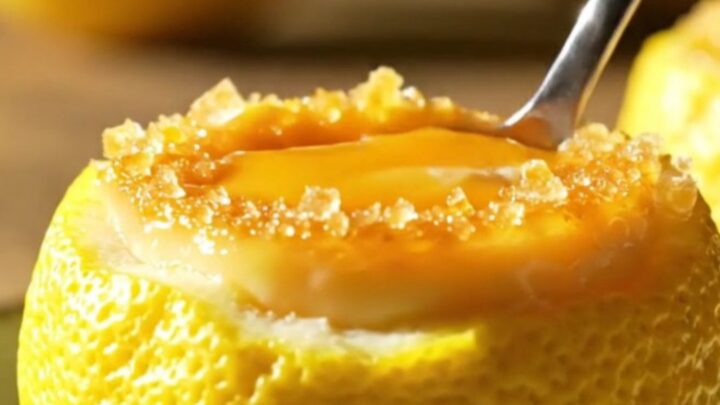
- Chill and torch the brûléeTransfer the lemon shells to the refrigerator and chill at 38 degrees Fahrenheit for at least 3 hours until the posset is set firm. Just before serving, sprinkle an even layer of caster sugar over the top of each chilled posset. Use a kitchen torch to melt and caramelize the sugar until it forms a deep amber, crispy crust.Look for The sugar should bubble and turn a dark golden brown; be careful not to hold the torch in one spot too long to avoid burning the shell.Tip If the sugar is not caramelizing evenly, move the torch in a circular motion to ensure consistent heat distribution across the surface.
After chilling, the posset will be firm and set. When you press it gently with a finger, it should spring back. The surface should be cold and dry, which is essential for the sugar to sit evenly.
The torched sugar crust should look like a smooth, dark glass sheet. It should crack audibly when tapped with a teaspoon, revealing the smooth, creamy interior that is perfectly chilled.
Common mistakes
A common mistake is failing to boil the cream and sugar for the full three minutes, which can result in a posset that never properly sets. Another error is adding the lemon juice while the cream is still on the heat; always remove the pan from the heat first to prevent the cream from curdling or separating.
Finally, avoid over-torching the sugar, which can cause the lemon shells to heat up too much and melt the cream underneath before you can serve it.
How to tell it’s done
The posset is done when it feels firm to the touch and has a wobble similar to a set panna cotta. It should not be liquid or runny when tilted. The surface will look smooth and matte.
Once the sugar is added and torched, the doneness of the topping is determined by the color and texture of the sugar; it should be a deep, dark amber color and feel hard and brittle when tapped with a spoon, signaling that the caramelization process is complete.
Up next · Part 3 of 3
2 variations · storage & make-ahead · 3 answers · printable card
Tips, FAQ & printable recipe (Part 3)← Back to the ingredients (Part 1)