Dinner · Part 2 of 3: Instructions
Texas Toast Patty Melt with Pulled Pork and Mac and Cheese Step-by-step instructions
- Prep
- Cook
- Total
- Serves
- 1
Before you start
Before the griddle goes on, set up the full station, because this sandwich moves fast once the beef hits the pan. Toss the pulled pork with barbecue sauce until every strand is coated, and have the mac and cheese in a bowl, thick and clump-free.
Spread garlic butter on one side of each slice of Texas toast and lay them buttered side up within reach. Line up two slices of colby jack, a clean plate for the cooked patty, a sharp knife for slicing, and a sturdy spatula.
Ingredients at a glance (7)
- 4 oz hickory smoked pulled pork, store-bought or made ahead
- 2 tbsp tangy barbecue sauce
- 1/2 cup ultra-creamy sharp cheddar macaroni and cheese, made ahead or store-bought
- 4 oz ground beef (80/20), for smashing
- 2 slices thick-cut Texas toast bread, about 2 inches thick together with the filling
- 2 tbsp softened garlic butter, for the bread
- 2 slices colby jack cheese
Instructions
Prep the filling and bread
- Sauce the pulled porkPlace the pulled pork in a small bowl, pour the barbecue sauce over it, and toss with a fork until every strand is coated and glossy. Keep it at room temperature for no more than 30 minutes while the rest of the prep comes together, or hold it in the refrigerator and let it take the chill off briefly on the griddle later.Look for The pork looks uniformly dark and tacky, with no dry, pale strands left.Tip A tangy, vinegar-forward sauce cuts through the rich cheese better than a very sweet one.
- Get the mac and cheese readySpoon the macaroni and cheese into a small bowl and break up any clumps so it spreads easily. It should be thick and creamy rather than soupy; if it has chilled, warm it for a few seconds just until it loosens, then let it sit so it firms slightly before it goes on the sandwich.Look for The mac holds its shape on a spoon and does not drip sauce off the edges.Tip Thick mac stays inside the melt; a loose, saucy mac slides out on the first bite.
- Butter the Texas toastSpread a generous layer of softened garlic butter over one side of each slice of Texas toast, all the way to the edges. Lay the slices buttered side up on a plate near the griddle so they are ready to go down the moment the patty comes off.Look for The butter coats the surface evenly with no dry corners showing.Tip Softened butter spreads without tearing the bread; melted butter soaks in and can scorch.
By the end of this phase, the pulled pork is evenly coated in barbecue sauce and looks dark and glossy, with no dry strands. The mac and cheese sits in a bowl, thick enough to hold its shape on a spoon, warmed just enough to loosen and then firmed slightly. Each slice of Texas toast carries an even coat of garlic butter on one side, right to the edges, waiting buttered side up near the griddle. Nothing is on the heat yet.
Smash the patty hot and fast
- Heat a hot smashing zonePreheat a cast-iron griddle or heavy skillet over high heat until a drop of water skitters and evaporates on contact, about 450°F on an infrared thermometer. Leave part of the surface empty so there is a cooler zone ready for toasting the bread later.Look for The oil shimmers and lightly smokes, and water droplets dance instead of sitting.Tip A dry, screaming-hot surface is what gives a smash patty its lacy, crisp edges.
- Smash and cook the pattyPlace the ground beef on the hot zone, press it flat with the spatula to about half an inch, and season with a little salt and pepper. Cook undisturbed until the underside is deeply crusted, about 2 minutes, then flip and continue until the internal temperature reaches 160°F (71°C), another 1 to 2 minutes.Look for Dark brown, crispy edges and a firm, fully browned surface on both sides.Safe temperature 160°F (71°C) internal temperature (ground meat)Tip Press hard once at the start; pressing after the crust forms squeezes out the juices.
- Rest the patty brieflyMove the patty to a clean plate and let it rest for about 3 minutes while you adjust the heat. This short pause lets the juices settle back into the meat instead of running out at the first cut, and it gives the griddle time to come down to the toasting temperature.Look for No juice pools around the patty when it is nudged with the spatula.Tip Resting on a plate, not paper towels, keeps the crust from steaming soft.
The griddle should be at roughly 450°F, with water droplets skittering and a light shimmer of smoke. The smashed patty has deep brown, lacy, crispy edges and a fully crusted surface on both sides, and it reads 160°F (71°C) on an instant-read thermometer.
After its short rest, no juice pools around it when nudged. The surface temperature is now dropping toward the toasting range. Before moving on, confirm the thermometer reading and adjust the heat down; the bread cannot survive smash-level heat.
Toast, stack, and melt
- Toast the bread goldenLower the griddle to a steady medium heat, about 360°F. Lay the toast slices buttered side down on the cooler zone and cook until they turn deep golden and crisp at the edges, 2 to 3 minutes, rotating them once for even browning.Look for The underside is evenly golden with darker, blistered spots and smells toasty and garlicky.Tip If the bread browns before the cheese melts, lower the heat and give it more time.
- Build the stackWorking on the griddle, lay a slice of colby jack on a toasted slice, then add the patty, the sauced pulled pork, and the mac and cheese in even layers. Cap it with the second slice of colby jack and the remaining toast, buttered side up, pressing gently so the stack holds together.Look for The stack sits tall but stable, with the cheese starting to soften against the warm patty.Tip Cheese below and above the filling acts as glue for everything in between.
- Griddle until gooeyCook the assembled melt over medium heat for 2 to 3 minutes, pressing lightly with the spatula, then flip carefully and cook the second side until it matches. The cheese should be fully melted and the filling warmed through, another 2 to 3 minutes.Look for Both faces are crisp and golden, and melted cheese just begins to peek out at the edges.Tip Use two spatulas or slide the melt onto a turner for a confident, spill-free flip.
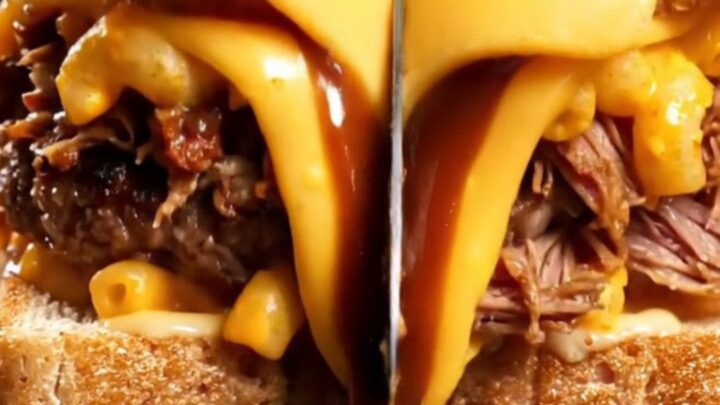
- Slice and serve hotTransfer the melt to a cutting board, let it stand for a minute so the molten filling settles, then cut it in half with a sharp knife. Serve immediately while the bread shatters slightly and the mac and cheese stretches between the halves.Look for The cross-section shows distinct layers and a slow, gooey cheese pull.Tip Cut with one firm stroke rather than sawing, so the layers stay neat.
The toast slices are deep golden with darker blistered spots and smell of garlic. The stack is assembled cheese-patty-pork-mac-cheese and griddled until both faces are crisp, the colby jack is fully melted and just peeking out at the edges, and the center filling is warmed through. After a one-minute rest, a sharp knife cuts through in one stroke, revealing distinct layers and a slow, gooey pull.
Common mistakes
The most common failure is pressing the patty after the crust has formed, which squeezes out the juices and leaves the beef dry; smash hard once, at the start, then leave it alone.
The second is toasting the bread over the same screaming heat used for the beef, which scorches the butter before the cheese melts; drop to about 360°F first. Overloading the sandwich with loose, soupy mac makes the filling slide out at the flip, so keep the mac thick and the layers even.
How to tell it’s done
The melt is done when both faces of the Texas toast are deep golden and audibly crisp, the colby jack is fully melted from top layer to bottom, and the filling is heated through in the center.
The reliable safety check belongs to the patty: ground beef must reach an internal temperature of 160°F (71°C), read with an instant-read thermometer in the thickest part. If the cheese melts before the patty registers, remember the patty was already cooked through in phase 2, so trust the thermometer over guesswork.
- Ground meat: 160°F (71°C) in the thickest part
Up next · Part 3 of 3
4 variations · storage & make-ahead · 5 answers · printable card
Tips, FAQ & printable recipe (Part 3)← Back to the ingredients (Part 1)