Desserts · Part 2 of 3: Instructions
12-Minute Molten Dark Chocolate Lava Cake Step-by-step instructions
- Prep
- Cook
- Total
- Serves
- 4
Before you start
Before starting, measure all ingredients and chop the chocolate if using a block. Butter the ramekins and dust with cocoa powder, tapping out the excess. Preheat the oven to 425°F (220°C) and place a baking sheet on the middle rack.
Ensure the eggs are at room temperature for a smoother batter. Have a whisk, spatula, and mixing bowls ready. This prep takes about 10 minutes and makes the baking process seamless.
Ingredients at a glance (8)
- 4 oz 70% dark chocolate, chopped
- 1/2 cup unsalted butter, cut into pieces
- 2 large eggs
- 2 large egg yolks
- 1/4 cup powdered sugar
- 2 tbsp all-purpose flour
- Cocoa powder, for dusting, to taste
- Madagascar vanilla bean ice cream, for serving
Instructions
Prepare the Batter
- Melt chocolate and butterPlace the chopped dark chocolate and butter in a heatproof bowl. Set the bowl over a saucepan of barely simmering water, making sure the bottom doesn't touch the water. Stir occasionally until melted and smooth. Remove from heat and let cool slightly.Look for The mixture is glossy and completely smooth, with no lumps.Tip Alternatively, melt in the microwave in 20-second bursts, stirring between each.
- Whisk eggs and sugarIn a separate bowl, whisk the whole eggs, egg yolks, and powdered sugar until well combined and slightly frothy. The mixture should be pale and slightly thickened.Look for The eggs are frothy and the sugar is fully dissolved.Tip Whisk vigorously for about 30 seconds to incorporate air, which helps the cakes rise.
- Combine chocolate and egg mixturesSlowly pour the melted chocolate mixture into the egg mixture, whisking constantly until fully combined. The batter should be smooth and glossy.Look for The batter is uniform in color with no streaks of egg or chocolate.Tip Pour slowly to avoid scrambling the eggs with the warm chocolate.
- Add flourSprinkle the all-purpose flour over the batter and gently fold it in with a spatula until just combined. Do not overmix; a few streaks are fine.Look for The flour is fully incorporated and the batter is thick and smooth.Tip Folding rather than stirring keeps the batter airy, ensuring a tender cake.
The melted chocolate and butter mixture is smooth and glossy. After whisking in the eggs and sugar, the batter is thick and uniform. When the flour is folded in, the batter has a silky, pourable consistency with no lumps.
The ramekins are coated with cocoa powder, ready for filling. This phase takes about 10 minutes and sets the stage for a perfect bake.
Bake the Cakes
- Prepare ramekinsGenerously butter the inside of four ramekins (or use nonstick spray). Dust each with cocoa powder, tapping out the excess. This ensures the cakes release easily.Look for The ramekins are evenly coated with a thin layer of cocoa powder.Tip Use a pastry brush to spread the butter evenly, then tap out excess cocoa.
- Preheat oven to 425°FPreheat the oven to 425°F (220°C). Place a baking sheet on the middle rack to catch any overflow while baking.Look for The oven reaches the correct temperature before baking.Tip A hot oven is key to a molten center; don't skip preheating.
- Fill ramekins and bakeDivide the batter evenly among the prepared ramekins. Place them on the baking sheet and bake for 12 minutes, until the sides are firm and the top is set but the center still moves slightly when gently shaken.Look for The edges look firm and the centers jiggle slightly when the ramekin is tapped.Safe temperature 160°F (71°C) internal temperature (egg dishes)Tip Bake exactly 12 minutes; overbaking will cook the center solid.
After 12 minutes in the oven, the cakes have risen slightly and the tops are set. The edges look firm and pull away from the ramekin sides. When gently shaken, the centers move subtly, indicating a molten interior. The kitchen smells richly of chocolate. The cakes are ready to be removed and inverted.
Unmold and Serve
- Let cool briefly and invertRemove the ramekins from the oven and let them cool on a wire rack for 1 minute. Run a thin knife around the edge of each ramekin, then invert onto serving plates. The cakes should release easily.Look for The cakes release cleanly from the ramekins, holding their shape.Tip Cooling too long may cause the cakes to stick; invert while still warm.
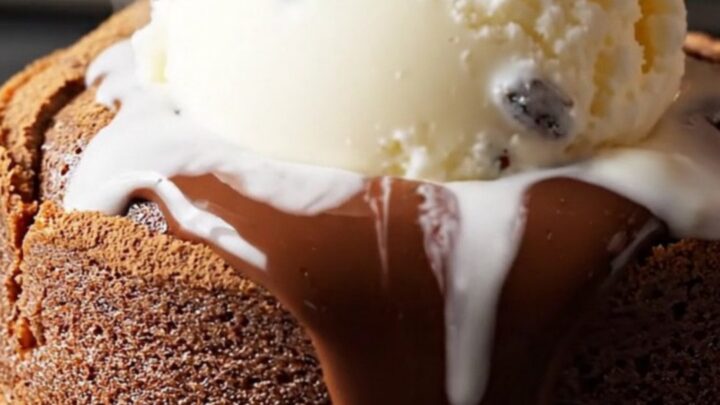
- Top with ice cream and servePlace a scoop of Madagascar vanilla bean ice cream on top of each warm lava cake. Serve immediately, allowing the ice cream to melt slightly over the warm cake.Look for The ice cream begins to melt and cascade over the cake.Tip For the hot-cold contrast, serve right away while the cake is still warm.
After cooling for 1 minute, the cakes release cleanly from the ramekins onto serving plates. The exterior is firm and cake-like, while the center is glossy and flowing. A scoop of vanilla ice cream melts slightly on the warm cake, creating a beautiful contrast. Serve immediately for the best texture and temperature contrast.
Common mistakes
A common mistake is overbaking, which results in a fully cooked center and no molten lava. To avoid this, start checking at 11 minutes and rely on the jiggle test. Another error is opening the oven door too often, which lets out heat and affects baking time.
Using cold eggs can cause the batter to seize; bring them to room temperature first. Also, be sure to butter the ramekins thoroughly and dust with cocoa, or the cakes may stick. Finally, do not overmix the batter after adding flour, as this develops gluten and makes the cakes tough.
How to tell it’s done
The lava cakes are done when the edges are firm and the top is set but the center still has a slight wobble when the ramekin is gently shaken. This typically takes exactly 12 minutes at 425°F. To check, gently press the center with a fingertip; it should feel soft and give slightly, but not be liquid.
If the center feels completely firm, the cakes are overbaked and the lava will be set. The internal temperature of the cake should reach at least 160°F (71°C) to ensure the eggs are fully cooked.
- Egg dishes: 160°F (71°C) in the thickest part
Up next · Part 3 of 3
4 variations · storage & make-ahead · 5 answers · printable card
Tips, FAQ & printable recipe (Part 3)← Back to the ingredients (Part 1)