Desserts · Part 2 of 3: Instructions
Strawberry Matcha Basque Burnt Cheesecake: Pretty Layered Dessert Step-by-step instructions
- Prep
- Cook
- Total
- Serves
- 8
Before you start
Before starting, bring the cream cheese, eggs, and heavy cream to room temperature for a smooth batter. Preheat the oven to 400°F (200°C).
Line a 9-inch springform pan with a large sheet of parchment paper, crumpling it first to create folds and creases; press it into the pan, leaving overhang. Hull and halve the strawberries, and grate the matcha white chocolate.
Ingredients at a glance (12)
- 1 lb fresh strawberries, hulled and halved
- 6 oz ceremonial matcha white chocolate, grated
- 24 oz cream cheese, softened
- 1 cup granulated sugar
- 4 large eggs
- 1 tsp vanilla extract
- 1 cup heavy cream
- 2 tbsp culinary matcha powder
- 1/2 cup strawberry puree (from fresh strawberries)
- 1 drop pink food coloring (optional)
- 4 oz matcha white chocolate, chopped
- 1/2 cup heavy cream
Instructions
Prep and Batter
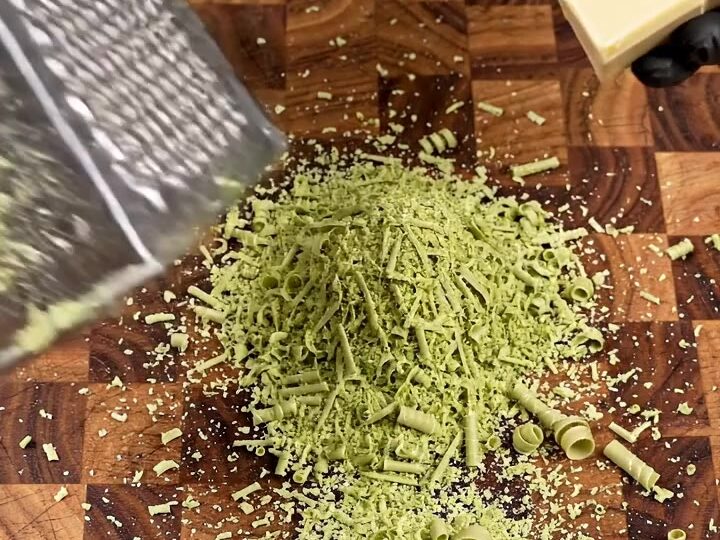
- Prepare the fruit and chocolateHull the strawberries and halve them lengthwise to create heart shapes. Set aside. Grate the ceremonial matcha white chocolate on a box grater into a bowl; you should have about 1 1/2 cups of grated chocolate. Reserve 4 oz for the ganache and keep the rest for the batter.Look for The grated chocolate should be fluffy and bright green.Tip Chill the chocolate for 10 minutes before grating for cleaner shavings.
- Make the cheesecake batterIn a large bowl, beat the softened cream cheese and sugar with an electric mixer until smooth and creamy. Add the eggs one at a time, beating well after each addition. Mix in the vanilla extract and heavy cream until fully combined. The batter should be silky and lump-free.Look for The batter is smooth and pourable, with no lumps.Tip Use room-temperature ingredients for the smoothest batter.
- Divide and flavor the battersDivide the batter into two bowls. To one bowl, add the grated matcha white chocolate and culinary matcha powder; stir until the chocolate melts and the batter is uniformly green. To the other bowl, add the strawberry puree and a drop of pink food coloring if using; stir until the batter is pastel pink.Look for The green batter is vibrant, and the pink batter is pastel.Tip If the chocolate doesn't melt, gently warm the bowl over a water bath.
At this point, you have a bowl of grated matcha white chocolate, halved strawberries, and a smooth cream cheese batter.
The batter is divided into two bowls: one vibrant green with matcha, the other pastel pink with strawberry puree. The textures are silky and pourable.
Bake and Chill
- Layer the battersLine a 9-inch springform pan with parchment paper, crumpled first for a rustic look. Pour the green matcha batter into the pan and smooth the top. Gently pour the pink strawberry batter over the green layer, spreading it evenly. Scatter the halved strawberries over the top, pressing them slightly into the batter.Look for The layers are distinct: green on the bottom, pink on top, with strawberries nestled in.Tip Pour the pink batter slowly over the back of a spoon to avoid disturbing the green layer.
- Bake the cheesecakePlace the pan on a baking sheet and bake in a preheated 400°F (200°C) oven for 50 to 55 minutes, until the top is deeply browned and the center is set but slightly wobbly. The cheesecake will puff up and crack on top, which is characteristic of basque style.Look for The top is dark amber and the edges are set; the center jiggles slightly.Safe temperature 160°F (71°C) internal temperature (egg dishes)Tip Do not overbake; the center should remain moist and creamy.
- Cool completelyRemove the cheesecake from the oven and let it cool in the pan on a wire rack for at least 2 hours. Then refrigerate for at least 2 more hours, or overnight, until fully chilled and set.Look for The cheesecake is completely cool and firm to the touch.Tip Chilling overnight yields cleaner slices.
After baking, the cheesecake is puffed and deeply browned on top, with a slight jiggle in the center. It has cooled completely and chilled in the fridge until firm. The top is caramelized, and the edges are set.
Finish and Serve
- Make the ganachePlace the chopped matcha white chocolate in a heatproof bowl. Heat the heavy cream in a small saucepan until simmering, then pour over the chocolate. Let sit for 2 minutes, then stir until smooth and glossy.Look for The ganache is smooth, shiny, and a vibrant green.Tip If the chocolate doesn't fully melt, microwave in 10-second bursts.
- Glaze and garnishRun a knife around the edge of the chilled cheesecake and release the springform. Carefully peel away the parchment. Place the cheesecake on a serving plate. Pour the ganache over the top, letting it drip down the sides. Crown with fresh strawberries.Look for The ganache flows down the sides, and the strawberries sit on top.Tip For a neat drip, pour the ganache in the center and spread gently.
- Slice and serveUse a thin, sharp knife dipped in hot water to slice the cheesecake. Wipe the knife clean between cuts for neat slices. Lift each slice with a cake server and serve.Look for Each slice shows distinct green and pink layers with strawberries.Tip Warm the knife for clean cuts; chill the cheesecake well before slicing.
The cheesecake is unmolded, glazed with glossy matcha ganache, and topped with fresh strawberries. When sliced, the layers are distinct: a green base, pink middle, and a burnt top. The ganache drips elegantly down the sides.
Common mistakes
Avoid overmixing the batter, which can incorporate too much air and cause cracks (though cracks are part of the basque style). Do not overbake, or the center will be dry instead of creamy.
When pouring the pink layer, do it gently to prevent mixing with the green layer. Make sure the cheesecake is fully chilled before slicing to get clean, distinct layers.
How to tell it’s done
The cheesecake is done when the top is deeply browned, almost charred in spots, and the edges are set while the center still jiggles slightly when the pan is gently shaken.
An instant-read thermometer inserted into the center should register at least 160°F (71°C) to ensure the eggs are cooked through. The center will continue to set as it cools.
- Egg dishes: 160°F (71°C) in the thickest part
Up next · Part 3 of 3
4 variations · storage & make-ahead · 5 answers · printable card
Tips, FAQ & printable recipe (Part 3)← Back to the ingredients (Part 1)