Dinner · Part 2 of 3: Instructions
Sticky Oven-Baked Barbecue Ribs Step-by-step instructions
- Prep
- Cook
- Total
- Serves
- 6
Before you start
Before beginning the cooking process, prepare the workspace and equipment. Line a large, sturdy baking sheet with aluminum foil for easy cleanup. Retrieve the refrigerated pork ribs and pat them completely dry with paper towels.
If the thin membrane on the bone side of the ribs is still attached, use a butter knife to loosen it at one end, then grip it with a paper towel and pull it off completely. Preheat the oven to 300°F (150°C) to ensure a stable, low-temperature environment.
Ingredients at a glance (2)
- 3 racks pork baby back ribs
- 2 cups barbecue sauce, divided
Instructions
Prep and Wrap
- Prep the RibsPreheat the oven to 300°F (150°C). Remove the thin membrane from the back of the pork baby back ribs if present, then pat the ribs dry with paper towels.Look for The ribs should be completely dry and clean.Tip Use a paper towel to get a firm grip on the membrane to peel it off smoothly.
- Wrap in FoilTightly wrap each rack of ribs individually in a double layer of heavy-duty aluminum foil, crimping the edges securely to prevent any steam or juices from escaping.Look for The packets must be completely sealed.Tip Double wrapping prevents any bone tips from puncturing the foil during handling.
At the end of this initial preparation phase, the ribs should be completely dry, trimmed of any tough membrane, and wrapped securely in a double layer of heavy-duty aluminum foil. The foil packets must be sealed tightly on all sides with no visible gaps or tears, ensuring that all natural steam and juices remain trapped inside during baking. The wrapped racks should rest flat on the prepared baking sheet, ready to enter the preheated oven.
Slow Baking
- Slow BakePlace the wrapped rib packets bone-side down on a large baking sheet and bake in the preheated oven for 2 to 2.5 hours until the meat is very tender.Look for The meat should feel very soft through the foil.Tip Keep the oven door closed to maintain a steady low temperature throughout baking.
- Unwrap the PacketsCarefully open the foil packets, minding the hot steam, and fold the foil back to expose the top of the ribs completely, leaving them on the baking sheet.Look for The meat should shrink back slightly from the bone ends.Tip Be extremely cautious of escaping steam when opening the tightly sealed packets.
After the slow-baking phase, the kitchen will fill with a rich, savory aroma of roasted pork. When carefully peeling back a corner of the foil packet, a plume of hot steam should escape, and the meat should appear shrunk back slightly from the ends of the bones. The meat should feel incredibly tender when pierced with a fork, indicating that the collagen has fully broken down and the ribs are ready for the final glazing step.
Glazing and Slicing
- Apply GlazeIncrease the oven temperature to 425°F (220°C). Generously brush the top of the hot ribs with a thick layer of the barbecue sauce using a basting brush.Look for The ribs should be evenly coated.Tip Ensure the sauce is applied while the ribs are hot to help the glaze adhere.
- Caramelize and SliceBake the glazed ribs for 10 to 15 minutes, or broil on high for 3 to 5 minutes, until the sauce is bubbling and caramelized. Ensure the whole cut meat reaches a safe internal temperature of at least 145°F (63°C) and let it rest for at least 3 minutes before slicing.Look for The glaze should be sticky, darkened in spots, and bubbling.Safe temperature 145°F (63°C) internal temperature (steaks, chops and roasts)Tip Watch closely during broiling to prevent the sugars in the sauce from burning.
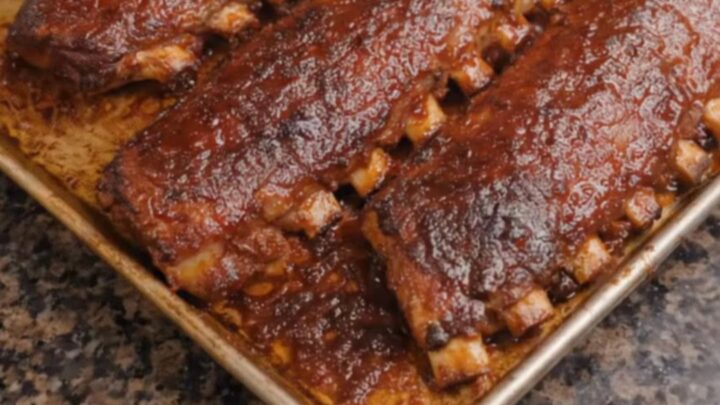
The final phase concludes with beautifully caramelized, glistening ribs. The barbecue sauce should be bubbling, darkened in spots, and sticky to the touch, forming a cohesive glaze over the meat.
When slicing smoothly through the rack with a sharp chef's knife, the meat should yield effortlessly, pulling away from the bone with just a gentle tug. The internal temperature of the thickest part of the meat must reach a safe minimum of 145°F (63°C), though cooking to 195°F (91°C) ensures optimal tenderness.
Common mistakes
One common mistake is rushing the cooking process by increasing the oven temperature. High heat will cause the proteins in the meat to contract tightly, squeezing out moisture and resulting in tough, dry ribs rather than tender ones.
Another frequent error is failing to seal the aluminum foil packets tightly enough. If steam escapes during the baking process, the ribs will bake dry instead of tenderizing in their own juices, leading to a chewy and disappointing texture.
How to tell it’s done
To determine perfect doneness, use a meat thermometer inserted into the thickest part of the meat between the bones, ensuring it does not touch the bone itself. For safety, whole cut pork must reach an internal temperature of at least 145°F (63°C) followed by a three-minute rest.
However, for maximum fall-off-the-bone tenderness, aim for an internal temperature between 195°F (91°C) and 203°F (95°C). You can also test doneness by gently lifting the rack; it should bend easily in the middle and the meat should begin to crack slightly.
- Steaks, chops and roasts: 145°F (63°C) in the thickest part, then a 3-minute rest
Up next · Part 3 of 3
3 variations · storage & make-ahead · 4 answers · printable card
Tips, FAQ & printable recipe (Part 3)← Back to the ingredients (Part 1)