Dinner · Part 2 of 3: Instructions
Southern Cornbread Dressing Bake Step-by-step instructions
- Prep
- Cook
- Total
- Serves
- 8
Before you start
Before beginning, ensure all ingredients are at room temperature to promote even baking. Dice the celery and onion into uniform pieces to ensure they cook at the same rate. Have your baking dish ready and clear a space in your kitchen.
If you are baking the cornbread from scratch, allow it to cool completely before crumbling, as warm bread will turn to paste when mixed with the liquid ingredients, negatively affecting the final texture of the dressing.
Ingredients at a glance (7)
- 8 cups crumbled cornbread
- 1 cup diced celery
- 1 cup diced onion
- 2 cups chicken broth
- 2 large beaten eggs
- 1 tsp dried sage
- 4 tbsp butter pats
Instructions
Layering the Aromatics
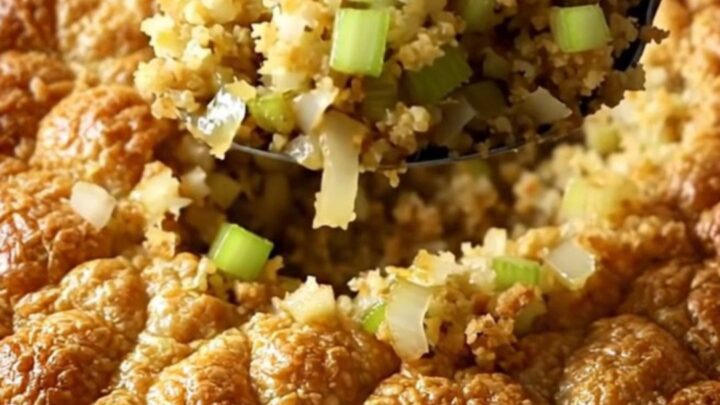
- Prepare the BaseIn a large rectangular baking dish, spread the crumbled cornbread evenly. Scatter the diced celery and diced onion over the top of the cornbread, ensuring an even distribution of the aromatics throughout the dish for balanced flavor in every bite.Look for The cornbread should fill the bottom of the dish in an even, loose layer.Tip Using day-old cornbread provides a better texture as it is slightly drier and absorbs the liquid more effectively.
The base is ready when the crumbled cornbread is spread evenly across the bottom of the baker and the celery and onion are scattered uniformly. You should see a consistent layer of bread crumbs and vegetables.
Ensure the vegetables are diced finely enough so they do not remain crunchy, but maintain enough texture to provide a pleasant contrast to the soft, absorbed cornbread base.
Binding the Mixture
- Combine and PourIn a medium bowl, whisk together the chicken broth, beaten eggs, and dried sage until thoroughly combined. Pour this liquid mixture evenly over the cornbread, celery, and onion, allowing it to soak into the crumbs. Place the butter pats on top of the mixture.Look for The cornbread should look thoroughly moistened but not swimming in liquid.Tip Ensure the eggs are fully incorporated into the broth to prevent scrambled egg patches in the final bake.
The dressing is ready for the oven once the broth, egg, and sage mixture has been poured over the cornbread. The liquid should be fully absorbed, and the butter pats should be distributed evenly across the surface. The mixture should look moist and fragrant with the scent of sage. Check that there are no large pockets of dry cornbread remaining in the corners of the dish.
Achieving the Golden Crust
- Bake the DressingPreheat the oven to 375°F (190°C). Bake the dressing for approximately 40 minutes until the top is golden brown and the edges are crisp and bubbling. Ensure the internal temperature reaches 160°F (71°C) to cook the eggs through. Remove from the oven and let it rest for 10 minutes before serving to ensure the structure sets properly.Look for The edges should be golden brown and crisp, with the center set and hot.Safe temperature 160°F (71°C) internal temperature (egg dishes)Tip Cover the dish loosely with foil if the top browns too quickly before the center is fully heated through.
The dish is finished when the top is golden brown and the edges are bubbling. The aroma of toasted corn and butter should be prominent. Verify that the center has set by pressing gently with a spoon; there should be no resistance or uncooked liquid. The dressing must rest for ten minutes to allow the moisture to distribute evenly before it is ready for service.
Common mistakes
A common mistake is using too much broth, which leads to a dense, soggy dressing that fails to set. Always measure the liquid carefully. Another error is over-mixing the ingredients; the cornbread should be gently folded into the broth mixture to maintain some texture.
Finally, failing to let the dressing rest after baking is a mistake, as the structure needs those ten minutes to firm up, making it easier to serve without it crumbling apart on the plate.
How to tell it’s done
The dressing is done when the internal temperature reaches 160°F (71°C) to ensure the eggs are fully cooked. Visually, the edges should be deep golden brown and slightly pulled away from the sides of the baking dish.
The center should look set and firm to the touch, not liquid or loose. If the top is browning too quickly, tent the dish with aluminum foil for the remainder of the cooking time to prevent the butter and herbs from burning.
- Egg dishes: 160°F (71°C) in the thickest part
Up next · Part 3 of 3
2 variations · storage & make-ahead · 3 answers · printable card
Tips, FAQ & printable recipe (Part 3)← Back to the ingredients (Part 1)