Appetizers · Part 2 of 3: Instructions
Smoked Gouda Hatch Chile Queso, Ready in 20 Minutes Step-by-step instructions
- Prep
- Cook
- Total
- Serves
- 8
Before you start
Grate both cheeses before anything touches the stove; melting goes fast once the milk base is ready, and there is no time to grate mid-sauce. Dice the Roma tomatoes into small, even pieces and drain the fire-roasted Hatch chiles thoroughly in a fine sieve.
Measure the butter, flour and evaporated milk and set them within arm's reach of the skillet. Set out the whisk and a heatproof spatula, and put a trivet where the skillet will land at serving time. If serving with warm chips, heat the oven to 300°F (150°C) now so the chips can toast while the queso finishes.
Ingredients at a glance (11)
- 2 tbsp unsalted butter
- 2 tbsp all-purpose flour
- 1 1/2 cups evaporated milk
- 2 cups smoked gouda, freshly grated
- 1 cup white cheddar, freshly grated
- 1 cup fire-roasted diced Hatch green chiles
- 1/2 cup diced Roma tomatoes
- Kosher salt, to taste
- Salted tortilla chips, warmed, for serving
- Fresh cilantro leaves, for serving
- Extra charred Hatch green chiles, for serving
Instructions
Build the milk base
- Melt the butterSet a 10-inch cast-iron skillet over medium-low heat and add the butter. Let it melt slowly, swirling the pan so it coats the bottom evenly, until it foams gently but does not brown. A patient, low start keeps the roux pale and the final queso free of any toasted, bitter edge.Look for The butter foams lightly across the pan with no golden specks forming.Tip Cast iron holds heat beautifully for serving; preheat it briefly so the queso stays warm at the table.
- Build a smooth rouxSprinkle the flour over the melted butter and whisk constantly for about one minute. The mixture should look like wet sand and smell faintly nutty, never dark. Cooking the flour briefly removes its raw taste and gives the sauce the body it needs to hold melted cheese in a glossy suspension.Look for The paste pulls from the pan edges and smells like pie crust, not cardboard.Tip Keep the whisk moving the entire minute; a settled roux catches and leaves floury lumps in the finished dip.
- Whisk in the evaporated milkPour in the evaporated milk in a slow stream, whisking all the while so no dry pockets survive. Raise the heat just enough to bring the sauce to a gentle simmer, then lower it and cook for two to three minutes, until it thickens enough to coat the back of a spoon.Look for The sauce leaves a clean trail when a finger is drawn across the coated spoon.Tip Evaporated milk resists curdling far better than fresh milk, which is why this queso stays smooth even when reheated.
At the end of this phase the sauce should be smooth, pale and just thick enough to coat the back of a spoon, leaving a clean trail when a finger crosses it. It should smell of warm butter and cooked flour, with no raw, pasty note and no dark browning.
If lumps survive, keep whisking over low heat for another minute; if the sauce has gone stiff, it has cooked too long and a splash of evaporated milk will loosen it. Only a fully smooth base should move on to cheese, because any lump left now becomes a permanent grain in the finished dip.
Melt and fold the add-ins
- Melt in the smoked goudaDrop the heat to low, around 200°F (93°C), and add the grated smoked gouda a handful at a time, stirring with a spatula until each addition disappears before adding more. Going slowly keeps the proteins in the cheese relaxed, which is the difference between silk and a stringy, broken mess.Look for Each handful melts fully into ribbons before the next one goes in.Tip Grate the cheese fresh from the block; pre-shredded cheese is coated with starch that makes sauces grainy.
- Add the white cheddarStir in the grated white cheddar the same way, one handful at a time, until the sauce turns thick, glossy and uniform. Cheddar brings the sharp tang that keeps the gouda's smoke from flattening out. If the dip seems tight, loosen it with a splash of evaporated milk.Look for The spatula leaves a slow-closing trail and the surface shines.Tip If strings form, keep stirring gently over low heat; patience melts them back into the sauce.
- Fold in chiles and tomatoesFold in the fire-roasted Hatch green chiles and the diced Roma tomatoes, scraping the pan bottom so nothing settles. Let the queso simmer gently on low heat for about four minutes, stirring now and then, so the chiles perfume the sauce and the tomatoes soften but keep their shape.Look for The dip burps slow, lazy bubbles and smells smoky, sweet and bright all at once.Tip Drain the chiles well; extra liquid can thin the sauce past the dipping point.
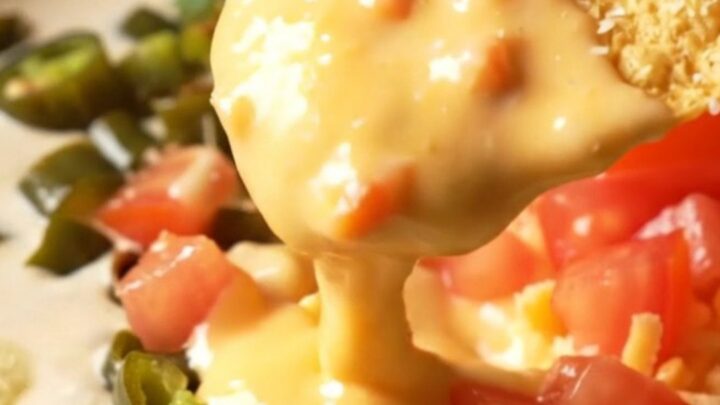
The queso should now be thick, glossy and completely uniform, with the smoked gouda and cheddar fully melted into the base and the chiles and tomatoes evenly suspended. Watch the texture as the spatula lifts: the sauce should fall in a heavy, slow ribbon and the surface should shine.
Lazy bubbles at the edges mean the low simmer is doing its work; vigorous bubbling means the heat is too high and the risk of splitting is real. Four minutes of gentle simmering is enough for the chiles to perfume the sauce without the tomatoes losing their shape.
Season, garnish and serve
- Season and adjustTaste the queso and season with kosher salt, starting with a quarter teaspoon and building slowly. Smoked gouda and fire-roasted chiles both carry salt of their own, so go gently. If the dip has thickened past a slow ribbon, whisk in a splash of evaporated milk to bring it back.Look for A chip dipped straight from the pan carries a thick, even coat without pooling.Tip Warm the tortilla chips in a 300°F (150°C) oven for five minutes while seasoning; warm chips stay crisp longer.
- Garnish and serve hotSlide the skillet straight to the table on a trivet. Scatter the top with extra charred Hatch chiles and fresh cilantro leaves, then set the warmed salted tortilla chips alongside. The queso should drape off a chip in a thick, velvety ribbon, glossy all the way to the last scoop.Look for The surface stays glossy and mobile, never skinned over or stiff.Tip Serve straight from the cast-iron skillet; it holds heat far longer than any ceramic bowl.
Before the skillet leaves the stove, confirm three things: the salt reads balanced on a clean chip, the sauce flows in a thick ribbon rather than sitting stiff, and nothing has skinned over. Scatter the charred chiles and cilantro on at the last moment so the herbs stay bright green. The dip should look like liquid gold under the warm kitchen light and move slowly when the pan tilts. Serve immediately; cast iron will keep it dippable for a good half hour at the table.
Common mistakes
The most common failure is heat: cheese added over medium or high heat tightens into strings and releases fat, leaving an oily ring around a clumpy middle. Keep the burner low, around 200°F (93°C), and add cheese gradually. The second mistake is pre-shredded cheese, whose anti-caking coating guarantees a grainy sauce; grate from the block.
Undrained chiles thin the dip past the dipping point, and flour whisked carelessly into hot butter leaves lumps that no amount of stirring fixes later. Finally, salting early and heavily over-salts the whole pan, since both cheeses bring salt of their own.
How to tell it’s done
The queso is done when it drapes off a spatula in a thick, slow ribbon and a dipped chip comes out wearing an even, glossy coat with no thin watery edge. The surface should shine and stay mobile, showing lazy bubbles at the edges rather than a skin. Taste for salt before it hits the table; the flavor should be smoky first, sharp second, with the chiles arriving last. There is no internal temperature to chase here, only texture: smooth, velvety and pourable, never stiff or oily.
Up next · Part 3 of 3
4 variations · storage & make-ahead · 5 answers · printable card
Tips, FAQ & printable recipe (Part 3)← Back to the ingredients (Part 1)