Dinner · Part 2 of 3: Instructions
Slow Cooker Veal Orloff with Bacon and Cheese Step-by-step instructions
- Prep
- Cook
- Total
- Serves
- 6
Before you start
Before beginning, ensure the veal roast is at room temperature for about 20 minutes to encourage even cooking. Prepare the onions by slicing them into uniform half-moons, which helps them soften evenly. Gather all ingredients near the slow cooker to streamline the assembly process.
Verify that the slow cooker vessel is clean and dry. Have a reliable meat thermometer ready, as it is the most accurate way to ensure the roast is perfectly cooked and safe to consume without overcooking the delicate veal.
Ingredients at a glance (4)
- 3 lb veal roast, stuffed with bacon and cheese slices
- 2 large onions, sliced
- 1 tbsp dried herbs
- 1 cup veal stock
Instructions
Assembly of the roast
- Prepare the slow cookerPlace the bacon and cheese stuffed veal roast into the base of the slow cooker. Arrange the sliced onions around the sides of the roast to create a flavorful bed that will infuse the meat as it slowly cooks.Look for The roast is centered in the cookerTip Ensure the onions are evenly distributed to keep the roast slightly elevated from the bottom.
The roast is nestled securely among the onions in the bottom of the slow cooker. The onions are distributed evenly to provide a sturdy base, and the veal roast is positioned so that the bacon and cheese filling is facing upwards. Everything is ready to receive the seasonings and liquid for the slow-cooking process.
Seasoning and braising
- Season and add liquidSprinkle the dried herbs evenly over the top of the veal roast. Pour the veal stock into the slow cooker, taking care to pour it around the sides of the roast rather than directly over it, which helps maintain the seasoning on the meat.Look for The stock fills the bottom of the cookerTip Using a high-quality stock enhances the depth of the final sauce.
The dried herbs are evenly coated over the roast, and the veal stock has been poured carefully around the edges. The slow cooker is covered, and the environment is now perfectly sealed to allow the aromatics to penetrate the meat as it begins to gently braise in the flavorful stock.
Cooking and resting
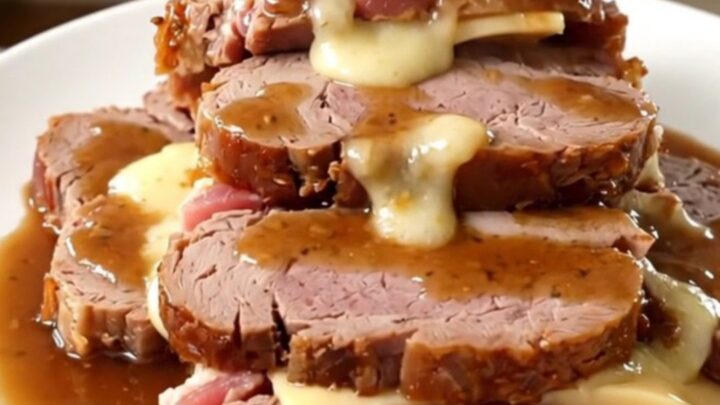
- Slow cook and serveCover the slow cooker and cook on low heat for approximately four hours. Once the roast reaches an internal temperature of 145°F (63°C), remove it carefully. Let the roast rest for at least 10 minutes before slicing to ensure the juices redistribute throughout the meat for a succulent texture.Look for The meat is tender and the cheese is meltedSafe temperature 145°F (63°C) internal temperature (steaks, chops and roasts)Tip Slice the roast into thick portions to keep the bacon and cheese filling intact.
The roast has reached the target internal temperature, the onions have caramelized slightly in the stock, and the cheese is beautifully melted. The meat is removed from the cooker to rest, allowing the internal juices to redistribute, ensuring every slice is succulent and ready to be served.
Common mistakes
Avoid lifting the slow cooker lid frequently during the cooking process, as this releases heat and steam, significantly increasing the total cooking time.
Another common mistake is failing to let the roast rest after removing it from the cooker; skipping this step leads to a loss of natural juices, resulting in drier meat.
Ensure the onions are sliced thinly enough to create a stable base, as thick chunks may prevent the roast from cooking evenly across its entire surface.
How to tell it’s done
The veal is done when it reaches an internal temperature of 145°F (63°C) at the thickest part of the roast. At this stage, the meat should be opaque and tender, while the cheese filling will be thoroughly melted and creamy.
Always verify the temperature with a digital probe thermometer inserted into the center of the meat, avoiding the bacon and cheese filling for an accurate reading. Let the roast rest for at least 10 minutes to allow the juices to settle before slicing.
- Steaks, chops and roasts: 145°F (63°C) in the thickest part, then a 3-minute rest
Up next · Part 3 of 3
2 variations · storage & make-ahead · 3 answers · printable card
Tips, FAQ & printable recipe (Part 3)← Back to the ingredients (Part 1)