Dinner · Part 2 of 3: Instructions
Slow Cooker Turkey Peanut Stew (Mafé) Step-by-step instructions
- Prep
- Cook
- Total
- Serves
- 4
Before you start
Before starting, ensure all vegetables are cleaned and chopped into uniform pieces. Having your ingredients measured and ready to go will make the assembly process seamless. Check that your slow cooker is clean and placed on a stable, heat-resistant surface with adequate clearance for ventilation.
If the turkey was stored in the refrigerator, take it out about twenty minutes before cooking to help it reach a more neutral temperature, which promotes more even cooking throughout the braising process.
Ingredients at a glance (5)
- 1 lb turkey breast, cut into 1-inch pieces
- 2 medium carrots, sliced
- 1 medium yellow onion, chopped
- 1/2 cup creamy peanut butter
- 2 cups tomato-based vegetable broth
Instructions
Assembly and layering
- Prepare the slow cooker basePlace the turkey pieces in the bottom of the slow cooker. Arrange the sliced carrots and chopped onions evenly over the top of the turkey to ensure they cook through evenly during the slow cooking process.Look for Turkey is evenly distributed at the bottom.Tip Ensure the pieces are roughly the same size for uniform cooking.
At this stage, the slow cooker contains raw turkey at the base, topped with chopped carrots and onions.
Everything is neatly arranged, providing a solid foundation for the sauce to penetrate during the cooking process. Ensure the turkey is not clumped together so the heat can circulate effectively around every piece.
Adding the sauce components
- Add the sauce ingredientsAdd the creamy peanut butter in a single dollop onto the vegetables. Pour the tomato-based vegetable broth over the ingredients, ensuring the liquid covers the turkey and vegetables to facilitate a thorough braise.Look for The broth reaches the top of the ingredients.Tip Whisk the peanut butter with a small amount of broth before adding if you prefer a smoother sauce.
The peanut butter sits as a dollop over the vegetables, and the tomato-based broth has been poured over all ingredients. The ingredients are now submerged in the liquid, creating a cohesive environment where the flavors will begin to meld as the slow cooker reaches the necessary operating temperature.
Final cooking and emulsification
- Cook and serveCover the slow cooker and cook on low for 4 hours. Once the time is up, check that the turkey has reached an internal temperature of 165°F (74°C). Stir the mixture gently to combine the peanut butter into the broth before serving on a plate.Look for The sauce is glossy and the turkey is tender.Safe temperature 165°F (74°C) internal temperature (poultry)Tip Let the stew rest for five minutes before serving to allow the sauce to thicken slightly.
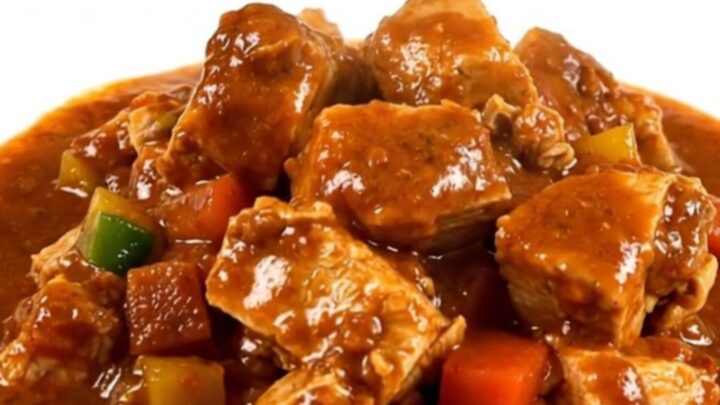
The stew has finished its four-hour cook time. The liquid has reduced slightly, and the peanut butter has fully dissolved, creating a rich, opaque, and aromatic sauce. The turkey is tender, and the vegetables are soft. A final gentle stir ensures a uniform consistency before the dish is plated and served.
Common mistakes
A common mistake is overcrowding the slow cooker, which can prevent the ingredients from cooking evenly and may result in excess liquid that dilutes the sauce. Ensure the ingredients are spread in a single layer as much as possible.
Another frequent error is stirring the stew too early or too often; let the slow cooker maintain its steady heat environment. Only stir once the cooking time is complete to incorporate the peanut butter fully into the broth for the best texture.
How to tell it’s done
The stew is ready when the turkey pieces are completely opaque and tender throughout. Use a meat thermometer to ensure the thickest part of the turkey has reached an internal temperature of 165°F (74°C).
The sauce should be smooth, glossy, and slightly thickened, with no separated oil visible on the surface. If the meat offers no resistance when pierced with a fork, it is perfectly cooked and ready to be served.
- Poultry: 165°F (74°C) in the thickest part
Up next · Part 3 of 3
2 variations · storage & make-ahead · 3 answers · printable card
Tips, FAQ & printable recipe (Part 3)← Back to the ingredients (Part 1)