Dinner · Part 2 of 3: Instructions
Slow Cooker Toulouse Duck Confit Cassoulet Step-by-step instructions
- Prep
- Cook
- Total
- Serves
- 6
Before you start
Before starting, ensure that the white beans have been soaked in cold water for at least 8 hours or overnight, then thoroughly drained. Gather all ingredients and have the slow cooker ready on a flat, heat-resistant surface.
Check that the duck confit is at room temperature to prevent temperature shock in the cooker. Ensure the chicken broth is ready for pouring and that the lardons are prepared for distribution throughout the mixture.
Ingredients at a glance (5)
- 4 legs duck confit legs, store-bought or made ahead
- 4 links Toulouse sausages
- 2 cups dried white beans, soaked overnight and drained
- 4 oz smoked lardons
- 4 cups chicken broth
Instructions
Layering the proteins
- Assemble the basePlace the duck confit legs and Toulouse sausages into the bottom of the slow cooker. Ensure they are arranged in an even layer to allow for consistent heating during the long cooking process.Look for Meats are resting flat at the bottom of the cooker.Tip If the duck legs are very large, overlap them slightly to fit.
The meat should be arranged carefully at the bottom of the slow cooker, providing a stable foundation for the beans. Ensure no large gaps are left between the duck and sausages, as an even layer promotes uniform heat distribution. The meats should look fresh and ready for the long, slow simmer that will transform their texture and concentrate their natural flavors.
Adding beans and lardons
- Add beans and aromaticsScatter the soaked white beans over the meats in the slow cooker. Sprinkle the smoked lardons evenly over the top of the beans to distribute the smoky flavor throughout the dish during cooking.Look for Beans are spread in an even layer covering the meat.Tip Ensure beans are fully submerged in liquid later to cook through.
The beans should be distributed in an even layer over the meats, ensuring they are not piled too high in the center. The lardons should be scattered evenly to ensure that the smoky flavor is dispersed throughout the pot.
At this stage, the ingredients should look well-organized, with the beans acting as a blanket that will protect the meats during the cooking process.
Final liquid addition
- Add liquid and cookPour the chicken broth over the ingredients. Cover and cook on low for 8 hours until the beans are tender and the duck reaches an internal temperature of 165°F (74°C). Let rest for 10 minutes before serving.Look for Broth is added and the liquid level is visible.Safe temperature 165°F (74°C) internal temperature (poultry)Tip Check the beans after 7 hours to ensure they have softened properly.
The broth should just cover the beans and meat, creating a poaching environment. The liquid should look clear and ready to absorb the fats and juices rendered during the cooking cycle. Once the lid is secured, the slow cooker should be set to the low setting, and the dish should be left undisturbed until the final check for tenderness and temperature.
Common mistakes
A common mistake is using beans that have not been soaked, which will result in undercooked, chalky beans even after 8 hours. Another error is over-crowding the slow cooker, which prevents the liquid from circulating and leads to uneven cooking.
Avoid lifting the lid frequently during the cooking process, as each opening releases heat and significantly increases the total time required for the beans to reach the desired level of tenderness.
How to tell it’s done
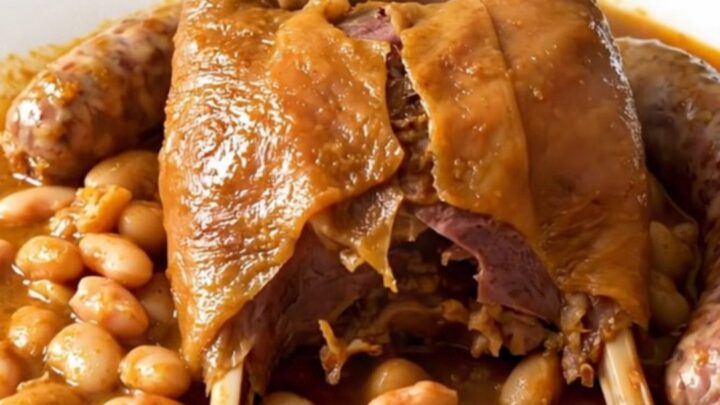
The dish is considered done when the white beans are tender enough to be easily mashed with a fork and the duck meat is falling away from the bone.
A meat thermometer inserted into the thickest part of the duck leg must read at least 165°F (74°C). The cooking liquid should have reduced slightly, creating a thick, glossy sauce that binds the beans and meats together.
- Poultry: 165°F (74°C) in the thickest part
- Ground meat: 160°F (71°C) in the thickest part
Up next · Part 3 of 3
2 variations · storage & make-ahead · 3 answers · printable card
Tips, FAQ & printable recipe (Part 3)← Back to the ingredients (Part 1)