Appetizers · Part 2 of 3: Instructions
Slow-Cooker Sweet Thai Chili Lime Cocktail Meatballs for a Crowd Step-by-step instructions
- Prep
- Cook
- Total
- Serves
- 12
Before you start
Take the meatballs out of the refrigerator if they are fresh, and if they are frozen, decide between two paths: thaw them overnight in the refrigerator for the exact two-hour cook, or drop them in frozen and add roughly 30 minutes, checking the temperature before finishing.
Rinse and dry the limes, then juice them until you have a full 1/3 cup. Mince the garlic finely so it disperses through the glaze. Chop the cilantro and roughly chop the peanuts, keeping both in separate small bowls near the cooker.
Ingredients at a glance (7)
- 2 lb pork and chicken cocktail meatballs (frozen or fresh)
- 1 1/2 cups sweet Thai chili sauce
- 1/3 cup fresh lime juice (from about 3 limes)
- 2 tbsp fish sauce
- 3 tbsp minced garlic (about 6 cloves)
- 1 handful fresh cilantro, chopped
- 1/3 cup roasted peanuts, roughly chopped
Instructions
Load the Slow Cooker
- Layer the meatballs in the insertDrop the cocktail meatballs into the insert of a 4-quart or larger slow cooker, spreading them into an even layer. Frozen meatballs can go straight in without thawing, though thawed ones hit temperature faster; fresh ones work exactly the same. Keeping them in a single layer at the bottom helps every meatball catch the glaze as it bubbles.Look for The meatballs should sit snugly in one layer with a little headroom at the top.Tip A 4- to 6-quart oval slow cooker fits 2 pounds comfortably; anything smaller risks overflow as the sauce bubbles up.
- Whisk the chili-lime sauceIn a medium bowl, whisk the sweet Thai chili sauce, fresh lime juice, fish sauce, and minced garlic until the mixture looks uniform and glossy. The lime keeps the sweetness in check while the fish sauce deepens the savory edge, so give it a full thirty seconds of whisking before the sauce meets the meatballs in the insert.Look for No streaks of chili sauce or pooled fish sauce should remain at the bottom of the bowl.Tip Whisking the garlic into the sauce, rather than sprinkling it dry over the pot, keeps it from scorching against the hot ceramic wall.
- Pour and coat the meatballsPour the sauce evenly over the meatballs, then use a silicone spatula to toss gently so each one is coated. Scrape every last bit of sauce from the bowl; the glaze thickens as it cooks, and losing any now means a thinner finish later. Cover the slow cooker with its lid and get ready to walk away.Look for Every meatball should glisten with sauce before the lid goes on.Tip Toss with a folding motion rather than a hard stir so the small meatballs keep their shape and coating.
At the end of the first phase, the insert holds a single even layer of meatballs, each one glossy with sauce, and the cooker is covered and switched to HIGH.
Before moving on, confirm three things: no meatball is stacked so high that the lid sits tilted, the sauce reaches at least two-thirds up the side of the layer, and the lid seals cleanly with no sauce trapped in the rim. The sauce will look thin and liquid at this point, which is exactly right; the two hours ahead are what turn it into a glaze.
Cook and Glaze
- Cook on HIGH for two hoursSet the cooker to HIGH and cook for 2 hours, lifting the lid once halfway through to stir. Each lift adds roughly fifteen minutes of cooking time, so resist peeking more than that. By the one-hour mark the sauce should be bubbling actively at the edges and the kitchen should smell of chili, lime, and garlic.Look for Steady bubbling around the edges means the cooker has reached full temperature.Tip HIGH for 2 hours is the sweet spot; LOW takes about 4 hours and the glaze never gets quite as sticky.
- Check the internal temperatureInsert an instant-read thermometer into the center of several meatballs in different spots of the cooker; pork and chicken meatballs are safe to eat at 160°F (71°C) throughout. Because cocktail meatballs are small, test three or four to confirm the whole batch has come up to temperature before moving on to the finishing touches.Look for The thermometer should read at least 160°F (71°C) in every meatball tested.Safe temperature 160°F (71°C) internal temperature (ground meat)Tip Pork and chicken meatballs must be cooked through, not merely hot; give them another 20 minutes on HIGH if any reading falls short.
- Fold in cilantro and peanutsSwitch the cooker to WARM, then fold in the chopped cilantro and the peanuts with a few gentle turns of the spatula. The residual heat wakes up the herbs without wilting them into darkness, and the peanuts keep just enough bite against the soft glaze. Re-cover and let everything mingle for five minutes before the final check.Look for The cilantro should stay bright green, not slumped and dark.Tip Add the cilantro off the active simmer so its flavor stays fresh; it turns dull and grassy if it keeps cooking.
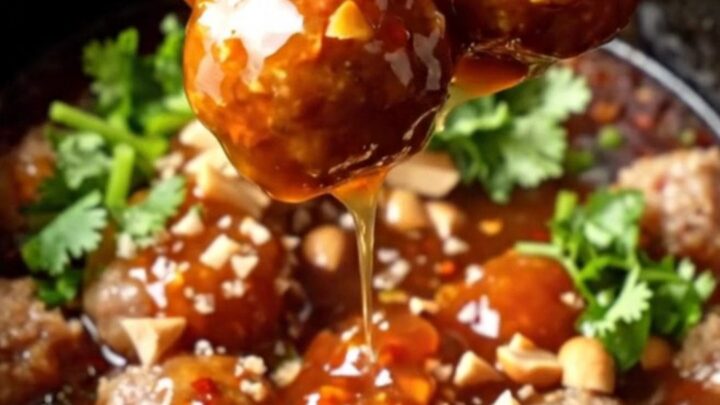
By the end of the second phase, the sauce has reduced to a thick, bubbling glaze that clings to the meatballs and the sides of the insert, and the meatballs have reached a safe 160°F (71°C) in the center. Bright green cilantro and golden peanuts are folded through, and the cooker sits on WARM.
Before serving, verify the temperature in three or four meatballs in different spots of the pot, since small meatballs heat unevenly, and confirm the glaze coats a spoon in a slow ribbon rather than running off.
Skewer and Serve
- Tighten the glazeLeave the slow cooker on WARM for 10 to 15 minutes with the lid slightly ajar if the glaze seems loose; escaping steam lets the sauce tighten to a lacquered, sticky consistency that clings to a spoon and drips in slow ribbons. Give everything one final gentle fold so every meatball picks up an even coat before serving.Look for The glaze should coat the back of a spoon and drip slowly rather than run.Tip If it thickens too much, loosen it with a tablespoon of water, not extra lime juice, to protect the sweet-tangy balance.
- Serve from the warm cookerServe straight from the warm insert, spearing the meatballs with bamboo skewers so guests can pluck them one at a time. Give the pot a gentle stir every half hour to keep the glaze glossy, and set out small plates or napkins for the sticky fingers that follow. The WARM setting holds the meatballs perfectly for two to three hours.Look for Glossy, lacquered meatballs that hold their shape on a skewer.Tip Keep a stack of spare skewers within easy reach so guests are never fishing for one with their fingers.
In the final phase, the meatballs go from a finished dish to a working party station. The glaze should now be at its glossiest, lacquering each meatball so it shines under the light and holds steady on a bamboo skewer without dripping more than a slow thread. Check that the cooker is holding on WARM, that the meatballs stir easily without sticking to the bottom, and that the texture stays sticky but not pasty; if it tightens too far, a tablespoon of water restores it.
Common mistakes
The most common error is lifting the lid to check on progress; every peek costs about fifteen minutes and slows the glaze. Cooking on LOW instead of HIGH saves nothing: the sauce never reduces enough to turn sticky, and the meatballs sit in a thin liquid instead. Adding the cilantro early wilts it into dark threads and flattens its flavor, so hold it until the final fold.
Skipping the internal temperature check is the riskiest mistake of all, since small meatballs heat unevenly; test three or four in different spots. Finally, over-thickening with the lid fully closed makes a paste; keep the lid ajar on WARM and watch the spoon test.
How to tell it’s done
Finished meatballs read at least 160°F (71°C) in the center, with pork and chicken cooked fully through and no pink at the core. Visually, the glaze is the better guide: it should be thick enough to coat the back of a spoon, drip in slow ribbons, and cling to each meatball in a shiny, lacquered layer rather than pooling at the bottom of the insert. The meatballs themselves look swollen and glossy, hold their shape on a skewer without sliding off, and tear apart tender rather than rubbery.
- Ground meat: 160°F (71°C) in the thickest part
Up next · Part 3 of 3
4 variations · storage & make-ahead · 5 answers · printable card
Tips, FAQ & printable recipe (Part 3)← Back to the ingredients (Part 1)