Dinner · Part 2 of 3: Instructions
Slow Cooker Salmon Blanquette with Leeks and Carrots Step-by-step instructions
- Prep
- Cook
- Total
- Serves
- 4
Before you start
Before beginning, ensure all vegetables are prepared correctly. Wash the leeks under cold running water, fanning out the layers to remove any trapped dirt, then slice them into thin rounds. Peel the carrots and slice them into uniform coins to ensure they soften at the same rate as the fish.
Have your salmon cleaned, patted dry, and cut into consistent, bite-sized cubes. Set out your slow cooker on a level, heat-resistant surface near an outlet, and ensure all ingredients are measured and ready to be layered into the pot.
Ingredients at a glance (5)
- 1 1/2 lb salmon fillets, cut into large cubes
- 2 large leeks, cleaned and sliced
- 3 medium carrots, peeled and sliced
- 1 cube vegetable bouillon cube
- 1 cup heavy cream
Instructions
Preparation and Layering
- Layering the ingredientsPlace the cubed salmon fillets into the base of the slow cooker. Scatter the sliced carrots and cleaned, sliced leeks evenly over the top of the fish to create an aromatic bed.Look for Salmon is arranged in a single layer at the bottom of the slow cooker.Tip Ensure the leeks are thoroughly washed, as they often trap grit between their layers.
At this stage, the slow cooker is filled with the raw components. You should see a uniform distribution of salmon, carrots, and leeks. The bouillon cube should be broken into small pieces to ensure it dissolves evenly.
Everything is arranged in the pot, ready for the liquid to be added. Check that the salmon cubes are not tightly packed, which allows the cream to circulate around each piece for consistent cooking throughout the entire duration of the process.
Cooking the Blanquette
- Seasoning and cookingCrumble the vegetable bouillon cube directly over the vegetables. Pour the heavy cream over the entire mixture, ensuring all ingredients are lightly coated. Cover the slow cooker and cook on low for 2 hours.Look for The cream begins to simmer and meld with the juices from the vegetables.Safe temperature 145°F (63°C) internal temperature (fish)Tip Do not stir too vigorously, as the salmon cubes are delicate and can easily break apart.
During the cooking phase, the slow cooker should be kept covered to trap the steam and maintain consistent heat. You will notice the sauce beginning to bubble gently around the edges. The aroma of the leeks and salmon should be mild and pleasant. Check that the heat setting is on low; cooking on high may cause the cream to boil and potentially curdle or separate from the fish juices, which would compromise the final texture of your sauce.
Final Assembly
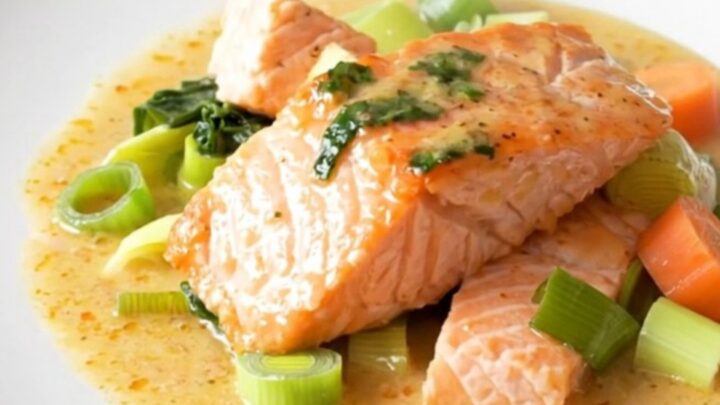
- Serving the blanquetteOnce the cooking time is complete, verify the salmon has reached an internal temperature of 145°F (63°C). Carefully transfer the mixture to serving plates, ensuring each portion includes a mix of salmon, carrots, and leeks with plenty of the creamy sauce.Look for The sauce appears glossy and slightly thickened, and the salmon flakes easily with a fork.Safe temperature 145°F (63°C) internal temperature (fish)Tip Use a wide, flat spatula to lift the salmon out to prevent it from crumbling into the sauce.
Once the cooking is finished, the dish should be handled with care. Use a gentle touch when plating to keep the salmon cubes intact. The sauce should be smooth, creamy, and fragrant. If the sauce appears too thin, you can let it rest for a few minutes in the pot with the lid off to allow it to thicken slightly. Ensure the salmon is fully cooked through before serving, and verify that the vegetables are tender enough to be pierced with a fork.
Common mistakes
A common mistake is cutting the salmon into pieces that are too small, which can lead to the fish disintegrating into the sauce during the long cooking time. Aim for substantial, one-inch cubes. Another error is failing to clean the leeks properly; grit in the final dish can ruin the texture.
Additionally, avoid stirring the dish too frequently once the cream is added. The salmon is fragile, and excessive movement will cause the cubes to break apart, resulting in a shredded appearance rather than distinct, elegant pieces of fish.
How to tell it’s done
The salmon is perfectly cooked when it reaches an internal temperature of 145°F (63°C). At this point, the flesh should be opaque and flake easily when nudged with a fork. The sauce will have thickened slightly and appear glossy, having integrated the juices released by the fish and vegetables during the long, slow heat cycle.
If the salmon is not yet at temperature, continue cooking in 15-minute increments until the desired level of doneness is achieved throughout the thickest parts of the fish cubes.
- Fish: 145°F (63°C) in the thickest part
Up next · Part 3 of 3
2 variations · storage & make-ahead · 3 answers · printable card
Tips, FAQ & printable recipe (Part 3)← Back to the ingredients (Part 1)