Dinner · Part 2 of 3: Instructions
Slow Cooker Provençal Braised Lamb Shoulder for Tender Results Step-by-step instructions
- Prep
- Cook
- Total
- Serves
- 6
Before you start
Before beginning, ensure that your lamb shoulder is completely thawed if it was previously frozen. Pat the meat dry with paper towels to remove any surface moisture, which allows the herbs to adhere better. Prepare your vegetables by washing, peeling, and cutting them into consistent large chunks.
Have your measuring cups ready for the veal stock and ensure your slow cooker is clean and placed on a stable, heat-resistant surface away from any water sources.
Taking these few minutes to organize your ingredients will make the assembly process seamless and ensure that your slow cooker is ready to start the long braising process immediately upon loading.
Ingredients at a glance (5)
- 3 lb bone-in lamb shoulder
- 4 large carrots, cut into large chunks
- 1 large yellow onion, cut into wedges
- 2 tbsp dried herbes de Provence
- 2 cups veal stock
Instructions
Assembly and Preparation
- Assemble the slow cookerPlace the bone-in lamb shoulder into the basin of the slow cooker. Arrange the large carrot chunks and onion wedges around the meat to ensure even cooking and flavor distribution during the long braise.Look for The lamb should be positioned centrally in the slow cooker basin.Tip Ensure the vegetables are cut into large, uniform chunks so they do not turn to mush during the extended cooking time.
The lamb is nestled securely in the slow cooker with the vegetables arranged around it. The ingredients are clean, prepped, and ready for the addition of the aromatics and stock. The kitchen should be organized, and the slow cooker should be plugged in and ready to be set to the low heat setting for the duration of the braise.
Seasoning and Braising
- Season and add liquidGenerously scatter the dried herbes de Provence over the lamb and surrounding vegetables. Pour the veal stock carefully into the slow cooker, ensuring the liquid flows around the meat to create a flavorful braising bath.Look for The liquid should partially submerge the vegetables and the base of the lamb.Tip Adding the stock slowly helps avoid splashing and ensures the herbs stay distributed over the surface of the meat.
The herbs are evenly distributed, and the veal stock has been poured over the ingredients. The slow cooker is sealed with the lid, and the cooking process has begun. The kitchen will soon begin to fill with the savory, herbal aroma of simmering lamb and onions as the braising process slowly transforms the components into a tender, unified dish.
Finishing and Shredding
- Slow cook and finishCover the slow cooker and cook on low for 8 hours. Once finished, ensure the lamb reaches an internal temperature of at least 145°F (63°C). Remove the meat carefully and let it rest for at least 10 minutes before shredding.Look for The meat should be fork-tender and easily shred away from the bone.Safe temperature 145°F (63°C) internal temperature (steaks, chops and roasts)Tip Letting the meat rest is essential for maintaining juiciness after the long cooking process.
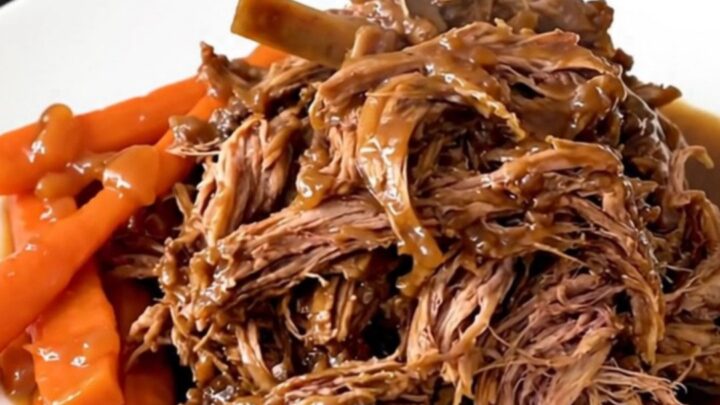
The lamb has finished its eight-hour cook and is fork-tender. The stock has reduced slightly and is glossy, while the vegetables are soft and fully cooked. The meat has been removed and rested, and it is now ready to be shredded and served with the accumulated juices and tender vegetables from the base of the slow cooker.
Common mistakes
A common mistake is cutting the vegetables too small, which results in them breaking down into an unappealing mush before the lamb is tender. Another error is neglecting to let the meat rest after cooking, which causes the juices to spill out and results in dry, stringy meat.
Avoid using a stock that is too thin or watery, as this will lead to a bland sauce; stick to a rich veal stock for the best results. Finally, do not lift the lid during the first six hours of cooking, as this significantly disrupts the internal temperature and extends the cooking time unnecessarily.
How to tell it’s done
The lamb is done when it reaches an internal temperature of 145°F (63°C) and the meat is visibly pulling away from the bone. Use a meat thermometer inserted into the thickest part of the shoulder to verify the temperature.
The texture should be exceptionally soft, allowing the meat to be shredded easily with two forks. If the meat offers resistance when pierced, continue cooking for an additional thirty minutes before checking again, as cuts of meat can vary in connective tissue content.
- Steaks, chops and roasts: 145°F (63°C) in the thickest part, then a 3-minute rest
Up next · Part 3 of 3
2 variations · storage & make-ahead · 3 answers · printable card
Tips, FAQ & printable recipe (Part 3)← Back to the ingredients (Part 1)