Breakfast · Part 2 of 3: Instructions
Slow-Cooker Peach Bourbon French Toast Bake Step-by-step instructions
- Prep
- Cook
- Total
- Serves
- 8
Before you start
Before starting, cut the brioche into 1-inch cubes and measure out 10 cups — this is about one large loaf. Slice the yellow peaches into thin wedges, or thaw frozen peaches and pat them dry. Grease the slow cooker insert with butter or nonstick spray so the bake releases easily.
In a separate bowl, whisk the eggs, brown sugar, heavy cream, cinnamon, nutmeg, and bourbon vanilla until the sugar dissolves. Have the toasted pecans ready, but wait to toast them until near the end so they stay crisp.
Ingredients at a glance (10)
- 10 cups cubed brioche (about 1-inch cubes)
- 4 cups sliced yellow peaches (fresh or frozen, thawed)
- 6 large eggs
- 1/2 cup packed brown sugar
- 1 1/2 cups heavy cream
- 1 tsp ground cinnamon
- 1/4 tsp ground nutmeg
- 2 tsp bourbon vanilla extract
- 1/2 cup toasted pecans, chopped
- cold pouring cream, for serving
Instructions
Layer and Soak
- Layer the Bread and PeachesLightly grease the inside of a 6-quart slow cooker with butter or nonstick spray. Place half of the brioche cubes in the bottom of the Crockpot, then scatter half of the sliced peaches over the top. Repeat with the remaining brioche and peaches, spreading them evenly.Look for The brioche and peaches should be evenly distributed in the slow cooker.Tip If using frozen peaches, thaw and drain them well to avoid excess liquid.
- Whisk the CustardIn a large mixing bowl, whisk together the eggs, brown sugar, heavy cream, cinnamon, nutmeg, and bourbon vanilla until the sugar is dissolved and the mixture is smooth and slightly frothy.Look for The custard should be a uniform amber color with no streaks of egg.Tip Whisk thoroughly so the brown sugar fully dissolves into the cream.
- Pour the Custard Over the BreadPour the custard evenly over the brioche and peaches in the slow cooker. Use a spatula to gently press down on the bread so every cube is soaked with the custard. Let the mixture sit for 10 minutes to allow the bread to absorb the liquid.Look for The top brioche cubes should look moist but not swimming in liquid.Tip Pressing down helps the bread absorb the custard evenly for a tender bake.
At the end of this phase, the slow cooker holds alternating layers of brioche and peaches, with the custard poured over and gently pressed down. The bread should look damp but not submerged, and the custard should be evenly distributed.
The mixture will sit for 10 minutes so the brioche can absorb the liquid — this is the step that ensures a creamy, custard-like interior rather than a dry one.
Slow-Cook and Set
- Slow-Cook on LowCover the slow cooker with the lid and cook on LOW for 3 hours. Do not lift the lid during cooking, as this releases heat and can extend the cooking time. The edges will become golden and caramelized while the center puffs up.Look for After 3 hours, the peaches should be bubbling and the edges deep golden brown.Safe temperature 160°F (71°C) internal temperature (egg dishes)Tip If the top is not browned after 3 hours, cook for an additional 15–30 minutes.
- Check the Custard SetInsert a knife or toothpick into the center of the bake; it should come out clean, and the internal temperature should reach 160°F (71°C) in the custard. If the center is still wet, cook for another 15–20 minutes and check again.Look for The knife should come out with no raw custard clinging to it.Safe temperature 160°F (71°C) internal temperature (egg dishes)Tip The temperature is the surest way to know the eggs are fully cooked.
After 3 hours on LOW, the kitchen smells of cinnamon and caramelized sugar. The edges of the bake are a deep golden brown, and the peach juices bubble around the sides. A knife inserted into the center comes out clean, and the custard has set into a soft, tender mass. The top is slightly puffed and feels springy to the touch, while the fruit has softened and released its sweetness.
Finish and Serve
- Toast the PecansWhile the French toast cooks, place the chopped pecans in a dry skillet over medium heat. Toast, stirring frequently, for 3–5 minutes until fragrant and lightly browned. Remove from the skillet and set aside to cool.Look for The pecans should smell nutty and look a shade darker.Tip Watch closely — nuts burn quickly once they start to color.
- Serve and TopSpoon the warm French toast bake into shallow bowls. Sprinkle each serving with toasted pecans and pour cold pouring cream over the top. Serve immediately while warm.Look for The cream should be cold and pouring, not whipped.Tip For a prettier presentation, use a large spoon to scoop from the edge to the center.
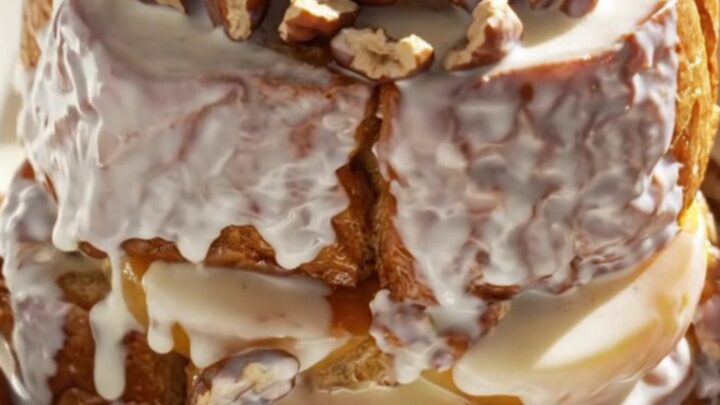
The finished bake is spooned into bowls while still warm, with toasted pecans scattered over the top and cold cream poured over each serving. The contrast of hot, caramelized bread and cool, creamy topping is the signature of this dish. The pecans add a toasty crunch, and the cream mellows the sweetness. Serve immediately, as the bake will continue to set as it cools.
Common mistakes
A common issue is a soggy, undercooked center — this happens when the slow cooker is opened too often or the heat is too low. Keep the lid on for the full 3 hours and use the LOW setting.
Another mistake is using too much custard, which leaves the bake floating; press the bread down gently so it absorbs, but do not drown it. Overcooking dries out the edges, so check at 3 hours and pull it off the heat as soon as the custard is set. Finally, skip stale bread — fresh brioche gives the best texture.
How to tell it’s done
The French toast bake is done when the edges are deeply golden and caramelized, and the peaches are bubbling around the sides. A knife inserted into the center should come out clean, with no wet custard clinging to it.
The internal temperature of the custard should read at least 160°F (71°C) on an instant-read thermometer. The top should feel set but spring back lightly when pressed. If the center still looks glossy, cook for another 15–20 minutes and check again.
- Egg dishes: 160°F (71°C) in the thickest part
Up next · Part 3 of 3
4 variations · storage & make-ahead · 5 answers · printable card
Tips, FAQ & printable recipe (Part 3)← Back to the ingredients (Part 1)