Dinner · Part 2 of 3: Instructions
Crockpot Parmesan Sausage Pesto Farfalle Step-by-step instructions
- Prep
- Cook
- Total
- Serves
- 6
Before you start
Before starting, brown the sweet Italian sausage in a large skillet over medium-high heat, breaking it into crumbles. Drain any excess fat and set aside. Measure out the farfalle pasta, baby spinach, pesto, and cheeses. Have a 6-quart slow cooker ready.
No need to pre-cook the pasta—it will cook in the slow cooker. If using a slow cooker liner, place it now. Keep a wooden spoon or spatula handy for stirring, and a serving spoon for plating. The prep takes just a few minutes, and then the slow cooker does the rest.
Ingredients at a glance (6)
- 1 lb browned sweet Italian pork sausage crumbles
- 12 oz bow-tie farfalle pasta
- 5 oz fresh baby spinach leaves
- 1/2 cup emerald green Genovese basil pesto
- 2 cups shredded Italian four-cheese blend
- 1/2 cup freshly grated Parmigiano-Reggiano
Instructions
Layer and Top
- Layer the IngredientsPlace the browned sweet Italian sausage crumbles evenly across the bottom of a 6-quart slow cooker. Spread the farfalle pasta over the sausage, then scatter the baby spinach leaves on top. Dollop the basil pesto over the spinach and gently stir to coat the pasta and sausage with the pesto, if desired. The layers should be fairly even.Look for The bottom of the slow cooker is covered with sausage, with pasta and spinach piled on top.Tip If the pasta is not fully submerged in liquid later, add a splash of water or broth, but avoid overfilling.
- Top with CheesesSprinkle the shredded Italian four-cheese blend evenly over the top of the pasta mixture. Follow with the freshly grated Parmigiano-Reggiano, covering the surface completely. Do not stir after adding the cheeses; they will melt into a golden crust during cooking.Look for The top is covered with a thick layer of shredded and grated cheese.Tip For an extra golden crust, add a little extra Parmesan on top just before serving.
At the end of this phase, the slow cooker contains distinct layers: sausage on the bottom, then pasta, spinach, pesto dollops, and a thick blanket of cheese on top. The colors are vibrant—green spinach, white cheese, and red sausage. The ingredients are not yet cooked, but the setup is complete and ready for heat. Check that the cheese covers the entire surface for an even melt.
Slow Cook
- Slow Cook on LowCover the slow cooker with its lid and set it to cook on low heat for 4 hours. Do not open the lid during the first 3 hours to allow the heat to build up and the pasta to cook evenly. After 3 hours, check the pasta for doneness; if it is still firm, continue cooking for another 30 minutes to 1 hour, checking every 30 minutes.Look for After 3 hours, the sauce should be bubbling gently and the cheese melted.Tip Cooking times may vary depending on the slow cooker model; keep an eye on the pasta to avoid overcooking.
- Check Pasta DonenessOnce the pasta is tender but still has a slight bite, the dish is ready. The cheese should be fully melted and the top lightly browned in spots. If the mixture looks too dry, stir in a small amount of warm water or broth to loosen it. The internal temperature of the sausage should have reached 160°F (71°C) if it was not pre-browned.Look for The pasta is al dente and the cheese is bubbly and golden.Safe temperature 160°F (71°C) internal temperature (ground meat)Tip If the top is browning too quickly, cover with foil or reduce heat to warm until serving.
After 3 to 4 hours, the slow cooker is filled with a bubbling, aromatic mixture. The cheese has melted and started to brown at the edges, and the pesto has infused the pasta with a fragrant basil aroma.
The sausage is sizzling gently, and the spinach has wilted into the sauce. The texture should be creamy and cohesive, with the pasta tender but not falling apart. Use a spoon to lift a portion and check for doneness.
Serve
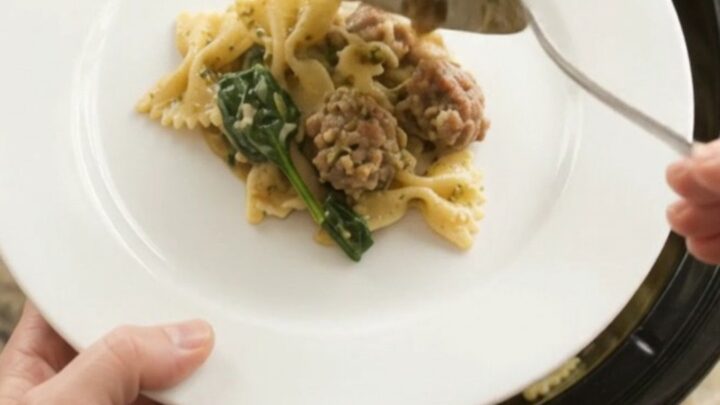
- Serve and EnjoyTurn off the slow cooker. Using a serving spoon, scoop the hot pasta and sausage onto a white dinner plate, making sure to include some of the melted cheese from the top. Serve immediately while hot and steamy. The dish is rich and satisfying on its own, but a side salad or crusty bread would complement it well.Look for The pasta is coated in pesto and cheese, with a stretchy, cheesy pull.Tip For a prettier presentation, twirl the farfalle with a fork as you plate it.
The finished dish is a golden, bubbling casserole with a slightly crispy cheese crust on top. When you scoop into it, you see the pesto-coated farfalle, juicy sausage crumbles, and wilted spinach all held together by a creamy sauce. The cheese stretches as you lift the spoon, and steam rises. The aroma is rich and savory. Plate it on a white dish for a beautiful presentation, and serve immediately.
Common mistakes
One common mistake is opening the slow cooker lid too often, which releases heat and extends cooking time. Resist the urge to stir during the first 3 hours. Another issue is using a pasta shape that becomes too soft; choose a sturdy shape like farfalle or penne.
Overcooking can make the pasta mushy, so check for doneness at the 3-hour mark. Also, avoid adding too much liquid, as the pasta releases starch and creates its own sauce. If the top browns too quickly, cover with foil or reduce heat to warm.
How to tell it’s done
The dish is done when the pasta is tender but still has a slight bite (al dente), and the cheese is fully melted with a lightly browned top. The internal temperature of the sausage should be at least 160°F (71°C) if it was not pre-browned.
The sauce should be thick and creamy, not watery. If the mixture looks too dry, stir in a small amount of warm water or broth. The spinach will be wilted and evenly distributed. Let the dish rest for a few minutes before serving to allow the sauce to set slightly.
- Ground meat: 160°F (71°C) in the thickest part
- Steaks, chops and roasts: 145°F (63°C) in the thickest part, then a 3-minute rest
Up next · Part 3 of 3
4 variations · storage & make-ahead · 5 answers · printable card
Tips, FAQ & printable recipe (Part 3)← Back to the ingredients (Part 1)